English
 Español
 Français
 Deutsch
 Italiano
 Português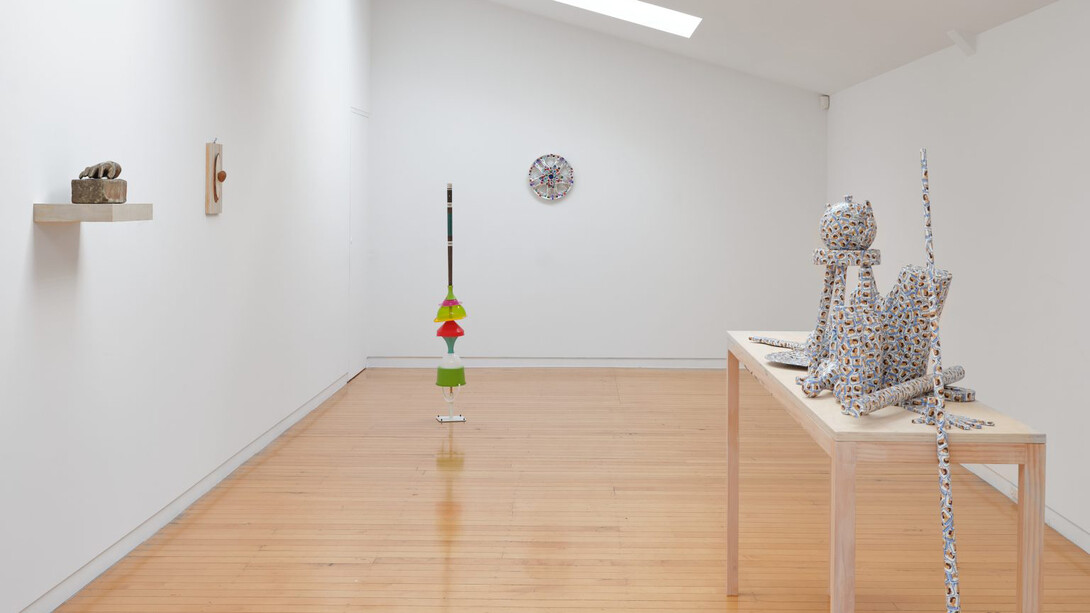
The works with one-word titles join forces and become a plastic chain of imperatives; like a set of shouted instructions for a rehearsal or drill. Or maybe there is to be no more practice: it’s go-time – performance, action, protest or improvised battle. Whatever you have been preparing for or gearing up to, get dressed and be ready to face off. It is a time of profound human dysfunction and irresponsibility, and the stakes are teeteringly high.
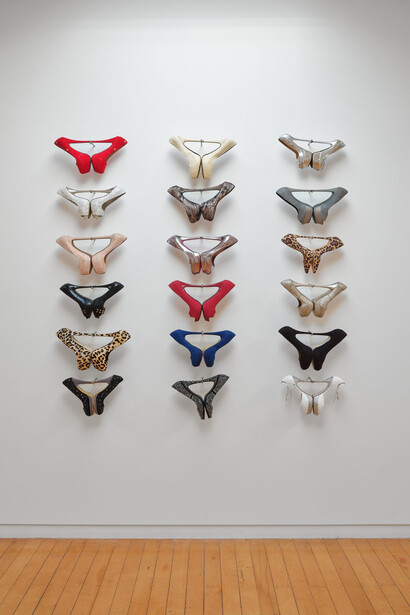
Stiletto was made in Covid time, like a glitch – environmental, societal, economic, ethical, metaphysical. And we are looking at it again, in the now, in its perpetual present, redeployed in the recession-tail of the pandemics. The material items brought together in these objects seem to figure inflation, to embody semio-inflation in their new beings.
The strangeness of a high-heeled shoe is amplified and its conventions bent so they burst, and other ideas spill out. And that is its point, if you will excuse the pun. It is indeed unusual, theatrical, to walk on two knives, two nails, one for each foot, as a biped. But what happens when the shoes (plural) become pelvic or spinal in form? Something apostrophic.
Oh, the glamour. The confounding, disorienting glamour. It might make you do things you didn’t think you wanted to do.
Wearing high heels tilts the pelvis of the ambulatory female, signalling, anthropologists have told us, a willingness to engage in something like mating, or some differently distributed exchange of libidinal power that is complicated. And even more so since Stiletto’s first outing, now that AI has insinuated itself into our reasoning, research and articulation. It scrapes our data and hallucinates our realities, and still, we run towards what we are most afraid of, enchanted.
Everything needs reassessment, including our motivations, our desires – our attention needs attention, not more whimsy. When it was first shown, Stiletto was a totemic single column; now it is three. It has not lost its anatomic qualities, and it remains uncanny that pairs of shoes – designed to modify the gait, manipulate behaviour and accrue power – can, when arranged just so, soles touching, become bodies together. A parable of self-organising.
The main trunk line of the nervous system, channels for I-wonder-what other energies, the spine is a sign of strength (as in ‘grow a spine’) but a site of actual vulnerability. We are flawed primates, subject to mating drives when young, and pack-mentality at any age. Energy bursts through the vertebrae of the three poles – Mother, Daughter, Holy Ghost – emanating from the pelvic frames that cradle the origin of the world.
The high-heeled shoe may be a technical fetish object extraordinaire – technical in the sense that it is an externalisation of human knowledge, sexuality, power, violence. But all the components of the works here have had lives before this. I wonder if they will be content to live now as parts of these assemblages; and play their part in the tidal submission–domination ritual of human desire, the drama of human waste.
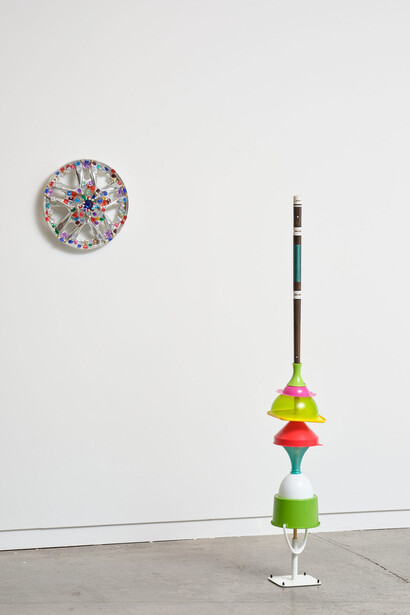
The shoes are powerful inspiration, arranged like this – perhaps because they are items of clothing and being so, they shadow the work of bodies. Other components – pool cue, chopping board, bowl, hubcap, chair – are also bodily and technical in the sense that they externalise knowledge and volition as tools of different orders. But it took the combined industrial advances of two world wars to make it possible to engineer the modern stiletto, named for knife fashioned to pierce and stab rather than slice or cut.
These fabulating shoes retain this original violence and can be read two ways – a woman cannot escape easily wearing such heels, but in them, she might be an object of worship. Two flocked hands, curled in noir-assent, when paired seem more fallopian than consenting. We ok? elegantly gestures that they (the panel of velvet-robed priestesses) see you and what you are doing – they are onto you and will respond on a dividing cell level presently.
Is sexual charge derived from risk and danger, and if so, is this a by-product or driver (horse and cart with spangly hubcaps) of the will to survive? The artist reported that she has been asking herself what it is to make art in a recession. She answers herself, with opshop bricolage, that it is not timely to spend big on making sculpture. Read the room. It is more interesting and politically–aesthetically effective to disturb the temporality and validity of the common commodities and the cycles of grift.
If one was to read this work as an oracle, the message is to at all costs resist the language–idea of ‘investing’ in your practice. In Chop, a chopping board prefers to be an artwork and to find connection with other wooden items – an egg, an oddly oval slice of the trunk of a retching small tree. In Globe, the earth vomits. It is all made of plastic. If we read the work’s aura, the plastic gives plasticity, a spirit-like capacity to change that is the alleged site of feminine essence.
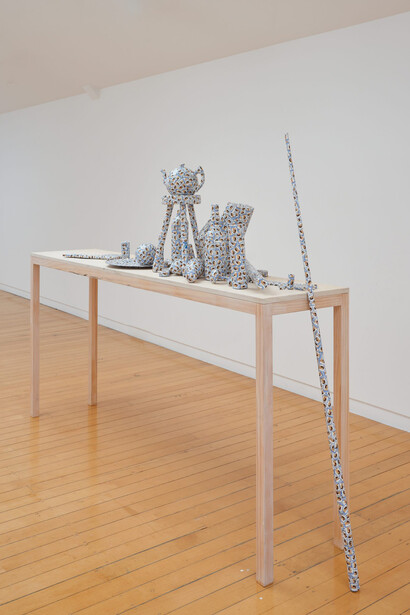
If women do transform more easily than men, it is because we have had to. Hand’s hand strokes a brick, looking at windows. The jobs have gone, the public service is in shreds, plants are flowering at the wrong times, and there are floods and fires. Queen’s queen might be gone, but her face covers the surface of objects like a neo-colonial rash. The layer of pasted stamps disguises the weight of the items it covers – how would you know what’s heavy or light with the monarch’s mug all over it like bird shit?
With this surface treatment, the forms become one form, like stippling, the artist says. The stamps came to her mysteriously in a plastic ANZ bag – collected, perhaps, by an obsessive pre-email bank-worker who also stockpiled string, rubber bands, carefully flattened paper bags, and opened envelopes for scrap paper. This is a time, she posits, to use squirrelled materials, objects, things stashed for a rainy day. For it is indeed a rainy day. But only a few of us can afford heating.
Art is implicated in powerful processes of visibility – what is seen, who speaks, who is heard, who is noticed, who is counted as important, who has needs and wants that are met – by being in the ‘business’ of making realities perceptible. Sometimes old ones come together to form new constellations and formal significances that carry weight. And in so doing there is a redistribution of power and our share, and we sense the earth-sized volumes of the mechanisms of transformation.
(Text by Gwynneth Porter, July 2026)