English
 Español
 Français
 Deutsch
 Italiano
 Português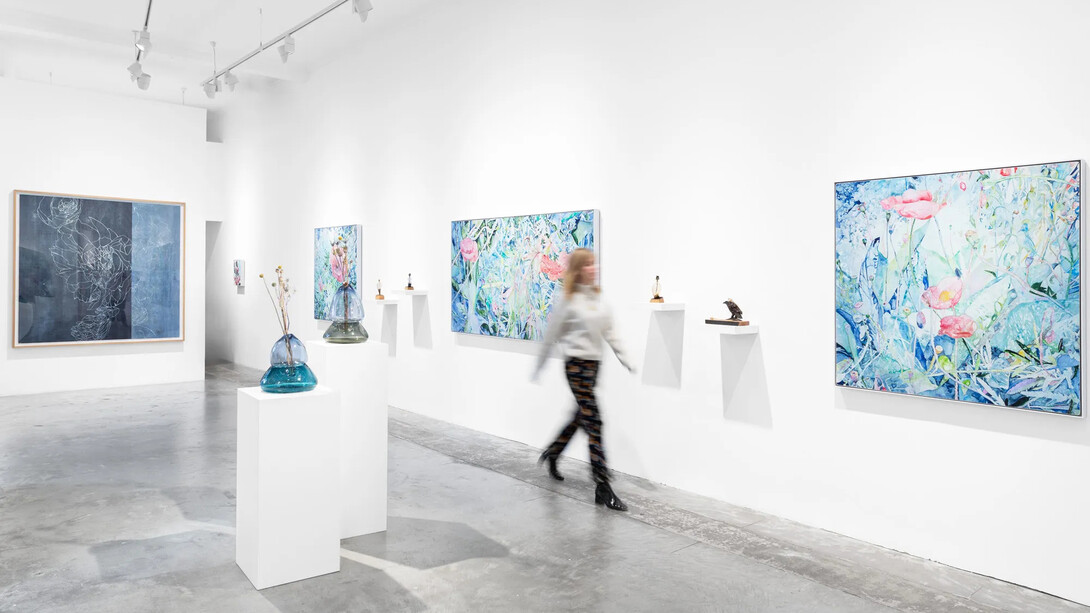
Reflecting on Belinda Fox’s Abundance, two films spring to mind: The salt of the Earth - Wim Wenders’s documentary about photographer, Sebastiao Salgado; and Ocean, by David Attenborough. In the former, we watch Salgado return to a desolate family property in Brazil, a former cattle ranch where the trees had been cut down and sold for timber. Within ten years, a vigorous program of replanting sees the rainforest regenerate with remarkable speed. It has now been gifted to the state as a national park.
In Ocean, the great TV naturalist paints a devastating picture of the exploitation and destruction of the marine environment. Attenborough takes viewers to the brink of despair with rolling footage of an environmental holocaust, but in the second part of the film a miraculous revival takes place. We see how, in ocean sanctuaries where driftnet fishing has been banned, marine life has come surging back.
The lesson of both movies is that nature’s resilience exceeds our wildest dreams. These stories demonstrate how little it takes to reverse the tide of environmental degredation if we could only agree on our collective responsibiities, and a limited range of actions. It’s a surprisingly small step from desolation to abundance.
Art has a disproportionate role to play in awakening our feelings for nature, with beauty being the ultimate weapon at the artist’s disposal. At a time when politics has saturated the contemporary art scene like never before, Fox has stepped back from the human dramas featured in much of her recent work and reassessed her ideas about the fundamental role of the artist.
While our public galleries are increasingly packed with works filled with strident messages, the walls of private homes are more likely to be hung with landscapes, genre scenes and still lifes. Matisse’s (in)famous idea that art should be like a comfortable armchair for a tired bourgeois, is passed down from one generation to the next. A perpetual hunger for beauty is more deeply rooted in our psyches than any set of social or political convictions.
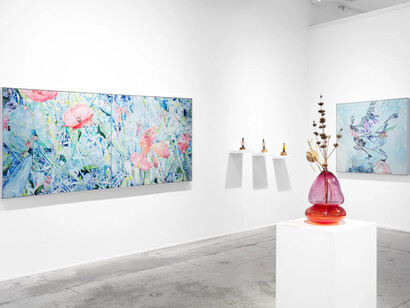
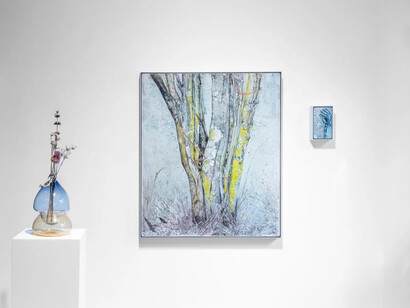
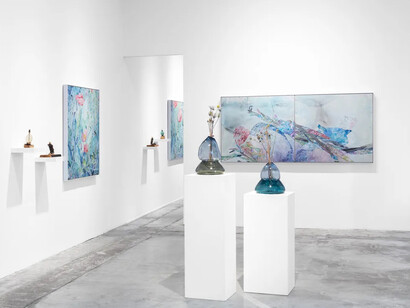
In these new works, Fox has literally gone back to the garden – more specifically, the gardens at Heide Museum of Modern Art, near her home in Melbourne, where she has conducted research and collected specimens. Heide has provided the major inspiration for her images of pink blossoms amid lush blue-green vegetation and delicate seed pods preserved in handblown shells of glass. It’s not a radical departure for the artist, merely a refinement, an affirmation of an instinctive, longterm attraction to organic forms.
The blueish palette and sinuous linework are familiar from previous works in a variety of media, but many of the side issues have been stripped away. In these pictures and sculptural pieces Fox celebrates nature’s power and self-sufficiency. She invites us to focus on that vital life force that provides so much pleasure when we watch plants sprouting from seeds, or the budding of new leaves and flowers.
While there are countless disputes that will always divide one group of people from another, the enjoyment of the natural world is universal. In this exhibition, Fox has embraced this commonality, seeing each plant as but one small, distinctive component of a profusion that knows no bounds. It’s not something we observe with critical detachment - it’s an unspoken article of faith that we are part of nature and nature is part of us.
(Text by John McDonald, art critic)