English
 Español
 Français
 Deutsch
 Italiano
 Português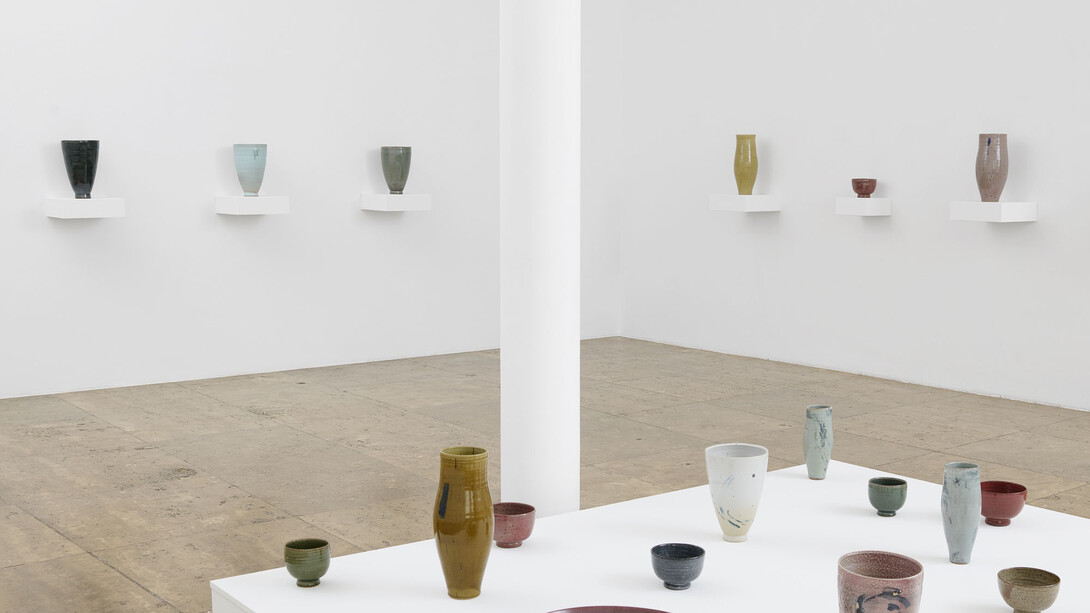
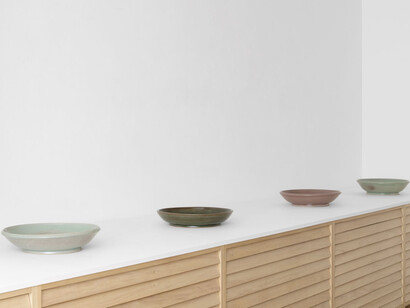
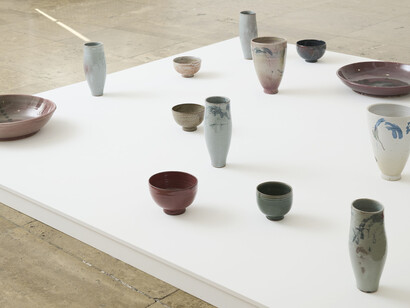
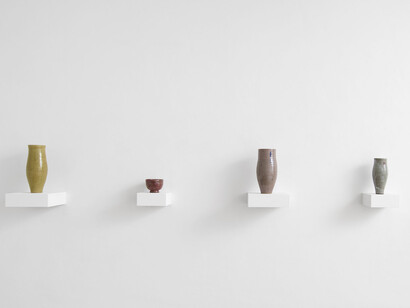
In this exhibition, Young-Jae Lee presents not only large bowls and cylindrical vases – good old favorites, in other words – but also new additions: slender, flaring vases from 2019-2025. They are aware of their “ancestors,” the cup-shaped drinking vessels – with their barely defined foot rings. Young-Jae Lee doesn’t exactly invent new forms. Rather, she seeks to transform their basic forms, expanding and stretching their structural possibilities.
But how does the theme of “Kumme,” which has recently appeared in her repertoire, fit into the context of the work presented here? As can be found in the literature, the Kumme was originally a drinking vessel. A container – definitely a type of bowl. This raises the question of whether there are parallels to the bowls, which have been a central theme in Young-Jae Lee’s work from the very beginning.
There seems to be a process. It was the Buddhist beggar monk’s bowl that had so captivated Young-Jae Lee back in Korea. The beggar monk’s bowl, intended to hold a modest meal – not large, round, and slightly curved inward, as if to shelter its contents. A dowry (or perhaps a legacy?) from her Eastern culture for her journey into the Western worlds. Later, having already been incorporated into the European design landscape, the bowls are unveiled; we are familiar with them from various exhibitions. Movement, lightness, and diversity – also in the wide variety of glazes. Then came the big surprise: spinach bowls – the name alone is provocative. Motivated by her fruitless search for the Korean teacup – which she cannot find because it does not exist – and her critical distancing from the Japanese teacup. Liberation, and yet a deeply hidden remembrance of Korean simplicity.
These bowls, which do not spill a drop, and their counterparts – the drinking cups that appear in so many shapes and sizes throughout Young-Jae Lee’s work, right up to the tall beaker vase – thus point the way to the Kummen. Kumme: a term for a vessel that is no longer very common has its roots in Middle High German and, as a type of vessel, appears to be in use in northern Germany but is certainly well known in more southern regions. The Kumme, a vessel with both rounded and straight sides, bears no resemblance to the beggar monk’s bowl. It has no ascetic origins, nor does it evoke charity. However, it was used simply to store food or drinks and was in daily use. It is also called a Napf [engl. bucket/bowl] or, rather uncharmingly, a Bottich [engl. vat]; on the other hand, 18th-century porcelain bowls exported from China and Japan are also referred to by these names. However, these rather elegant, often ornate vessels do not appeal to Young-Jae Lee. Spinach bowl and Kumme are closely related in form. The spinach bowl has a very personal origin story, but Young-Jae Lee describes the Kumme as a deliberate reference to a vessel shape from her current home. A sense of “having arrived,” as she herself describes it.
(Text by Gisela Jahn)