English
 Español
 Français
 Deutsch
 Italiano
 Português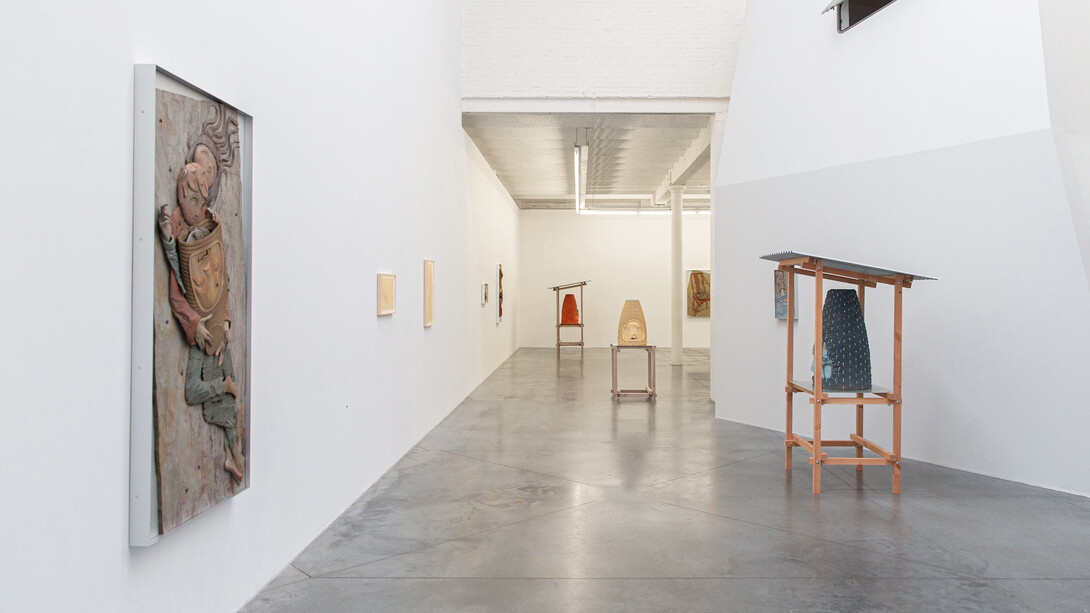
Tatjana Pieters is pleased to invite you to Life in cold blood, a solo exhibition by Belgian artist Charles Degeyter, unveiling new sculptures that draw from a narrative centered on a young beekeeper, his bees, and his cat.
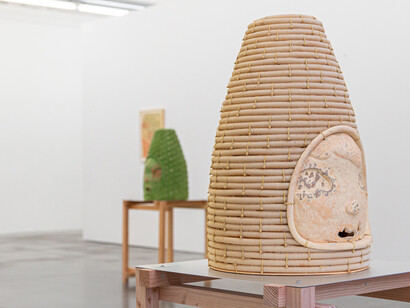
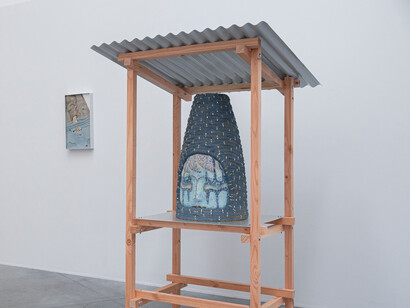
At the core of the exhibition are figurative beehives. These works build upon the nearly lost tradition of the Bannkörbe: woven beehives from Northern Germany that were fitted with masks and believed to protect against malevolent forces. Degeyter reinterprets this tradition within a contemporary context, by creating connections with popular culture, and personal narratives.
Although beekeeping is traditionally associated with honey production, the hives in the exhibition are approached primarily as living structures — an architecture for bees. Honey harvesting plays no role here. Instead, the works propose a model of coexistence in which humans and bees live alongside one another without exploitation.
Informed by Degeyter’s background as a designer of concert posters for metal bands (Nine Inch Nails, Melvins, and Pentagram) the works are infused with contemporary subcultural influences. The masks, with their corpse paint markings around the eyes, refer to black metal culture and anti-humanist attitudes. Black metal’s imagery and lyrics often focus on the darker aspects of humanity and society, while rejecting religious and social structures. This makes the works embody a sense of unease that manifests itself on multiple levels in society. At the same time, nature functions within the subculture as a form of refuge — an idea explored in publications such as Becoming the forest, which approaches the relationship between humans, music, and the natural world as a process of transformation and reconnection. Degeyter finds a similar refuge in beekeeping, collaborating with VZW Zwarte Bij and Imkerij Sprookjesbos, organizations committed to preserving the genetic integrity of the native black bee and its ability to survive independently in the wild.
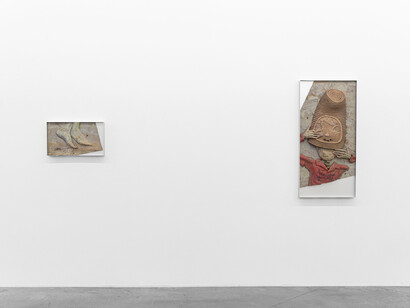
Influences from metal culture reappear in another series within the exhibition: the reliefs, where band logos occasionally emerge within the compositions. These high reliefs depict scenes in which the beekeeper, his bees, and his stray cat interact with one another. Figures and characters appear flattened into the surface, resembling flowers pressed into a herbarium. The scenes are partly autobiographical, yet they also suggest an imagined future or past. Time is not presented linearly; rather, the reliefs can be read as fossils in which moments from the past, present, and future have been compressed and preserved.
The works occupy a space between drawing and sculpture. Executed in stone, 3D print, and aluminum, the reliefs reference both fossil slabs found in natural history collections and archaeological discoveries such as the mummified bog bodies uncovered across Northern Europe, where time and geological pressure acted upon humans, animals, and their surroundings alike.
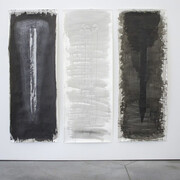
The transition from three-dimensional sculpture to the two-dimensional surface reaches its conclusion in the rubbings. These drawings are created by placing paper over the reliefs and rubbing the surface with colored pencil. Traditionally, this technique has been used to document textures such as rock engravings or inscriptions. In this context, the frottages function as derivatives of the reliefs, revealing and emphasizing details and textures.
Ultimately, Life in cold blood, presents a body of work centered on care, distance, and mutual dependency. The works envision a coexistence between humans, animals, and their environment without seeking to define it in absolute terms.