English
 Español
 Français
 Deutsch
 Italiano
 Português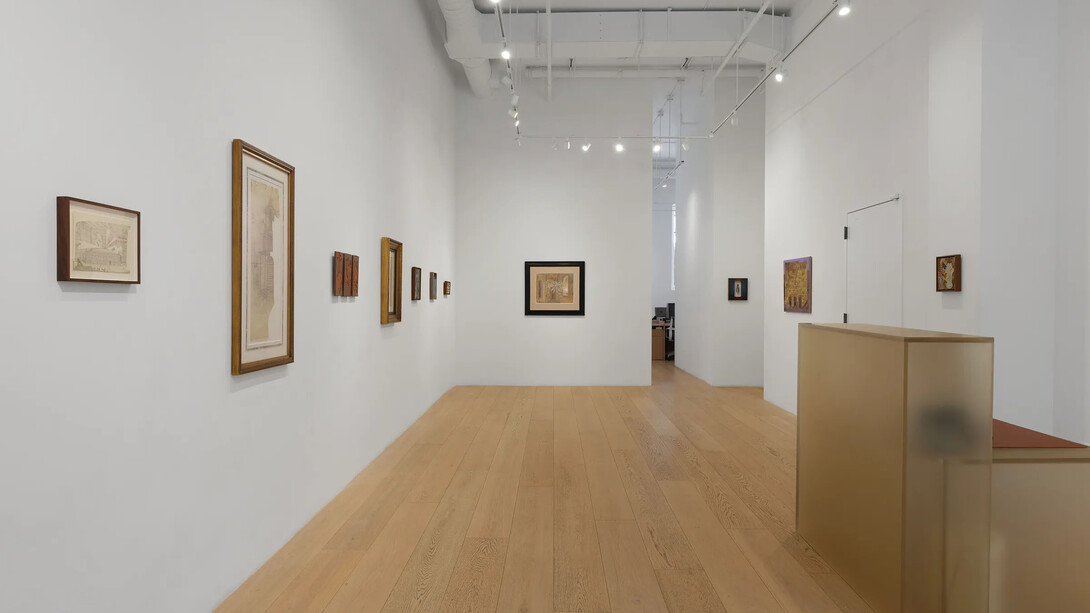
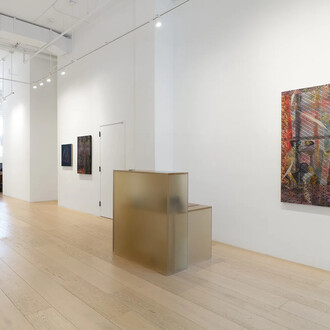
Gallery Wendi Norris is proud to present Architects of absence, a generation-spanning exhibition pairing paintings and works on paper by Surrealist masters Remedios Varo and Marcel Jean with new works by Dabin Ahn, Selva Aparicio, and Yaxkin Fuentes-Barrientos.
Spanning distinct eras, mediums, and geographies, these five artists are united by a shared project: navigating the voids that shape existence. Whether investigating the psychic, mythic, and alchemical realms of the imagination, documenting the material remnants of industrial and biological change, or harnessing loss and memory into resonant forms, their works map the absences that define reality.
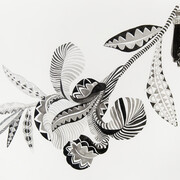
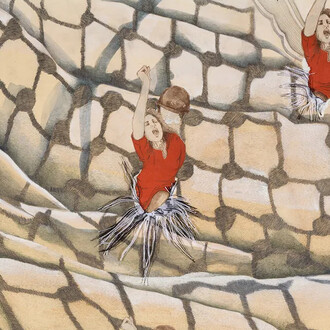
A highlight is Aprendiz de Ícaro (1959), a luminous and exquisitely detailed mixed media work on bristol board by Remedios Varo (1908, Anglès, Spain – 1963, Mexico City, Mexico). Drawing inspiration from Greek mythology and the Old Masters—evoking Leonardo da Vinci’s aerial designs and Francisco Goya’s airborne figures—Varo depicts Icarus’s apprentice trapped within a crumbling alleyway. The fateful scene captures the apprentice gliding toward a candle flame, a manifestation of the mythic void and the fragile threshold between aspiration and ruin.
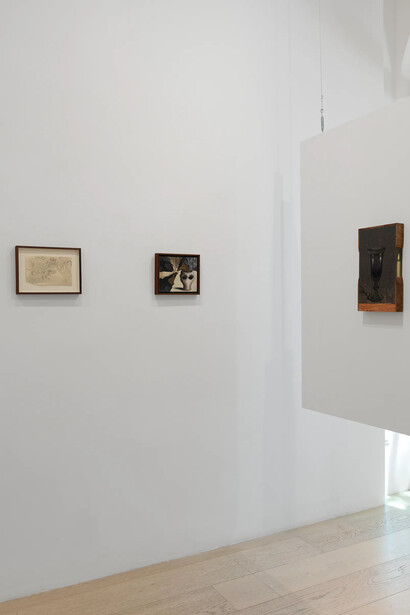
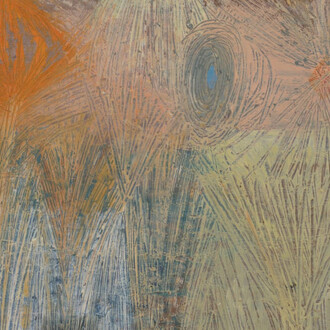
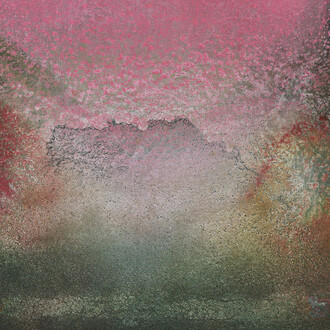
Paintings by Marcel Jean (1900, Charité-sur-Loire, France – 1993, Louveciennes, France) and new works by Selva Aparicio (b. 1987, Barcelona, Spain) further this investigation into material transformation. As a technically inventive member of the Surrealist circle, Jean pioneered flottage, a technique where diluted oil paint is floated on water and captured on paper. In the paintings on view, the artist creates evocative, abstract topographies that suggest the emergence of forms from an alchemical void.
Aparicio anchors this exploration in the physical realm, creating work that carries the memory of the living. Using original clay roof tiles from the Frank Lloyd Wright-designed Martin House in Buffalo, NY, Aparicio carved by hand the impressions of oak leaves pressing themselves into the substrate. Here, the roof serves as a site of convergence for memory, architecture, and the natural world, documenting how bodies and histories settle into one another and leave distinct traces of their presence.
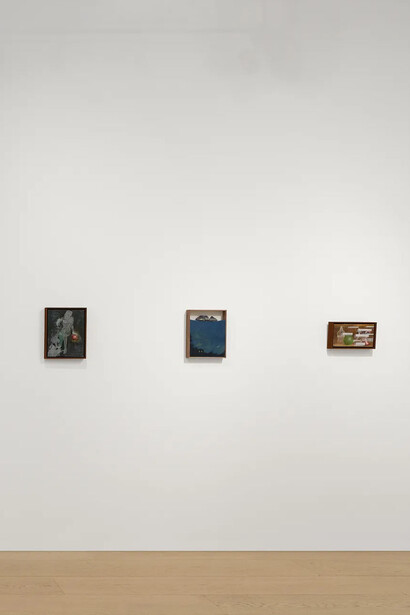
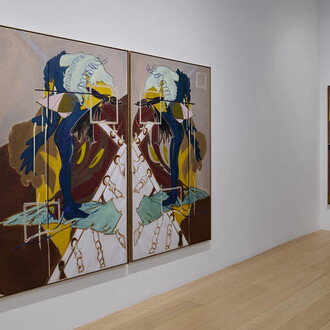
The works of Dabin Ahn (b. 1988, Seoul, South Korea) and Yaxkin Fuentes-Barrientos (b. 2001, San Jose, CA) explore different dimensions of loss—one personal and intimate, the other industrial and historical. Ahn’s new body of work, produced during a period of bereavement, questions what it means to hold time. He constructs his own frames and panels, shaping them beyond the canvas edge, and in one work integrates footage of flickering flames directly into the canvas, marking the composition with both continuity and grief. The remaining paintings of candles and bodies suspended in deep nocturnal light share this elegiac quality.
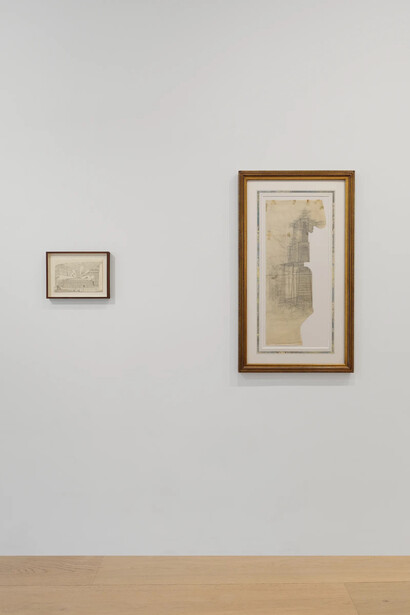
Fuentes-Barrientos draws from the industrial residue of Northern California, exploring decommissioned factories and buried histories. His subjects include an ancient lime kiln in Colfax, CA, recently uncovered by a wildfire; a decommissioned commercial kiln in Lincoln, CA; and the dilapidating cooling towers of the Rancho Seco Nuclear Generating Station outside Sacramento, CA—structures that remain standing despite their operational obsolescence. These forms exist in a perpetual state of becoming, echoing a history that is physically present yet functionally absent. Drawing on his background in architectural drafting, Fuentes-Barrientos reveals the profound resonance of these incomplete transitions.