English
 Español
 Français
 Deutsch
 Italiano
 Português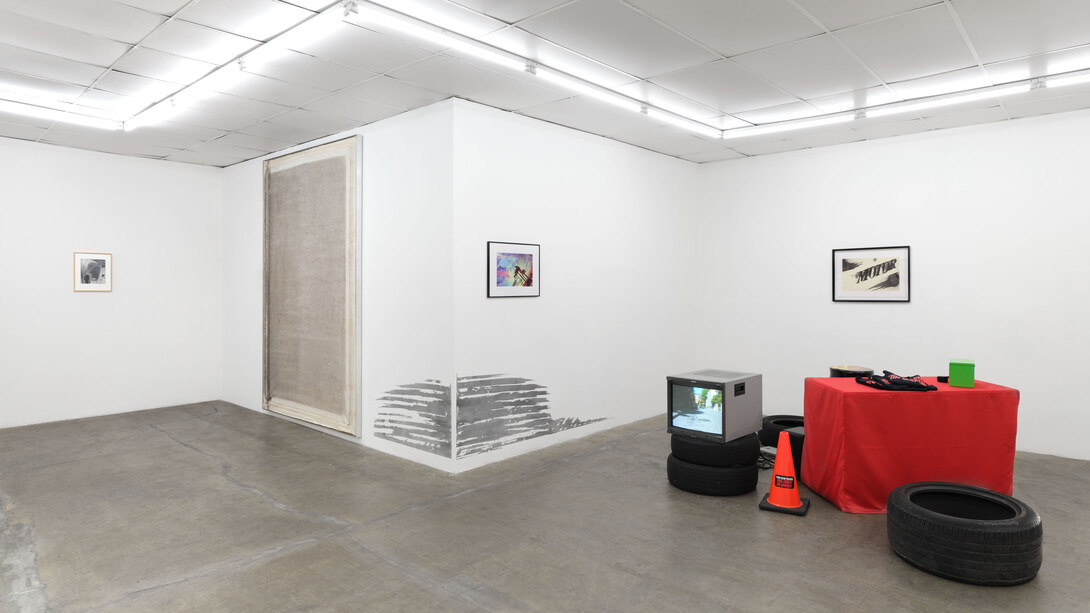
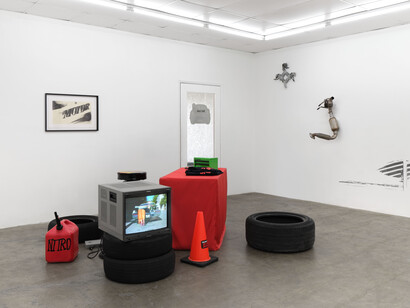
In Nicole Antonia Spagnola‘s video Ragged dick, set in the early twentieth century and imitating black and-white silent cinema, intercut with archival footage, a child shoe shiner waits for a job to earn the two cents needed to go to the movies. Eventually, a customer comes by, flipping the coin into the child’s hand, who seals it with his eyes, then moves the brush across the bourgeois shoe as if it were a toy car and the shoe a highway. After leaving the movie theater, the montage suggests that he is run over by a horse-drawn carriage and dies. The video runs in an endless loop, accelerating, through the repetition of economic transcendence and death, toward the horsepower of the car, keeping pace with the speed of the (death) drive.
If, in the early days of automobilization, the shoe shiner was run over by a horse-drawn carriage, the horse, in turn, was run over by a car. By 1910, the city of New York was populated by more than 20,000 dead horses, which were carried away by cars modelled after carriages — recall the Horsey Horseless, a hybrid of automobile and carriage, whose bolted-on wooden horse head served as a gasoline tank — or simply left to die, becoming obstructions that blocked the streets and brought traffic to a standstill. Street cleaners often waited until the bodies had decomposed, making them easier to saw into pieces, ready to be carted away as dog food. Such was the food chain of automobility’s ur-time.
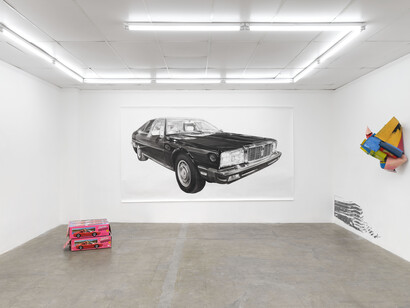
The invention of the automobile, one of speed and imagination, collided with that of cinema, and before long both Fordism and the film factory were selling motion out of what is, essentially, stillness — nowhere perhaps more than in Los Angeles, where highways rose alongside Hollywood. Images rush by on a screen, or past a windshield, while the driver or viewer sits still, held there by the same promise as the shoe shiner’s ticket to the movies: a pathway to class mobility. What we inherit now, more than a century into the car’s reign, in a present known as petro-capitalism, is transcendence, like the shoe shiner’s, of another kind: not a rising above, but a passing away, an a road headed toward destruction from the start.
The ancient echo of an enraged whinny from the early age of automobilization reaches me, writes Monika Rinck in Kritik der motorkraft, a 2018 book of auto-moto-fiction, like an evil haunting … And soon the last automobiles came quietly rolling up and knew they would be like the horses, one day they would park in endless recycling yards for an infinite time. And soon we too will be like the horses, said the grazing drivers, overtaken, but of the greatest beauty.
The end of the road, the beauty of the wreckage yard, was perhaps already prefigured in cinema’s early beginnings. In 1896, Maxim Gorky went to see the Lumières’ cinematograph at the All-Russia Industrial and Art Exhibition, where the empire unveiled its first automobile, the carriage-like Yakovlev-Freze. Gorky described entering a kingdom of shadows, where everything — the earth, the trees, the people, the water and the air — is dipped in monotonous grey. Grey rays of the sun across the grey sky, grey eyes in grey faces, and the leaves of the trees are ashen grey. It is not life but its shadow. It is not motion but its soundless spectre. Watching L’arrivée d’un train en gare de La Ciotat, Gorky felt as if the train darted like an arrow straight into the darkness towards where he was sitting, reducing him, the viewer, to a mangled sack of skin, full of crumpled flesh and splintered bones, and transforming the theater, so full of wine, women, music and vice, into fragments and dust. But this, too, he knew, was merely a train of shadows. The soundless spectre of early cinema, its carriages and cars flickering in grey, now haunts the kingdom of automobiles: cities submerged in the grey light of their own debris.
Ilya Ehrenburg’s industrial novel 10 л.с. (10 HP) — written in Paris in 1929, and translated into English as The life of the automobile in 1976, during the era of malaise — proceeds through the birth of the automobile and the industrialization that follows: the fictional assembly-line worker Pierre Chardain, the real-life capitalist André Citroën, the toxic gases and foul death-breath of machines, colonial exploitation, and the violent struggles over rubber and oil. The book opens with Charles Bernard, who first dealt in cigarette paper, then sold the paper depot and simply began living, slow and wise, like a turtle, and who, after seeing a galloping horse running across the screen, goes to the movies every Friday. When, one week, a car races across the screen and Bernard feels that he too is racing somewhere, he buys a car: ten horsepower, a smooth ride, a steel body. On the road, the car takes its own way, goes crazy. Things like that happen. A chapter in the manual: Illnesses of the Engine. Addendum: Mental Illnesses… Here comes the end. The highway ended. The long, straight highway came to an end. School, cigarette paper, Estrapade, sparrows. Everything ended. Faster! Faster, faster! Bernard dies, but he was never quite living, a mere invention, as Ehrenburg writes, unlike the car, which has a heart that beats. There are no people at the stock exchange. In fact, there are no people anywhere. Citroën is stocks, it’s lightbulbs on the Eiffel Tower, it’s the iron belt, presses, acids, Michelin tires, Deterding gasoline, it’s the dust and howling on the straight highway, the trembling of needles and dials, the heartbeat of engines, but there are no people anywhere — people are just a fabrication.
In Viktor Shklovsky’s 1923 quasi-auto-theoretical novel Zoo, or Letters Not About Love, his beloved Alya is a fabrication, as is his love for her — though the pain of it is nevertheless real. From exile in Berlin, somewhere close to Tiergarten where Russian émigrés took their walks, he writes her a tragic minnesong in letters. She, however, refuses him in return, and asks that he not write about love, as she is just very tired. So he writes letters not about love, but about Ehrenburg and Andrei Bely, about literature and life after the revolution, about the services of the automobile before the revolution (You brought the revolution sloshing into the city like foam, O automobiles!), about the driver who is not a worker, for he is alone in his car, about speed divorcing one from life, about the difficulty of starting a car that has no heart, no crank to turn, about sad taxis, about the pleasant crescendo of the Fiat’s engine, and the snobbish, deceptive length of the Hispano-Suiza’s hood, which Alya foolishly admires. The car becomes an object, a metaphorical vehicle, of sublimation.
In letter thirteen, a long one written between six and ten in the morning, when automobiles slowly awaken, and like most letters, a cheerless one, he writes to her instead of writing a potboiler, a film advertising motorcycles: Thoughts about you, motorcycles and automobiles swirl in my head … A man begins to love on the day after he has said, ‘I love you.’ Therefore those words should not be said. The love keeps growing, the man’s ardor increases, but by then you have lost interest. When this lack of synchronization happens in an engine, the car backfires. … I sit here with my malady; I think about you, about automobiles. (The combination helps.) You have turned my life the way a worm screw turns a rack. A rack, however, is unable to turn a wheel. In technical language this is called a stationary transmission. Stationary is my fate.
The letter ends with a myth in which God, who does not want to get wet or dirty his hands, sends the devil down to retrieve sand from the bottom of the sea. He sends him down three times; then, from the sand brought back by the devil’s dive, he creates man. If, by the 21st century, God has taken the form of a catalytic converter, as Jason Hirata’s readymade sculpture suggests, the devil, on God’s command, dives for fossil fuel. Created from that, we drive on horsepower toward our own de-creation. We, the drivers-turned-horses, might end with great beauty, but the cars decay with terrible grace, as Rinck’s Kritik der Motorkraft continues. Oh, what a strangely frivolous privilege: to see grace in decay. And the picturesque overpainting, in chalky pastel colors — light green, neon, mint! An endless peeling, the future desert. But what, then, would be the alternative? Don’t ask.
(Text by Sophia Roxane Rohwetter)