English
 Español
 Français
 Deutsch
 Italiano
 Português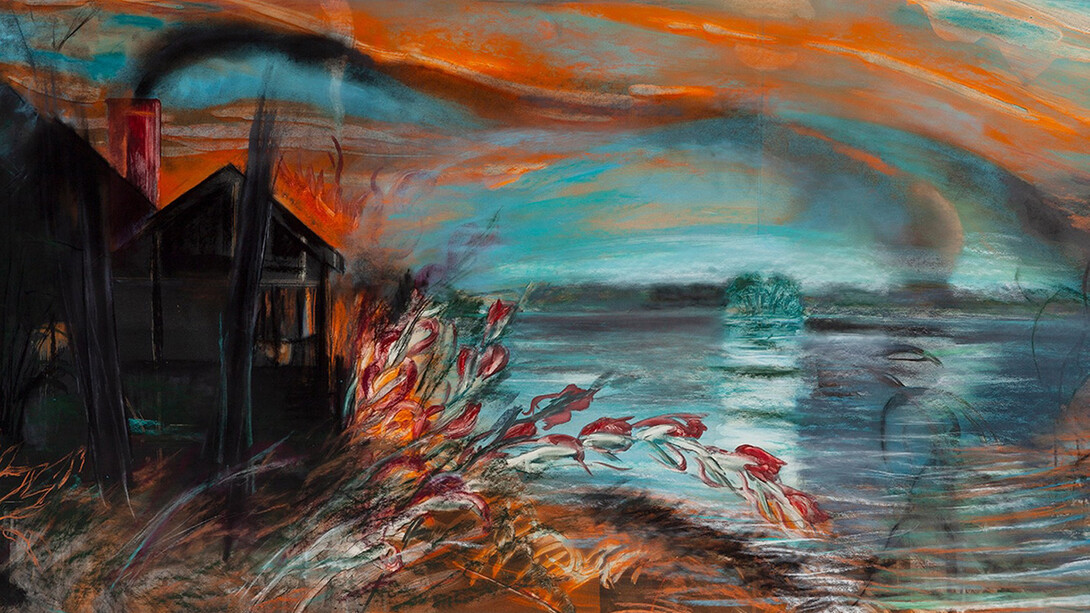
Michael Mazur (1935-2009) was an American painter and printmaker whose lifelong interests pursued a balance between the narrative power of observation and the nonrepresentational expression of gesture. Throughout his five-decade career, he reveled in the physicality of his chosen medium, relishing the process of making. He approached his work through the constructive vocabulary of observation—deftly capturing fleeting moments in nature, human tragedy, and rapture. Broad themes in his work encompassed social documentation, psychological portraiture, and passionate landscapes that moved back and forth aesthetically between figuration and abstraction.
Mazur was born in New York City in 1935. While attending Horace Mann School in the Bronx, he founded an art club whose only other members were cartoonist Ed Koren and the future curator Henry Geldzahler. He also worked Saturdays as a studio assistant to painter Alan Ullman in Greenwich Village.
In 1957, Mazur took a year off from his undergrad studies at Amherst College and moved to Florence where he studied at the Accademia di Belle Arti. There, he tested his desire to be an artist asking himself, “Could I live alone every day, would I wake each morning inspired to work? Could I sustain […] the passion for an art life I had just begun to imagine?” When he returned, he finished his education at Amherst, while embarking on a rigorous curriculum with the master printmaker and sculptor Leonard Baskin, who was teaching at Smith College. Through Baskin, Mazur learned the traditional techniques of printmaking. He received his BFA (1960) and MFA (1961) from Yale School of Art and Architecture in 1961 where he studied with Josef Albers, Naum Gabo, Rico Lebrun, Ab-Ex painter John Schuler, printmaker Gabor Peterdi, and Fairfield Porter among others.
Settling in Cambridge, MA, in 1964, Mazur held several teaching appointments, most notably at the Rhode Island School of Design (‘62-‘65) and Brandeis University (‘66-‘75). His proximity to student unrest of the era and his own political activism made space for the somber tone of works such as the “Closed Ward Series,” “Stoneham Zoo Series” (1976-1979), and his masterful illustrations of Dante’s “Inferno” (1993). In 1970, he was invited along with Jim Dine, Sam Francis, Roy Lichtenstein, Robert Rauschenberg, Frank Stella to represent the United States at the Venice Biennale, but declined to participate in protest of the governments involved in “war, racism, sexism and repression.”
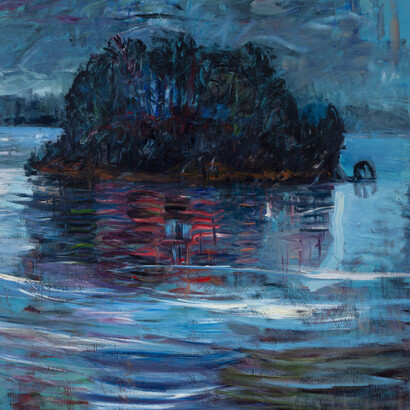
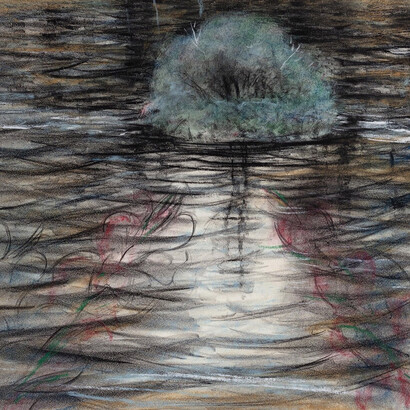
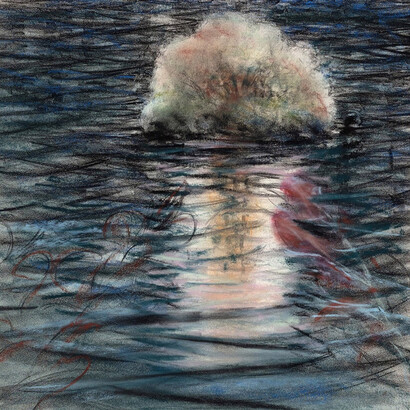
His landmark print and painting series Wakeby day/Wakeby night—which culminated in some of the most important, large-scale monotypes in American art history—considers the landscape of Cape Cod’s Wakeby Pond through the prism of passing time and layers of the mysterious, unspoken history that is inherent in natural landscapes. M.I.T. commissioned and installed a major group of these monotypes.
For this exhibition we present works from Mazur’s ‘Wakeby Island’ works; one large oil painting, one large pastel/monotype, three hand colored etchings, one never seen diptych monotype and one smaller oil painting.
From the 1970s, Cape Cod played a role in Mazur’s life as he and his wife, poet Gail Mazur, began to spend part of the year in Provincetown. There, he became an integral part of the Fine Arts Work Center, taught, and painted in his bay studio.. Mazur died in 2009.
Major awards include Louis Comfort Tiffany Foundation Grant (’62); Guggenheim Foundation Award (’64); American Academy of Arts and Letters Fellowship (’64).