English
 Español
 Français
 Deutsch
 Italiano
 Português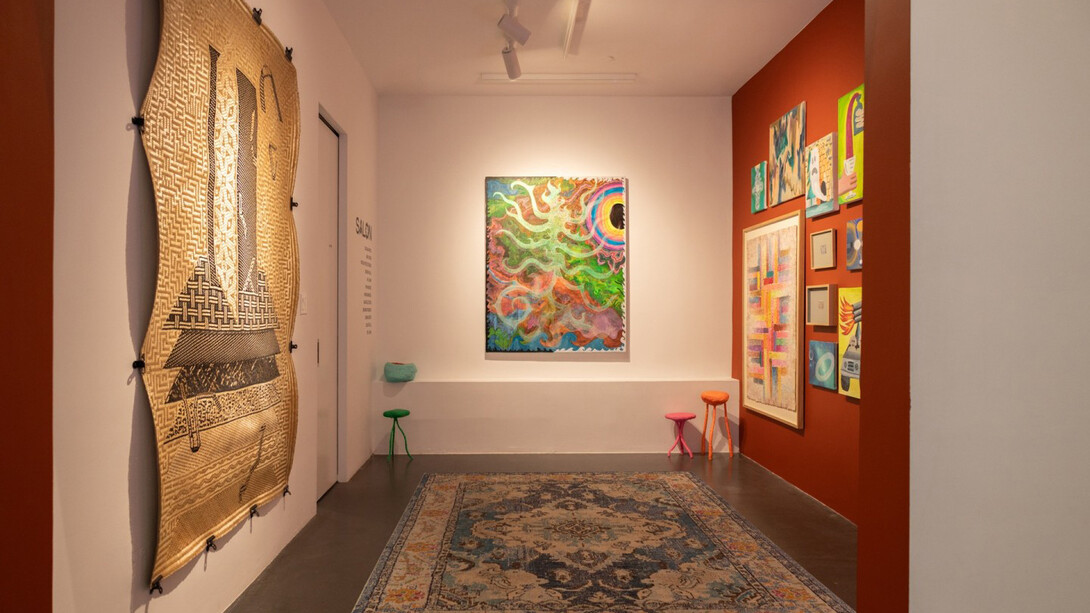
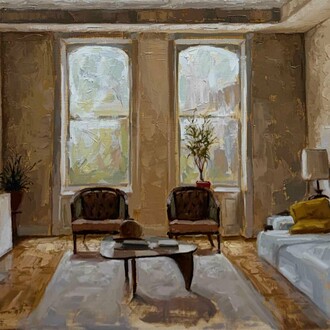
There is a particular pleasure in rooms where too much is happening. A painting hangs beside a woven mat. A butterfly rests on a capiz shell. A photograph is wrapped in gingham. Nothing quite matches, yet everything seems to belong. Such spaces resist tidy classification, asking us to navigate by instinct rather than hierarchy.
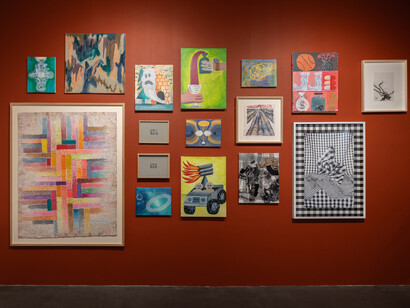
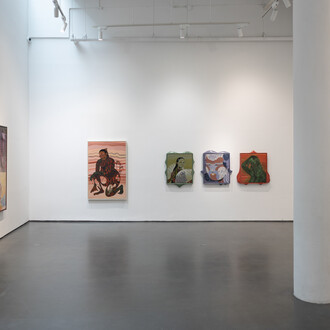
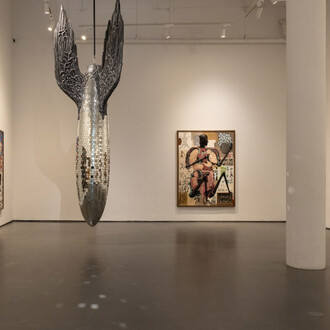
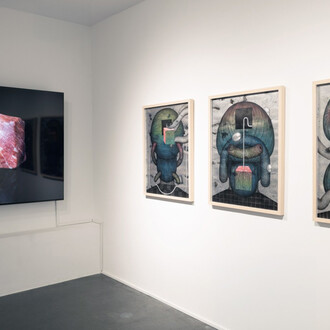
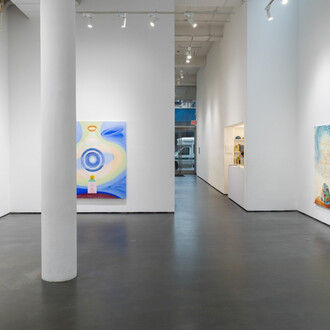
Salon takes its title from both the salon-style hang and the domestic interior: two modes of display built on proximity, accumulation, and personal taste. Bringing together works by artists who transform familiar materials and everyday forms, the exhibition considers what happens when distinctions between art and decoration, utility and ornament, begin to dissolve.
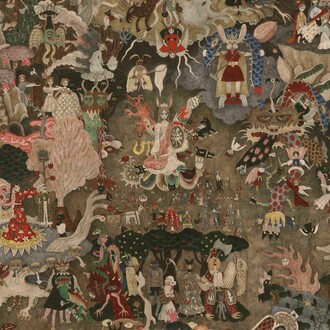
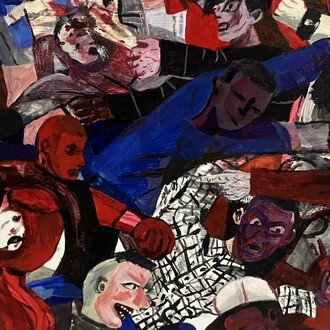
At the center of the gallery are paintings by Pow Martinez. In Bar fly, Chest of the mundane, and Flame tank (2025), cartoon figures, social archetypes, and fragments of popular culture collide within compositions that treat absurdity as a form of realism. A hand pours wine. A socialite drives a tank. The familiar appears slightly out of register, as if reflecting a world in which cultural references circulate faster than meaning itself.
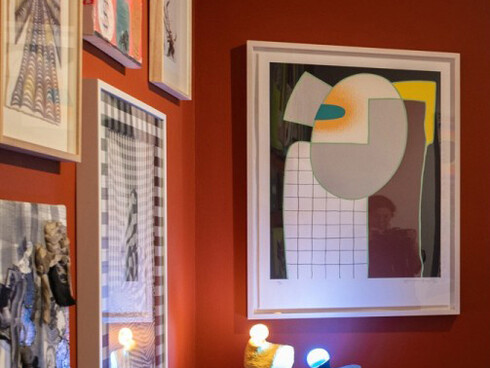
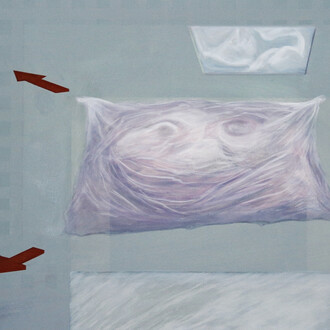
That sense of transformation continues in Nakatsuji Etsuko’s Untitled (2025), where grids and fragments of anatomy are reduced to their essential forms. Nearby, Wawi Navarroza’s Poleng, 3 ways (2016) shifts attention away from photography alone and toward the object that contains it. By wrapping an archival print in gingham fabric, Navarroza turns a common pattern into an act of framing, elevating the language of domestic decoration into the realm of display. Mit Jai Inn’s Untitled (2023) similarly layers paint in a quilt like fashion, mimicking the lowland rice paddy’s varied rectilinear plots. In many sects of Buddhism, the rice-field is considered the original merit-field, where seeds offered to fertile ground create abundant harvest.
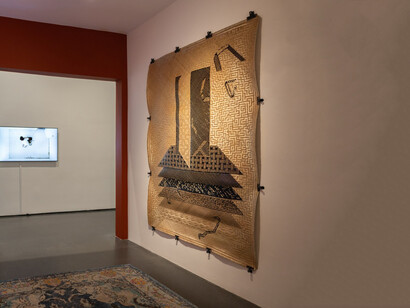
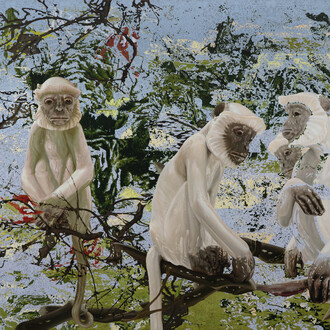
Elsewhere, artists draw on craft traditions and found materials to complicate ideas of value. Gregory Halili’s Vanishing XIII (2024) and Vanishing XIV (2025) place delicate butterfly illustrations on thinned capiz shells, bringing together natural history, souvenir culture, and memorialization. Yee I-Lann’s Doormatic glide refractor (2023), created with the Dusun and Murut weavers of Sabah, adopts the form of a floor mat while transforming a utilitarian object into a field of pattern and visual rhythm. Patricia Perez Eustaquio’s Vertigo V (2024) layers velvet, silk, wool, and cotton across handwoven Inabel cloth, revealing textile as both material and repository of memory.
Carlos Villa, Bernardo Pacquing and Carina Santos all utilize darker, cooler tones to bring a sense of clarity and calm to the array of works. A Vale of Gloom by Santos is a gestural abstraction in navy, teal, olive, and blush, evoking a feeling of melancholy as viewers see each color unify into one feeling. Villa’s Untitled is its near-opposite in temperament, a tightly rhythmic drawing of radiating arcs in ballpoint that fan outward from a single vanishing point, shifting through black, yellow-green, lavender, and pink in a pattern that feels both mathematical and hypnotic. In this drawing specifically, Villa combines his slinky motif into the design of a cape, also a form that reoccurs in Villa's major sculptural and performative works. Pacquing’s Drawing #10 ties them both together in its bold yet gentle strokes, a gnarled, branching form erupts from the left and center, referencing a deciduous tree in Auckland which has purposely lost its leaves to conserve water, he captures the silent beauty existing in its bareness.
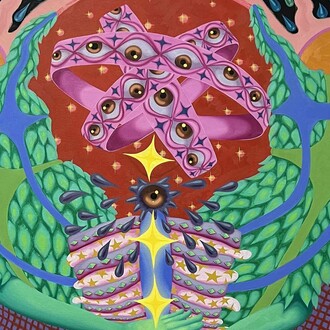
The exhibition also embraces forms of speculation and invention. Emily Cheng’s Lanterns for longevity and suspended for a moment (2026) borrow from the visual language of diagrams, cosmologies, and imagined architectures. Catalina Africa’s plant/spirit/portal (2024) similarly constructs a world governed by its own internal logic, where landscape and symbolism merge into a single environment. James Clar’s Parol #4 (2026) channels these ideas of structure and navigation through the lens of Filipino parol lanterns—star-shaped holiday lights historically linked to colonial history and the North Star.
Perhaps that is the proposition at the heart of Salon. Not that all objects are equal, but that the boundaries separating art from ornament, artifact from souvenir, or masterpiece from curiosity are often less stable than we imagine. Meaning emerges through proximity, association, and attention. Sometimes the most revealing way to look is not through hierarchy, but through accumulation.