English
 Español
 Français
 Deutsch
 Italiano
 Português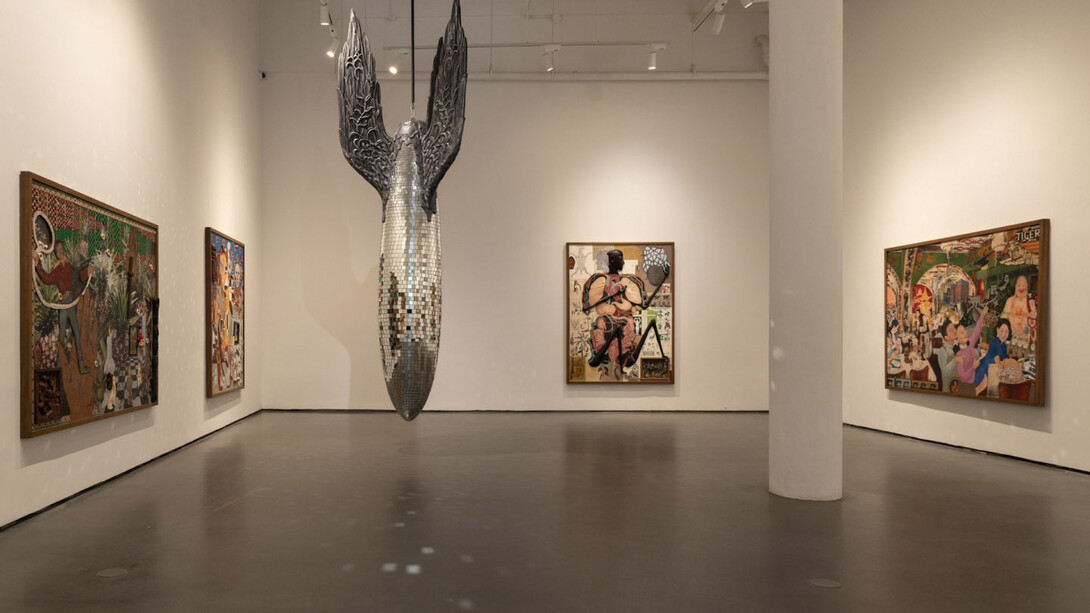
The world is but colliding forces, an amalgam of signals, objects, inherited stories, and gestures. Everything we encounter bears a charge, an essence. Kawayan de Guia’s instinctual approach to art-making dialogues with those broader gravitational forces in continuous expansion and contraction.
Born and based in Baguio, the former American military base and heart of the Philippines' troubled American occupation, de Guia was raised in the Cordilleras, surrounded by artists, makers, secular leaders, and ancestral knowledge systems attuned to interdependence. In his world, the human is not perceived as a center but rather as a singular element in a complex cosmology. Growing up in a grounding where film, ritual, and community organizing coexisted, he learned to see art not as an isolated object but as a living interface between ancestral wisdom, shamanistic traditions, tangible turmoils and future uncertainties. Over time, this intimate understanding of the pulse and spirit of the region and beyond became the core of his relentless support for his local community and shaped him into a key figure of the uniquely structured and organized Cordilleras artist collective network.
De Guia creates as he feels, adding, subtracting, and merging mediums, narratives, tropes, and symbols gleaned and accumulated throughout years of research into mind maps, expansions of a wider reality in which colonialism confronts its ghosts and humans their inherent contradictions. His process is a perpetual excavation: a return to the same troves of printed ephemera, religious imagery, medical diagrams, state propaganda, and touristic brochures that make up a shared visual unconscious narrative that expand beyond Philippines and its diasporas. These fragments are re-cut, painted over, distorted and set against one another until they begin to misbehave, revealing the fractures in otherwise countless seemingly seamless stories of progress and development.
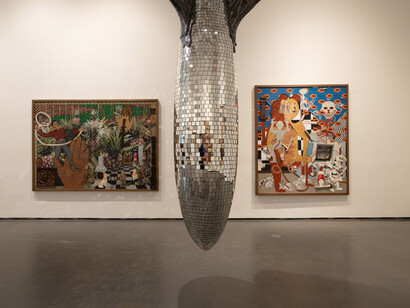
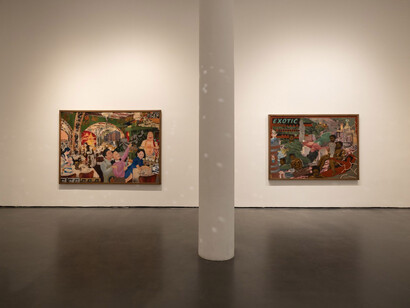
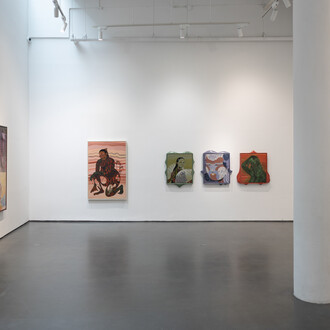
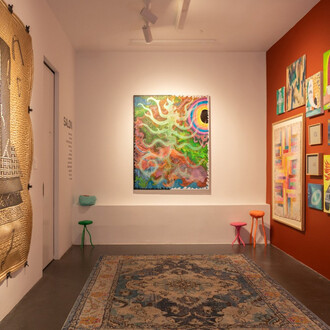
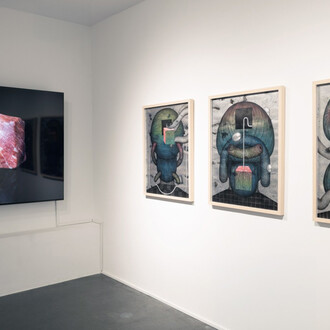
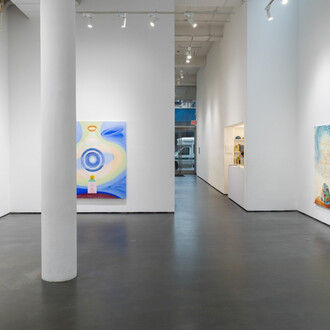
In Excavations from the land of the not so plenty, de Guia turns the gallery into a kind of operating theater for these collisions and collapses. Large-scale assemblage paintings stand across the walls like feverish storyboards for an unknown obscure film about empire, desire, and extraction. Conveyor belts spill endless bunches of bananas beneath the watchful eyes of soldiers; abundant plantations overflow into backdrops for tropical resort cities; anatomical cross-sections of organs and veins swell across the surface of the picture plane, intertwined with medicinal charts, agricultural diagrams, and devotional prints, dissecting their subject matter with inquisitive scrutiny. Bulol guardians and devotional iconographies share space with haunting logos, packaging ephemera, and export-ready branding, the sacred and the commercial pressed tightly against one another. A single body becomes a landscape, a map, a colony; a single fruit shifts between commodity, ration, weapon and joke; a bomb becomes a disco ball, object of allure and worship/warship.
De Guia’s large-scale assemblage paintings include inset sculptural elements, antique imagery, and sourced trinkets, which, far from being decorative, become quintessential to his vernacular. Small carved reliefs appear like reliquaries or hidden gems tucked into the work: shelves stacked with tools, votive figures, and domestic objects feel both tender and ominous. Niches hold tiny portraits, saints, soldiers and icons; ladders and grids climb over fields of pineapples and checkerboard floors, suggesting both escape routes and systems of control. Through these layered materials, at once narrative and didactic, geopolitical and intimate, De Guia dissects the uneasy and uncanny with elegance, offering to hold space for fragments of overlooked iconographies, erased histories, and cultural memories.
Throughout the exhibition, parody and pain, humor and horror, inner and outer universes compound. Iconic characters and advertising mementos exist beside images of authoritarian leaders; a tiger grapples with a snake while a brain-like organ sits exposed nearby; a discombobulated cowboy aimlessly endeavors to capture an unspecific prey; schematic renderings of the senses, ears, tongues, nerves are surrounded by suggestive charts of spices, plants, and trade routes. The surfaces are busy, and even overwhelming, because so are the existences and lands shaped by colonization, dictatorship, and relentless resource extraction.
De Guia’s practice is earnest, embodied, and haunted. It positions creation as a porous territory in which lived experience, historical markers, inner life, and scholarly knowledge can intersect and coalesce. The title may point to a society where abundance is choreographed as spectacle, while scarcity, exhaustion, theft and dispossession remain the ground condition for those who labor beneath it. But the works never reduce themselves to simple indictment. They also act as homages to grounding, spirituality, resilience and resistance: to communities who continue to gather, jest, worship, organize, and improvise futures with all they can nurture and all that remains at hand.
Excavations from the land of the not so plenty offers viewers a chance to stand inside this charged field. Rather than presenting history as a neat, singular timeline, De Guia stages it as a dense, pulsing anatomy combining arteries of trade, nerves of memory, organs of belief all cross-wired in seemingly unpredictable ways. His work defines the contours of systems that go beyond the perceptive alone and calls on the spirit that inhabits us and all that surrounds us. In these paintings and sculptural assemblages, the ghosts of empires and commodity culture are not merely illustrated, they are made visible as the very tissue through which we move, inviting us to look, to feel, and perhaps to begin our own introspections.
(Text by Words by Anne-Laure Lemaitre)