English
 Español
 Français
 Deutsch
 Italiano
 Português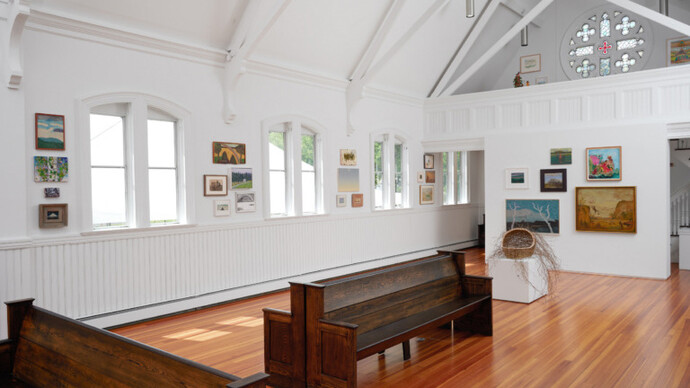
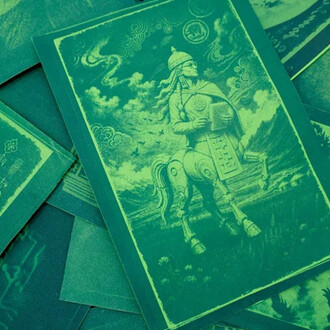
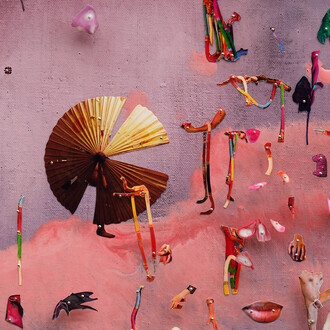
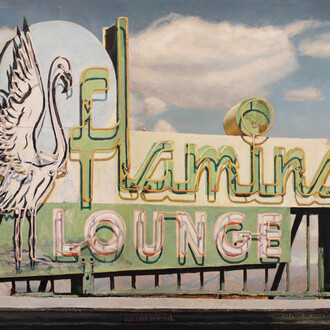
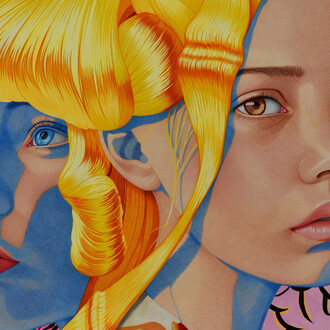
Organized by Matthew Higgs, Outside is the sequel to his 2016 exhibition of the same name at Karma’s Amagansett, Long Island space. With work by nearly seventy artists, this presentation in Thomaston, Maine revisits the first show’s premise in a new landscape. As Higgs writes:
The “outside” alluded to in the exhibition’s title is as much a physical place (i.e. the world around us) as it is a psychological state (as evidenced by the mercurial sensibilities of so-called “outsider” art.) It is in this liminal space—between what can be measured or depicted and that which remains unknowable—that Outside seeks to operate. The artists in Outside, of many generations, both conventionally and unconventionally trained, subscribe to no recognizable ideology or tendency. If Martin Kippenberger had his “psychobuildings,” Outside has its “psychogeographies” or perhaps more accurately its “psychotopographies.” Outside ultimately suggests that our sense of “place”—like our sense of “self”—remains elusive: a shape-shifting terrain, constantly in flux.
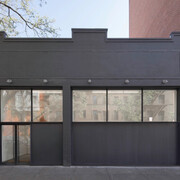
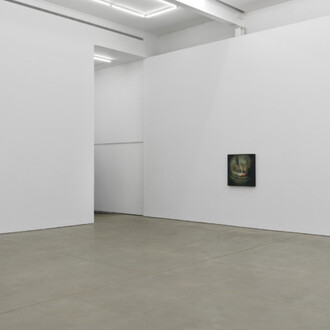
Installed in a deconsecrated church, the exhibition features numerous artists with ties to Maine, which has long been an important tributary in the development of American art. The artist colonies that flourished in the state at the turn of the twentieth century were hotbeds for the emergence of modernism. Beyond the monopolizing hold of New York, artists found in Maine a vernacular tradition—informed by the landscape, Indigenous material cultures, the simplicity of Protestant architecture, and folk art, among other muses—which opened the greater visual field.
Beginning in the late 1950s, Yvonne Jacquette, Alex Katz, Rudy Burckhardt, and Lois Dodd together renewed realist painting during their summers on the state’s mid-coast. Today, a new generation of Mainers—Katherine Bradford and Ann Craven among them—have taken up their torch. Each artist’s singular approach to representational painting exposes what Higgs terms their “psychotopographies”—how the unconscious maps itself onto the observed world, connecting inside and out.
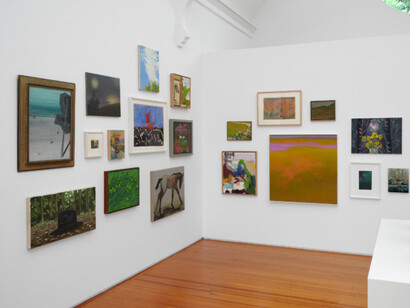
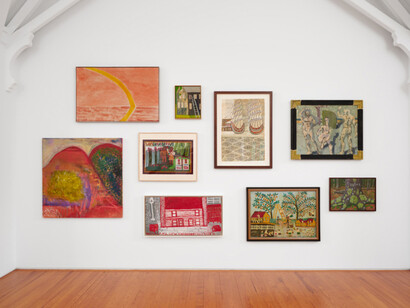
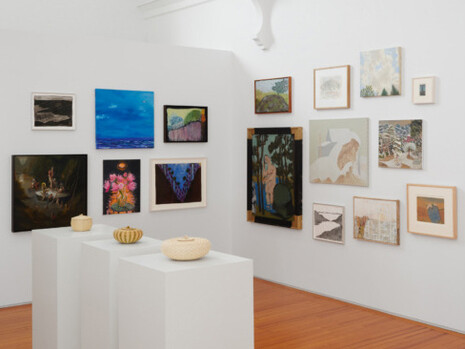
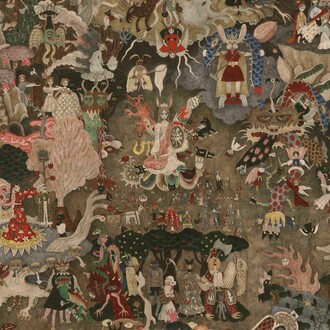
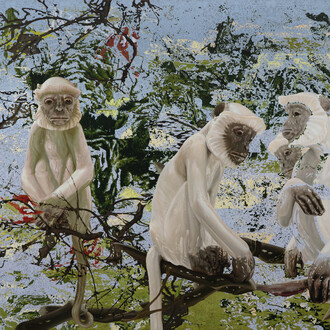
The exhibition’s salon-style hang situates so-called outsider artists like Aaron Birnbaum, William Hawkins, and Helen Rae alongside their conventionally trained counterparts, highlighting the connections between modern and contemporary practices and those variously described as folk, visionary, and naïve. Autodidacts like Milton Avery, Margot Bergman, Thaddeus Mosley, Matthew Wong, and Uman are among those who bridge the two realms, retaining their self-taught foundations even as their work enters mainstream institutions. In the end, as Higgs wrote a decade ago, the world we all share is “a shape-shifting terrain, constantly in flux,” just like the boundary drawn between inside and out.