English
 Español
 Français
 Deutsch
 Italiano
 Português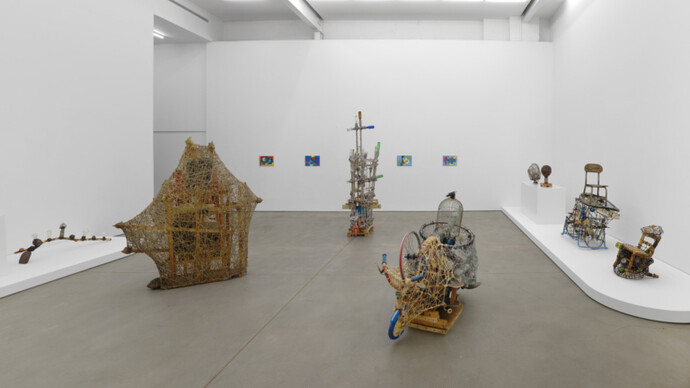
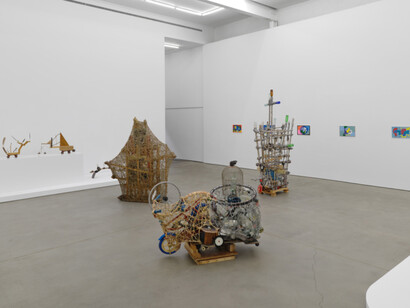
Alongside traditional materials, each gleaned or gifted object woven into Arthur Simms’s work “has a special significance,” he says, “in the same way as if you had to carry all your belongings with you all the time.” Collapsing time and space, he incorporates references that bridge his childhood in Jamaica with his life in New York City, Central African artefacts with American Neo-Dada sculpture, light with dark. Spanning the years 1992 to the present, Caged bottle is the first exhibition to place his works on panel and aluminum in dialogue with his sculptures, offering an expanded picture of the central motifs and techniques of Simms’s nearly four-decade-long practice.
Interior structures in Simms’s work are alternately perceptible and hidden in a constant negotiation between what he calls “concealment and revelation.” To create Sexual tension (1992), the earliest work in the show and one of his first uses of the hemp cord that envelops many of his largest sculptures, the artist, “drew with rope obsessively until it became a sort of skin” around a wood framework whose form was inspired partially by New York’s Queensboro bridge. Sexual tension introduces themes of accumulation and ritual that continue to occupy Simms to this day. The knife and the hammer, fear of aggression (1994)—shown here for the first time—is a totemic assemblage of blades and hammers bound with rope and wire. A horizontal component affixed perpendicularly to the sculpture’s trunk lends the overall form the look of a crucifix. The work emerged during Simms’s tenure as an art handler at the Brooklyn Museum during the early 1990s, when he became fascinated with the institution’s collection of Central African throwing knives. It also attests to his interest in the relationship between beauty and danger across art history, from Richard Serra’s hulking steel mazes to the nails driven into Congolese Nkisi figures to activate their latent powers. The wood skeleton of Dreamcatcher IV (2017) is wrapped with aluminum armature wire that evokes the woven-string heart of the titular sacred object. Whereas the body of the sculpture is visible though a delicately knotted, weblike silver veil, the joints and extremities of Dreamcatcher IV are thoroughly swathed.
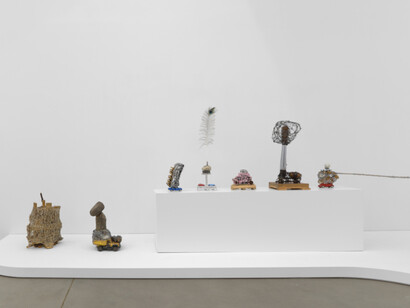
The wheels that recur across his oeuvre begin with Simms’s memories of his early childhood in Kingston, Jamaica, of homemade carts created from offcast wheels and boxes. In New York, where he immigrated at seven years old, another encounter with the object made a lasting mark—at the city’s Museum of Modern Art, Robert Rauschenberg’s combine First landing jump (1961), which features an inflated tire, expanded the young artist’s ideas about sculpture’s materiality. Wheel (2003), created during Simms’s fellowship at the American Academy in Rome, is held together by tension alone—removing the stones that anchor the work would cause the whole thing to collapse. Meanwhile, the titular wheel’s warped rim forecloses any chance of motion. Caged bottle incorporates skateboards and multiple bicycle wheels, none of which make contact with the ground. Although these materials imply movement, the only element not bound in place by wire or hemp is a single glass wine bottle, theoretically free to rattle around the confines of a bird cage. Smaller works, like Insect in the wall (2024) and Stone on top (2020) extend precariously upward from miniature toy cars, balanced through a careful calibration of tension and weight that is central to Simms’s method.
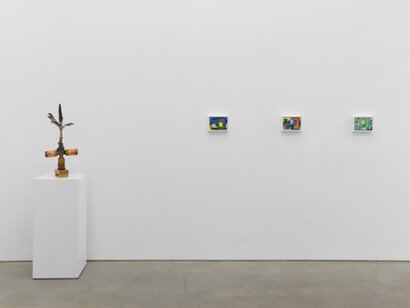
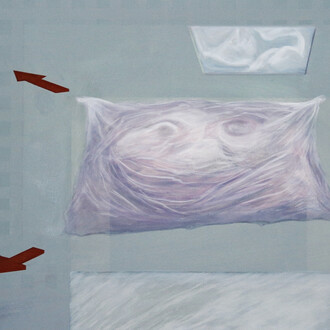
Like his sculptures, Simms’s two-dimensional works, represented here by paintings on panel and aluminum from 2015 and 2025, contain layered references including Aboriginal X-ray paintings and the graphic designs of Etruscan vases. They also affirm the primacy of line in Simms’s practice—rope and wire are as linear as his strokes of acrylic marker. Indeed, his earliest art education was in painting, not sculpture; his former teacher Lois Dodd’s observational paintings on aluminum flashings inspired Simms to try working on the same material. Though largely abstract, the forms in Simms’s compositions provoke identification akin to pareidolia, the process by which recognizable figures and items emerge from ambiguous stimuli. Set against a grid of blues and greens outlined in red, the central entity in Search for form three might be a fish; in Search for form two (both 2025), winding lines and flat planes come together to suggest a birdlike creature. Retablo 5, staten island (2015), which resembles a landscape viewed from above, pays tribute to the borough where Simms and his wife, the artist Lucy Fradkin, have lived and worked since 2011. With this tender homage to their shared home, he honors the hub around which his practice rotates, gathering material as it moves.