English
 Español
 Français
 Deutsch
 Italiano
 Português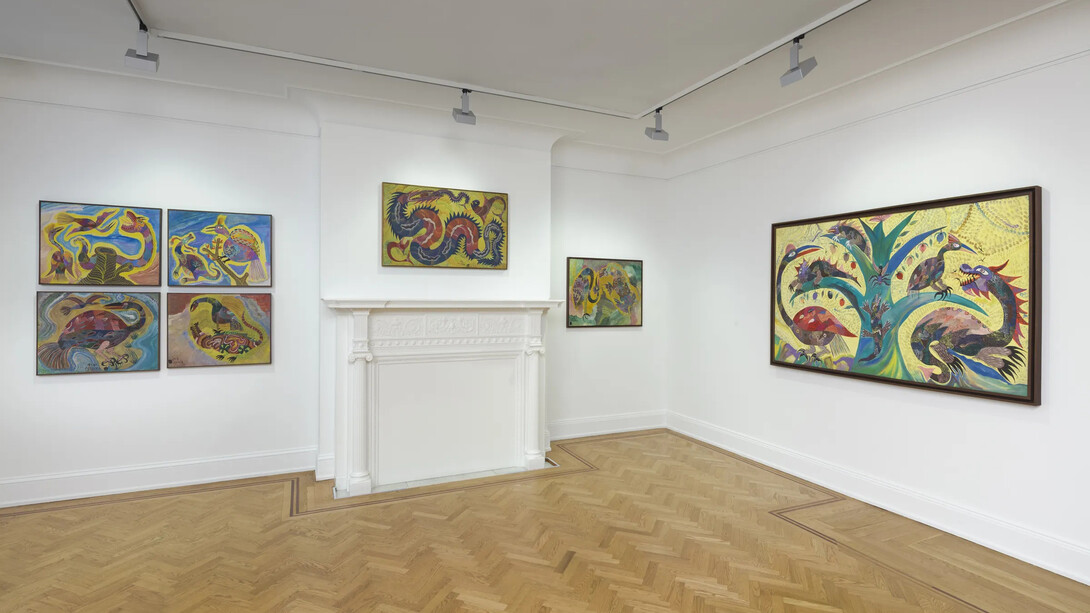
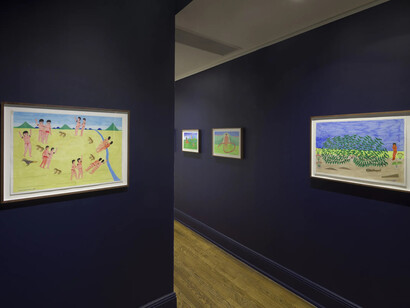
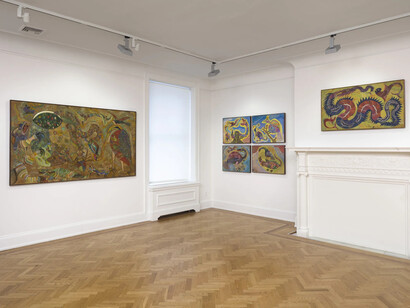
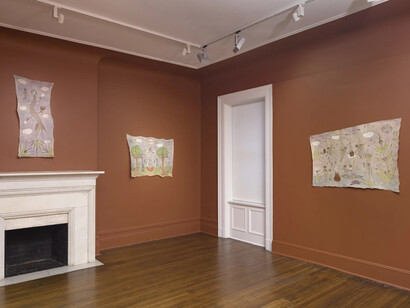
David Nolan Gallery presents Riverlines, an exhibition of work by three generations of Amazonian Indigenous artists Chico da Silva, Joseca Yanomami, and Kuenan Mayu. The exhibition brings together sustained practices rooted in the living traditions of the Yanomami, Tikuna, Tariana, and Tukano peoples. Through painting, drawing, and bark-cloth, these works examine how knowledge moves across lineage and territories, and how ceremonial practice is reimagined in contemporary form. The works reveal continuity, transformation, and innovation: an elder generation’s interpretation of cosmology, a middle generation’s negotiation of tradition alongside modernity, and a younger generation’s experiments in cross-cultural and cross-gender exchange.
Riverlines makes visible artistic genealogies long underrecognized in global narratives of modern and contemporary art, and positions these works within current discourse on climate, extractivism, and indigenous rights. The Amazon – with its visionary painters and relational cosmologies — can no longer remain at the margins. While the paintings are beautiful, their beauty is political. They offer ways of seeing that refuse a separation of art from life and insist upon integrity as both an aesthetic and an ethical practice. The exhibition features sixteen 1964 paintings on paper mounted on wood by Chico da Silva, alongside signature works from the 1970s and early 1980s that map riverine geographies and cosmologies. It also includes a cycle of Joseca Yanomami paintings embodying the visions of the Yanomami people’s land–forest; and twenty paintings by Kuenan Mayu, who uses natural Amazonian pigments on sacred tururi canvas to create works ranging from intimate ancestral gestures to hallucinatory cosmologies.
One of Brazil’s most influential and widely exhibited artists, Francisco da Silva (1910–1985), known as Chico da Silva, grew up in the state of Acre, in the Amazon rainforest. He related to painting as a form of world-building, his visual language consisting in hybridized animal forms, hypnotic eyes, serpentine lines, and elongated claws drawn from the mythologies and oral traditions of Northern Brazil. The centerpiece of the exhibition is Serpente da serra luminosa (Luminous mountain serpent), one of seventeen paintings created for the 1966 Venice Biennale: abundantly textured, multidimensional, surreal, and immersive, it fully expresses the artist’s visual ecosystems. Chico’s work invites comparison with twentieth-century painters who understood the surface as a site of cosmological invention: Joan Miró’s biomorphic constellations, Paul Klee’s pictographic fields, Hilma af Klint’s spiritual abstraction. What makes Chico’s work distinct is that his practice emerged from indigenous cosmology as opposed to European esotericism. As he remarked: “The drawing is what the hand gives and the color is what the details ask for...painting is autonomy” — not a formalist claim but an ontological one. The painting is alive because the world it holds is alive.
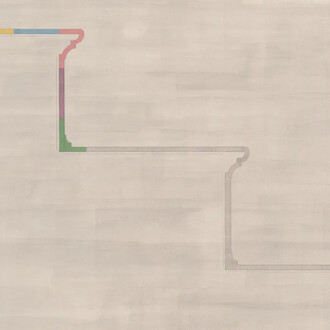
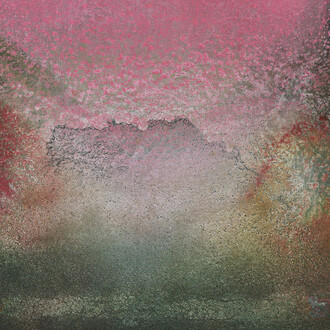
![Julia Fish, Before and since : Capriccio, after Epitaph [ from J.S. Bach BWV1080- in contrario motu ] (detail), 2022-25. Courtesy of David Nolan Gallery](/attachments/9af7904271e741d997914568345fdd5b01d41780/store/fill/330/330/83e2732d922820457f8e7cbd5ff09dd423f55bd6fd48e73a82070217041c/Julia-Fish-Before-and-since-Capriccio-after-Epitaph-from-JS-Bach-BWV1080-in-contrario-motu.jpg)