English
 Español
 Français
 Deutsch
 Italiano
 Português
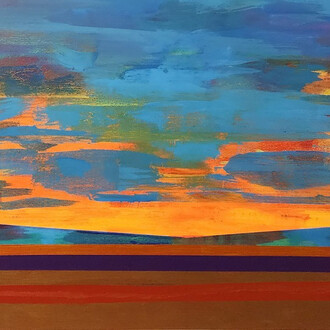
My work is about the experience of vision, prior to the interpretation of a specific image—I am interested in that early reaction to light as it becomes cognitive. Painting is a vehicle of light and vision first, and then symbolic and narrative.
(Tony Bechara, 2001)
Tony Bechara: an artist of many worlds is the first-ever comprehensive survey of this Puerto Rican artist, including works from his later years and exploring his career-long dedication to color theory and abstraction. Born in Puerto Rico and based in New York City, Bechara (1942–2025) drew on his bilingual and bicultural upbringing, his studies in law and international relations, his long stays in Europe and the Hamptons, and his characteristic, enduring curiosity to become a man of many worlds—seeking light and illumination in far corners of the globe and across its diverse cultures.
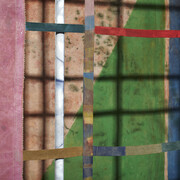
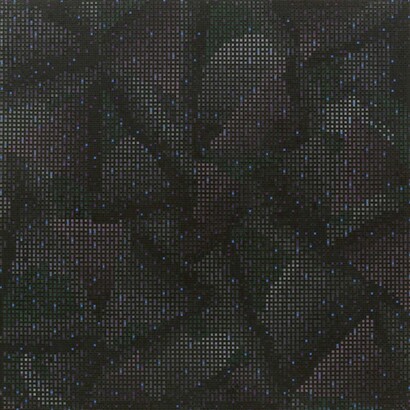
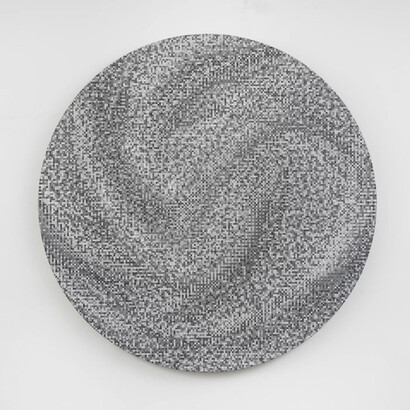
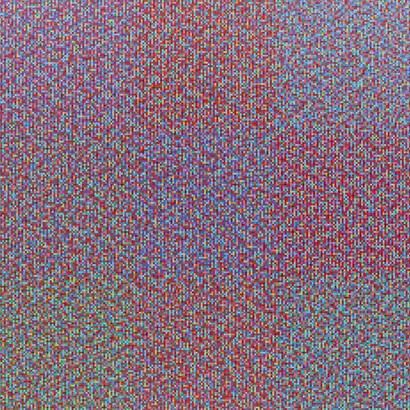
The artist’s iconic abstract work—realized on square, circular, and triangular canvases as well as in prints and three-dimensional sculpture—deftly engages the viewer’s optics, creating compositions that seem to shimmer and vibrate. This effect stems from his fascination with pointillism and the work of French Impressionists Georges Seurat and Paul Signac. In Bechara’s practice, however, the “points”—in his case, pixels—are meticulously mapped by hand, randomized through analog mathematical formulas and calculations, and arranged to create structures in which chaos and harmony fuse into a unified composition.
Bechara’s compositional process was shaped by his first encounter with the 5th- and 6th-century Byzantine mosaics of Ravenna, Italy—an experience that inspired his methodical approach to painting through the use of an orthogonal grid. For Bechara, exploring the variations and permutations of a grid became a technique that encapsulated his interests in art history and the interplay between past and present, ultimately forming a visual language rooted in pixelation—a signature expression he developed well before the digital age, offering a prophetic vocabulary ahead of its time.
His method centered on a handmade grid is created through a four-step process of covering and superimposing masking tape directly onto the canvas. This technique enabled him to achieve a randomized color display—a “vehicle of light and vision” that brought together a unity of “order and randomness.” The resulting works provoke an experience that taps into the “symbolic” and “narrative” by offering a platform—a vibrant, chromatic strategy—for diversity and inclusion in a single gesture. An artist of many worlds highlights Bechara’s harmonizing strategy as an important American expression that encourages diverse cultures and ethnicities to blend into a single, unified American culture fabric; a strategy celebrated at the Parrish on the 250th anniversary of the United States.