English
 Español
 Français
 Deutsch
 Italiano
 Português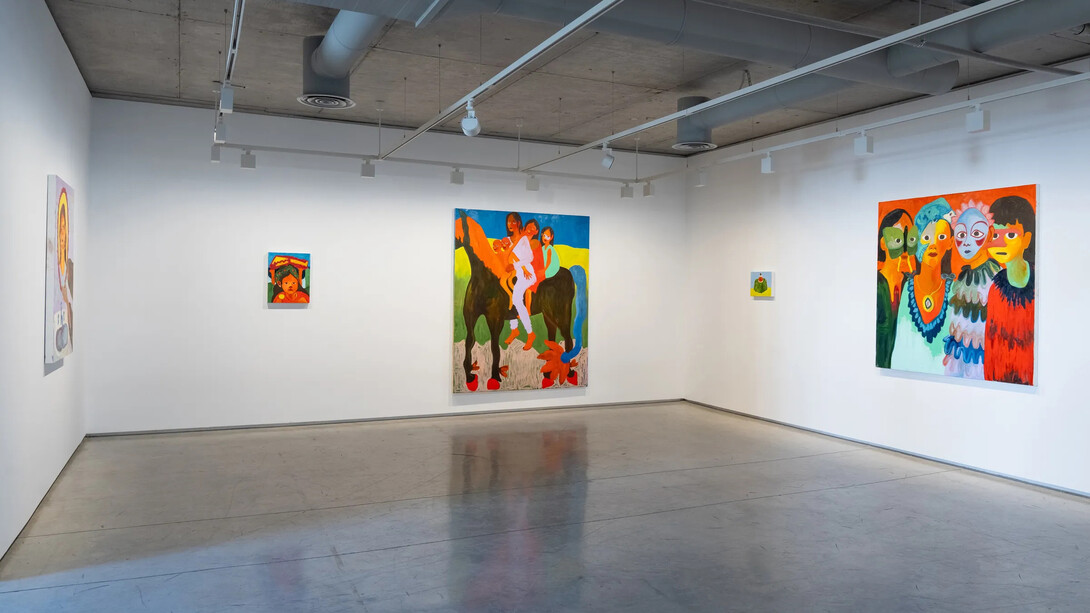
Masquerading is both character play and self-display.
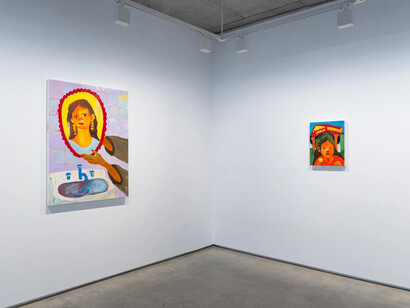
Quietly existing in her bathroom, a woman stares out at us. She may be looking at herself, guarding something, just as she may be surveying us. She is both observer and observed, residing in an interval where the image begins to detach from its source. The bodies that inhabit Dora Dalila Cheffi’s A never-ending masquerade sway and spin within this same condition.
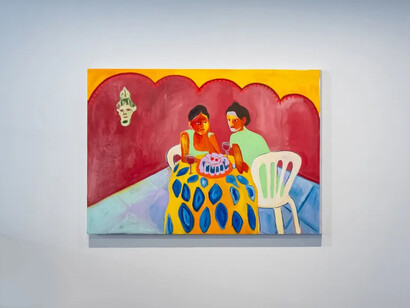
Some are solitary, others appear in pairs, and sometimes in small constellations. Seated at a table, meeting our gaze at close distance, or mounted on an ornamental horse, they face us, unapologetically. They are sealed within the world she has made for them, in the space she carves out for them, which encloses them as much as it frees them. Cheffi is, in this sense, almost a playwright.
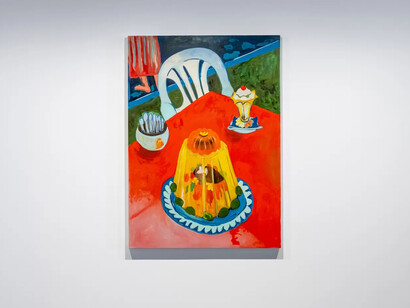
There is something of jelly in this world. Not as motif alone, but as a translucent sealing. You can still see what is inside, but it is held at a slight remove, protected by a thin, glistening coating. Cheffi’s paintings propose instead a kind of radical reimagining as an ode to the ways women have been represented throughout history. The masquerade here does not read as spectacle in the classical sense either. Because the theatricality is strangely flat, almost deadpan. So, masquerade here becomes less about pretending to be something else and more about being too much of something to resolve into a suitable identity.