English
 Español
 Français
 Deutsch
 Italiano
 Português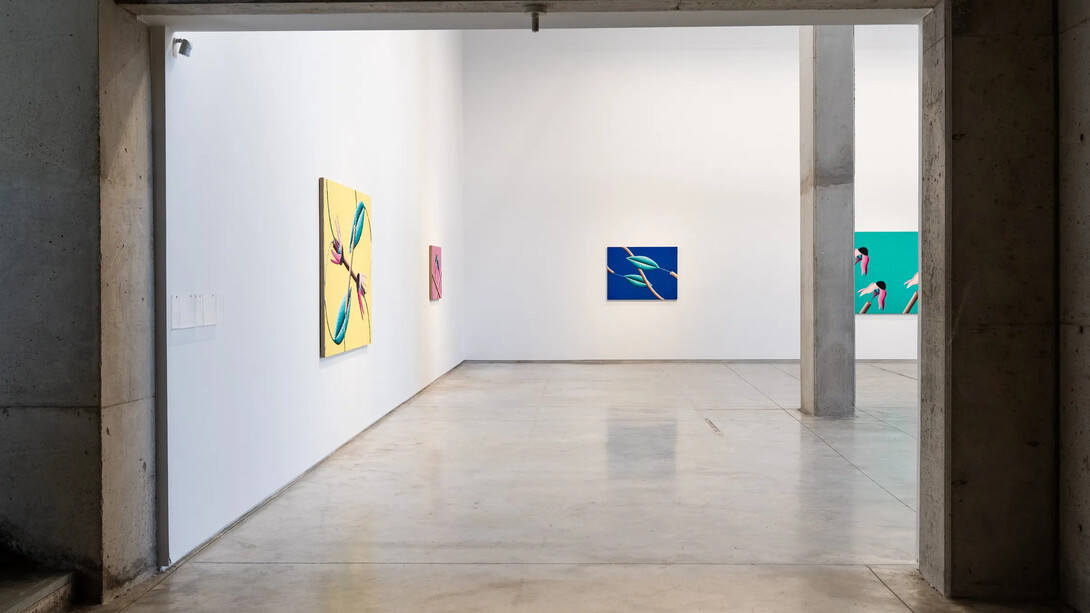
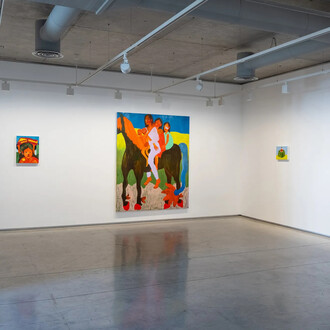
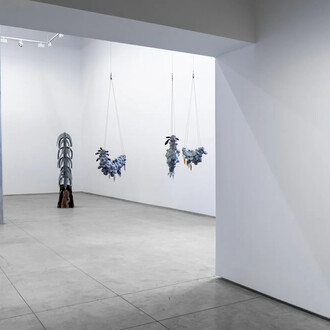
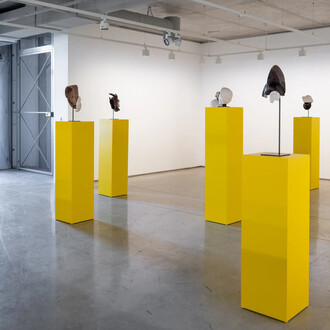
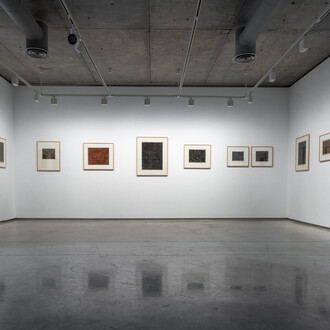
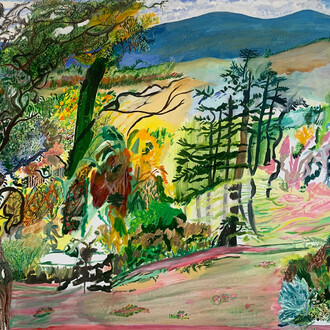
This solo exhibition by Nadia Ayari in the main space marks her first solo presentation in Tunis, a meaningful return to her native city. Curated by Fawz Kabra, Oblivion Rains: Notations of Gravity, Light, and Resistance presents painting as an act of resistance and survival. Stylized botanical protagonists negotiate gravity, light, and chaos within charged and saturated atmospheres, operating as notations in a visual score, and registering rhythm, momentum, and time. Together, the works trace an expansive narrative about perception and persistence, revealing how color, motion, and compositional rupture can hold truth against the pull of oblivion
“Big droplets of oblivion,” Nadia Ayari remarks in relation to her new body of work, describing painting as a way of resisting them. For Ayari, painting is not simply a means of expression but a mode of atmospheric survival, a practice that pushes back against chaos, violence, inertia, and the world’s continual unmaking. Each canvas becomes a site of negotiation between order and disorder, between the sharp edged precision of her protagonists, weaponized flowers, leaves, branches, and the underlying discord coursing beneath the surface.
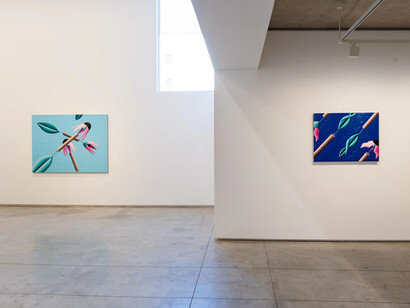
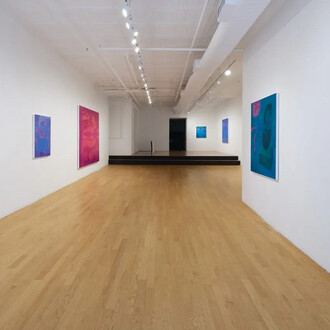
In Ayari’s exhibition Oblivion rains: notations of gravity, light, and resistance, repetition turns into rhythm, and rhythm becomes a way of thinking about form as energy and momentum. Flowers, branches, and leaves register as pulse and tone in the space of the painting. The sequence of paintings unfolds like a score, each work marking a shift in tempo, from the held tension of a single bloom to the cascading force of a network of relations. Impastoed hues of manganese blue, dense magenta, and piercing yellow establish an atmospheric field in which gestures hover, fall, and reassert themselves. The paintings carry time, allowing motion to function as a form of inscription, registering density through layers of brush strokes, sedimenting the material into a membrane-like surface.
Ayari’s body of work extends a vocabulary that has been refined over time where stylized botanical figures, puncturing a saturated atmosphere are articulated through graphic imagery and rendered in contradictory directional light that sets her protagonists as alien and remote. Bold shapes emerge, allowing form and light to carry the tension of the painting. These elements offer a sharpened visual lexicon, where imagery and gestures become more abrupt, the stakes are more pronounced, and narratives are charged. The paintings become systems of notation, scripts within an expanding orchestration where Ayari’s protagonists traverse the canvas in swift arcs and collisions: fluttering petals launched by an unseen force, the clack of branches ricocheting through luminous space, forms propelled across and beyond the pictorial field.
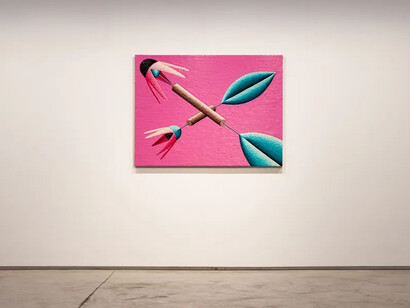
Color punctuates this rhythm through shifting registers of blue, orange, magenta, and yellow. The palette operates as both a destabilizing force and structural anchor. Ayari describes color as producing a bodily effect, “a feeling in the base of my tongue,” that registers as either tension or release. This somatic sensitivity gives rise to grounds that are as psychological as they are atmospheric. Manganese blue, a pigment newly introduced into her practice and inflected with an icy transparency, alters the gravitational pull of her compositions, functioning like an emotional weather system. Pink becomes a problem of calibration: too dark and it recedes, too light and it floats free. Orange appears sparingly, deployed for its abrasive charge, as in Drift I and bound (both 2025). In Bound, two flowers joined by a single stem are locked together at the center of the canvas, their connection at once sustaining and confining. By contrast, in Drift I, pink flowers and twisted leaves pass one another in flight. The protagonists appear to prepare to fight one another, failing to connect as they cross through a viscous orange field. Color contrasts emphasize their velocity, suggesting mass, energy, and a painterly analogue to gravitational waves.
Across the series, events unfold through the protagonists’ folding, striking, twisting, drifting, and collision. Movement carries from one surface to the next, generating a narrative rhythm that extends beyond a single canvas. In earlier bodies of work, a solitary fold of the leaf or directional shift of a flower often served as the central event. In Oblivion Rains, gestures accumulate, overlap, and multiply. The logic is not causal but elastic, operating through montage of color, time, layering, and interruption.
Teeth I and Teeth II (both 2025), introduce pink flowers and pointed leaves erupting from rigid branches angled across the canvas. The forms evoke uncanny instruments of ritual as they spear, tumble, and catapult through space. The flowers themselves hover between the anthropomorphic and mechanical, their swelling black pistils alternately confronting or retreating into pink petals. At times they recall Ayari’s earlier paintings of proliferations of eyes and pupils, and at others they suggest falling ordnance. Taut green leaves dance on their branches or penetrate the deadpan void, and off-edge cuts imply a continuation beyond the frame where forms have exited the system altogether, accelerating into an unseen plane.
Teeth III (2025) formalizes Ayari’s system, folding two protagonists against a deep indigo blue, fluttering flower and twisted leaf, and doubling the sense of tension as they diagonally travel on rigid branches up and down and in and out of the canvas. Other works Ayari describes as having arrived to her almost fully formed, disrupting the relative control of earlier compositions. In Fall (2025), suspended at the brink of action, the branches, leaves, and flowers pause in mid-air within their manganese blue fields, while in Twist II (2025), a single branch curves in an infinite figure eight, a deep creased portal at the center of each leaf drives the gaze inward. Drift II (2025) captures intersecting forms and introduces a deeper spatial plane as the flowers, connected to their rigid branches and sturdy leaves enter and recede in space.
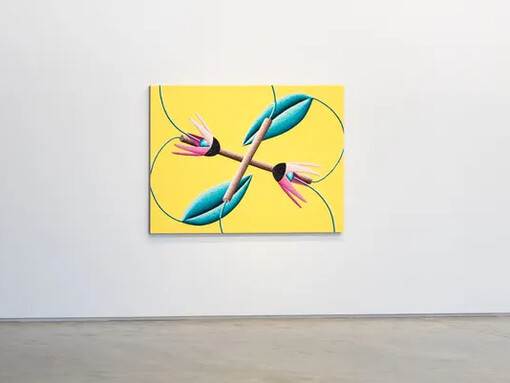
Throughout, light emerges as a narrative force, shifted off-center and heightening tension, as in Teeth I (2024). Lit from within, the flowers appear drawn downward by an invisible pull. Resistance ultimately defines both the content and the process of these paintings: the refusal to resolve, the struggle against predetermined outcomes, the willingness to reorient a composition after weeks of labor. As Ayari moves from one painting to the next, she reduces her use of solvent, allowing for density and accumulation. In Spark I (2025), built with layers of thick and minimally diluted paint, Ayari experiments with her solvent recipe, working on the single canvas for three months. She sets her protagonists upon a vivid yellow atmosphere, conjuring leaf, flower, and branch to hover, extending their stem to intertwine, making it difficult to determine where the journey leads and where one leaf begins and a flower ends. The branches cross and lock into one another as the stems spiral, their loops exit the surface of the canvas and return back into themselves. It is the gesture of elongating the stem that is the revelatory moment, where a new possibility opens formally and through the body of the work itself.
Binding the exhibition is an expanded field of narrative potential. Figures that once operated within controlled scenarios now inhabit a universe of multiple temporalities and unexpected truths. The intervals between paintings become as significant as the spaces within them. Ayari’s palette absorbs fragments of lived memory. She recalls the hand-painted tiles in her uncle’s hallway: delicate dots and lines forming diamond patterns, a frieze of musicians alternating with abstract motifs. These memories surface in repeated grounds and anchoring hues, while directional light and abrupt compositional cuts evoke a cinematic sensibility. Ayari asks what the term cinematic might have been before cinema as she locates motion within stillness, narrative within form, and duration within paint.
Oblivion rains: a notation of gravity, light and resistance unfolds as a constellation of notations. Each painting operates as a unit of affect, a measure of emotional weather, a beat in a choreography of resistance. Together they form the artist’s expansive narrative, a story of forces, perception and a sustained luminous refusal to yield to the weight of oblivion.
(Notations of Gravity, light, and resistance. Text by Fawz Kabra)