English
 Español
 Français
 Deutsch
 Italiano
 Português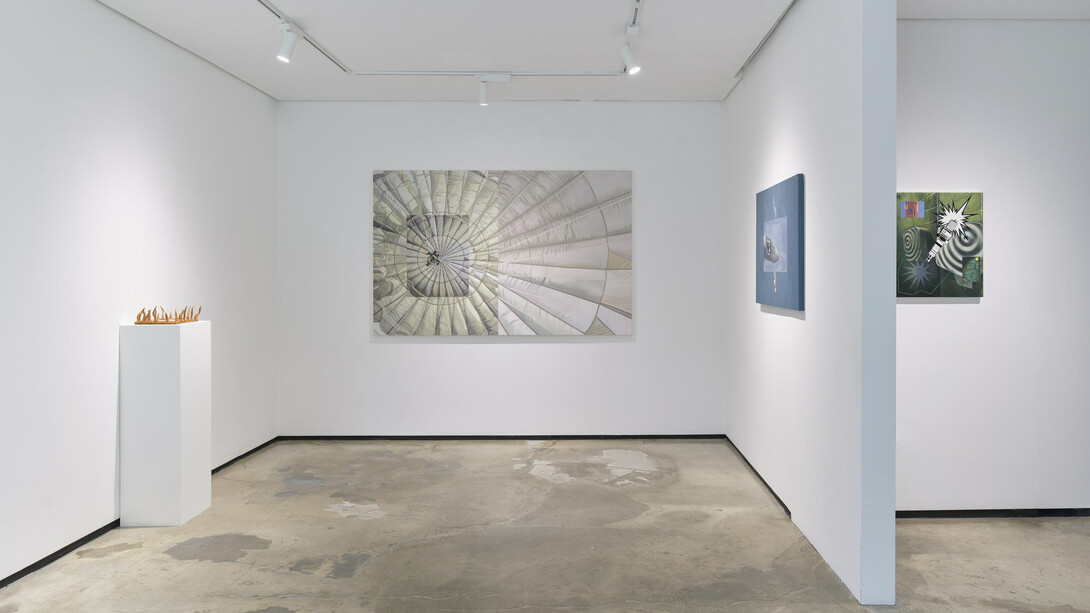
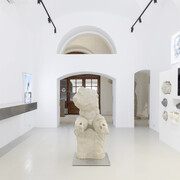
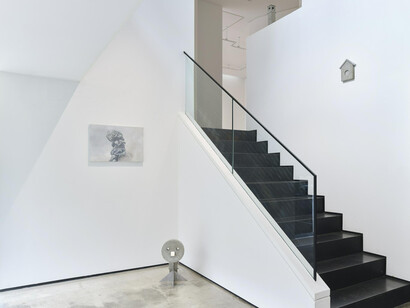
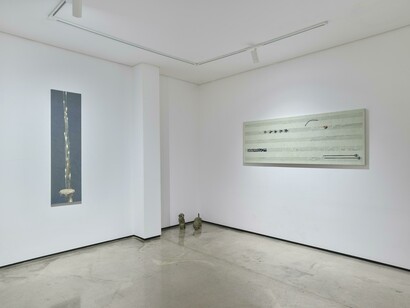
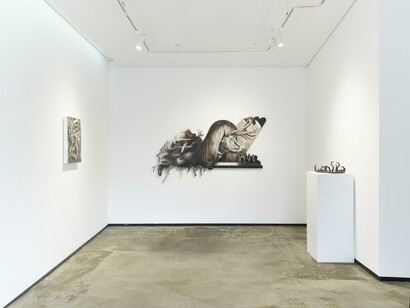
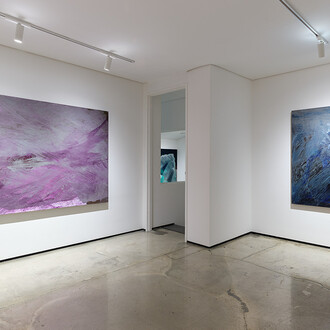
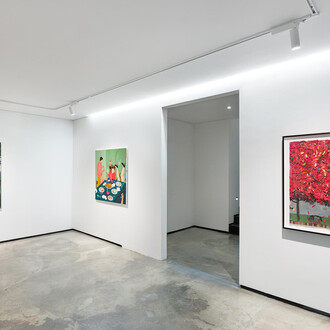
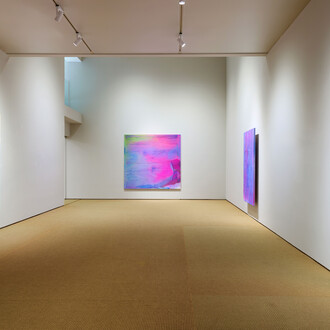
Lazy Mike is pleased to present The unflattening mandate, a group exhibition featuring Eunsi Jo, Hyerin Lee, Moohyun Jo, Seongguk Cho, and Yewon Seo.
Taking inspiration from Orit Halpern and Robert Mitchell’s The Smartness Mandate, the exhibition considers “smartness” not simply as technological progress, but as a data-driven way of seeing and managing the world.
Within this smartened world, sensations, relationships, memories, and tastes are increasingly compressed into data and reaction values. Through painting and sculpture, the five artists reopen the surface of a flattened world, restoring the density of body, time, material, and sensation in their own ways.
Moohyun Jo’s work takes shape as an attempt to forcibly fix the temporality of painting, its surface and interior, and beyond that the digital image, as a single substance. He speaks of “the bodily epidermis as at once a marker and a functional expression for survival,” meaning that his images do not remain mere visual markers. A contemporary image that has lost its temporal context can be caught in painting and made to function as a substance. His work summons AI images that have grown sharper yet at the same time more opaque, setting a “snare” for images that endlessly transform and proliferate. In Snaring a bird, the “bird” is not yet an actually existing object but a latent state prior to being made visible as an image. It is distorted, it proliferates, and it is caught on the surface of the painting. The image of the bird marked before our eyes is at once an image that actually is so, and one that has passed through a process of correction and conversion in order to be so. The artist uses this contradictory condition to make us see the flatness of painting as unstable, and as more dimensional.
That boundary between being “seen” as actually so and being “shown” connects to Eunsi Jo’s work as well. She plants devices of resemblance within a composition strewn with signs, drawing narrative out of the similarity and affinity among images. In Protagonist, for instance, the sprout of a root vegetable rising above the ground appears to be the protagonist of the picture, yet it hints that its true center lies below the ground. Here the shovel becomes the hidden structure of life and a clue for digging up the real protagonist. In Bonsai, too, soil, a watering can, scissors, and images of cutting pull at one another around the tree drawn at the center, prompting us to imagine the conditions that form an ecosystem and the forces that prune and disturb it. Such composition exposes the discrepancy between fragmentary signs and actual narrative, leading the viewer to infer the relationships among images. For this artist, then, resemblance is not a fixed meaning but an unfinished structure made by sign-images that pull and push at one another, a medium through which scattered clues link into a single web of relations.
While Moohyun Jo’s and Eunsi Jo’s work heightens the tension between one image and another, Seongguk Cho affirms the inseparable relationship between architecture and sculpture, letting their different logics complement each other. This is an attempt to redefine “nature” in today’s grammar rather than muddling a medium’s inherent qualities. Now that the smart city has become another kind of nature, the city is no longer a backdrop in which humans live but a vast body that organizes movement and sensation, breath and the rhythms of life. The artist returns these urban conditions to the material body of rebar, cement, and finishing materials. In his work Ghost ornament, for example, the function of a wall that divides inside from outside is reorganized into the language of sculpture. Here the sharp-edged ornament is part of the environment surrounding the exhibition space and at once a bone or blood vessel extending from a spine. The relationship between architecture and the body emerges still more intuitively in Kawamura and Ovo, where building materials are likewise reconstituted into animal flesh, suggesting that architecture has become part of today’s nature.
If Seongguk Cho returns architecture to today’s nature, Yewon Seo transposes onto painting the traces of the invisible forces that pass through that body. In her paintings, sound is no longer something heard but is rearranged into density and direction, division and afterimage. This is why fighter jets, explosions, and military apparatus recur. The artist is concerned with arranging and controlling, within the picture, the uncontrollable forces of a site where an overwhelming roar comes pouring in. In cresc., for instance, she enlarges and crops the same image to hold figures of a parachutist at differing scales within a single picture. Here the crescendo, the musical notation to play ever louder, is replaced by a composition in which the image is drawn progressively larger. This is less a matter of representation that translates a particular sound into an image than a way of replicating and recalibrating the intensity of movement in the source image in order to arrange the structure of the picture strategically. And within this strategy, a force that is invisible yet plainly at work, a sensation that has vanished yet still sustains the picture, returns not as flat data but as painterly density.
Finally, Hyerin Lee most directly rips open the surface of this flattened world. The deer image she summons calls to mind a harmless, compliant being, a soft skin readily accepted by the gaze of others. But that skin does not hold for long. The grotesque antler that erupts through the deer’s skin is a protrusion of the anxiety and aggression that the datafied human figure had concealed, and above all of the sensation of striving to survive. In The spear of longinus, this form drifts ever further from the deer until the antler itself becomes an independent entity, and in Face to face, again, an antler shaped from clay juts out into the world and occupies space. In these ways, it ceaselessly announces its own presence. Her work, then, is not simply the making of grotesque creatures but an attempt by a flattened subject to regain its volume. The artist describes this figure as “a strange and alien being that cracks the smooth system.”
The blind spot of the black-hole image, in the end, interlocks with the way the smart world operates. The system learns resilience through the repetition of crisis and response, and absorbs even error back into manageable data. Here the image, as compressed, filtered, and restored data, overwhelms and surpasses the actual black hole. Painting and sculpture, however, operate quite differently. They do not always recover with such resilience. Any attempt to re-inflate the flattened world is bound to carry repeated failure and shock, irreparable pain, and ever more conspicuous error. Rather than erasing this error and suturing the cracks, painting and sculpture pry them open and tear them wider, slowing recovery. Perhaps it is the things that are inflexible, and so easily broken, that leave the deepest cracks. And only within those cracks does flattened sensation finally get its chance to swell.