English
 Español
 Français
 Deutsch
 Italiano
 Português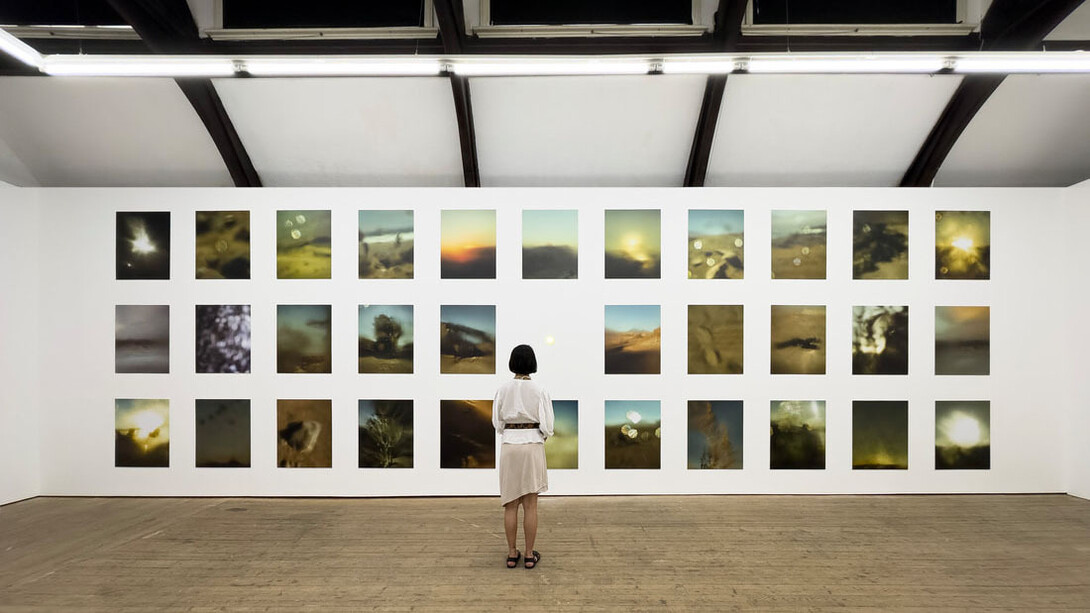
This exhibition departs from a work that enables “the desert to look at itself”.
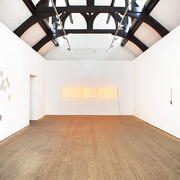
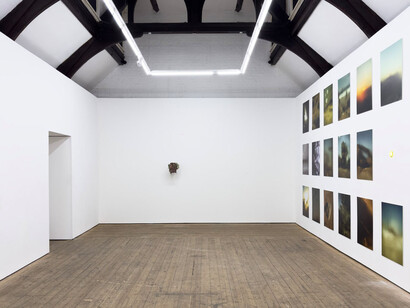
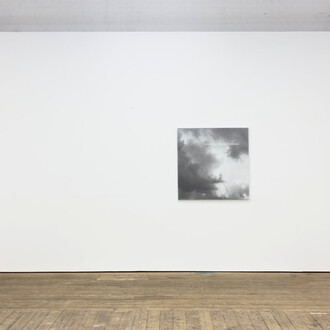
In the history of photography, just about everything possible has been done to both subject and image, but the crucial aspect – the camera lens – has remained largely unaltered. Solaris (2025) is the culmination of a long-standing body of research and refinement, comprising 35 printed photographs taken with a single special lens, which together span an entire wall of the gallery.
This installation emerges from the Atacama Desert, the driest place on Earth and the world’s best-known location for astronomical observation. Over time, this vast territory has been inhabited by diverse cultures and communities, and today it is home to some of the most powerful sets of lenses in the world. To make this work, the artist collected Atacama sand, which was melted down and turned into glass. The resulting glass was then painstakingly transformed into a photographic lens.
Finally this “eye of the desert” was taken back to Atacama and used to photograph the desert itself. The ecological traces of the territory are directly present because the sand was not purified before being melted and turned into glass, and they distort the resulting images, showing us the desert through itself. Inspired by the acclaimed sci-fi novel of the same name by Stanisław Lem, in which a form of planetary intelligence manifests as a conscious ocean, the images and the lens here propose an act of self-awareness: the desert may see itself and we may see it through its own eye.
The current collision of contemporary technologies and our planetary reality suggest that the constructs that frame our civilization are exhausted. A sensible response may be to search for ways of understanding reality that do not over rationalise. In that sense, Santillán proposes materialities that awaken a sort of geological rediscovery, which manifests in different ways in the other three pieces in the show.
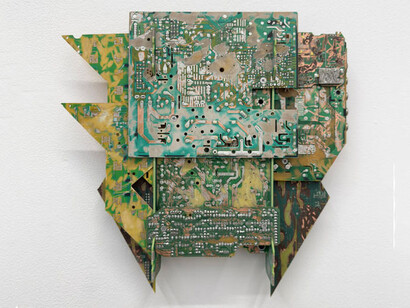
Placenta (2026) underlines the impossibility of detaching technology from nature. Taking computer motherboards as its basis, the artist strips the machinery of its function by eroding its components until its surface reveals an uncharted landscape. Electronic nodes transform into mineral-like patterns, exposing a sort of “techno-geology.” The boards appear less as instruments of computation than as fragments shaped by planetary transformation: incredibly sophisticated devices that will eventually be metabolized back into raw matter. Through this process, Santillán melds the technological and the geological, creating an almost hallucinatory terrain of machine, mineral, and earth.
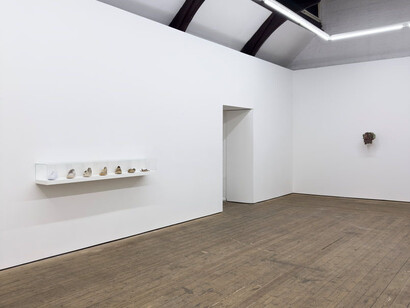
Echoing the source and fate of our most advanced technologies, in 1'111,111 (2023), Santillán approaches time-travel through one of the most mundane objects fabricated by our civilization: white trainers. Working with scientists, the artist manages to artificially accelerate the trainer's aging and hasten its return to the dust and the dirt. This project started when the artist was introduced to a device used in aeronautics to expose components to artificial weathering in order to accelerate their aging and assess their future safety. Inspired by these tests, the artist collaborated with chemists to generate formulations customised to the specific components within a trainer. Following calculations made with scientists, it was possible to project the shoe into future deterioration up to one million years.
1'111,111 confronts us with an uncomfortable paradox: A pristine white trainer is made from oil by-products-become-plastics that have their origin in the sticky black liquids that have been naturally secreted in the soil. The trainer is shaped as a modern fantasy that combines fashion and practicality, and some vestige of that fantasy endures while nature struggles to consume them, but ultimately it will succeed.