English
 Español
 Français
 Deutsch
 Italiano
 Português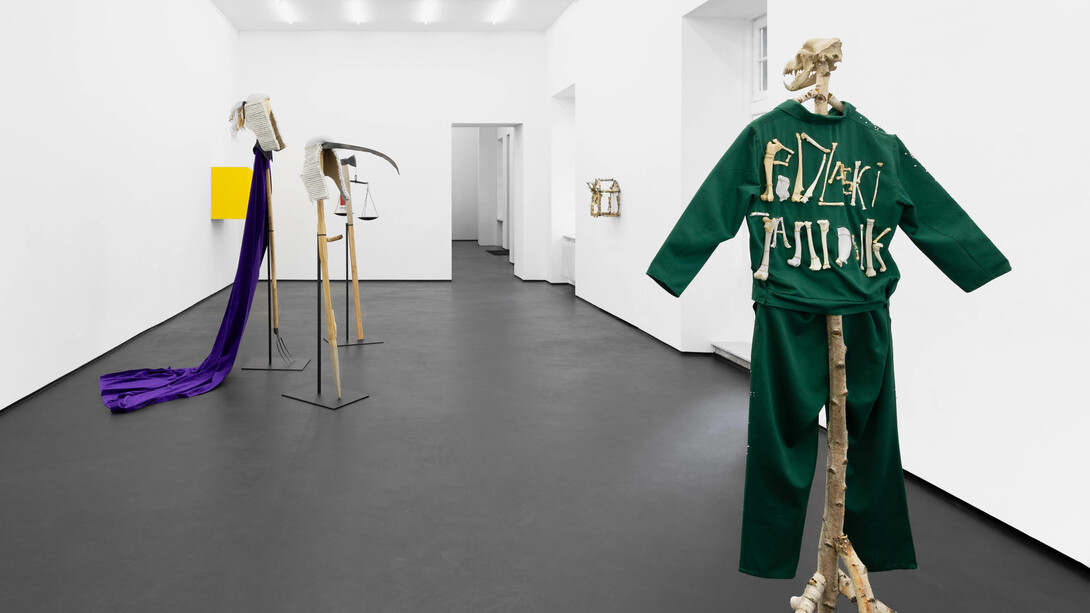
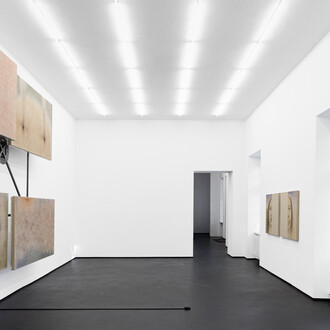
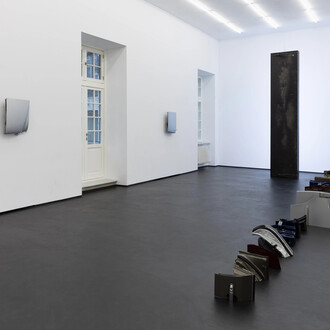
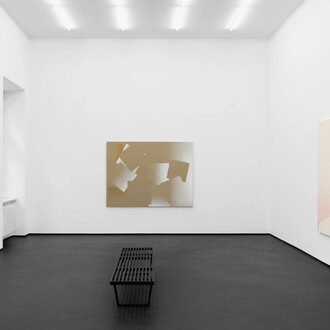
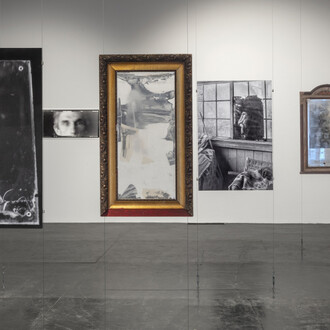
Daniel Rycharski’s exhibition Wolf’s hole at Gunia Nowik Gallery examines the mechanisms through which systems of power produce guilt, exclusion, and dependency. Developed through a year of weekly visits by the artist and Taras Gembik to a detention center, the exhibition emerges from direct encounters with institutional structures and the individuals shaped by them.
Moving between references to peasant history, prison culture, and contemporary forms of social control, Rycharski reflects on how legal, economic, and cultural systems define who is granted freedom and who becomes vulnerable to punishment. Rather than presenting imprisonment as an isolated condition, Wolf’s hole reveals the subtle “micro-prisons” embedded within everyday life—structures of class, language, and power that shape contemporary experience long before any prison walls appear.
A text by Taras Gembik, curator and writer, accompanies the exhibition.
For making our presence at the Warsaw-Białołęka Remand Center possible, and for their collaboration and support, we would like to thank: the Director of the remand center, Major Piotr Jankowski, Second Lieutenant Anna Kobusińska, Major Beata Jasińska, Andrzej, Adam, Damian, Krzysiek, Łukasz, Radek, Dominik, Wojtek, Karol, Paweł, Grzegorz, Kamil, as well as the Academy of Art in Szczecin, Fundacja Dom Kultury, Inez Dapszus, Edmund Szpanowski, Angelika Glonkowska, Ewelina Gajewska, Oliwia, Emilia Chełmońska, Iwona Czapiewska, Zbigniew Maciejewski, Andrzej Wochnik, Kaja Depcie-Kleść, Ewa Maciejewska, Marek Rycharski, Kazik Mariański, Julia Bujnowska, Vanessa Wieliczko, Antonios Trimintzios, Dr. Mikołaj Iwański, Professor Monika Płatek, Professor Marek M. Kamiński, Professor Sabina Pierużek-Nowak, and Professor Paweł Leszkowicz.
(Daniel Rycharski and Taras Gembik)
Each of us can become a criminal. Not because we have done something wrong, but because we may be named as one. All it takes is becoming caught in the machinery of a certain system, passing through its procedures and submitting to its language, being marked by a stigmatizing label.
Daniel Rycharski’s exhibition Wolf’s hole at Gunia Nowik Gallery grows out of the artist’s and Taras Gembik’s year-long weekly visits to a detention center. Every Friday, they crossed the prison gates, entering a space of isolation in order to speak with incarcerated individuals and observe the workings of the institution from within. The exhibition emerges from this encounter with a system that produces dependency, helplessness, and even guilt itself.
The exhibition’s title comes from Władysław Reymont’s The peasants. “Wolf’s hole” names the site of a conflict between peasants and a landowner over a forest. The peasants win physically, only to immediately lose to the apparatus of the state: courts, police, prison. Their conflict is taken away from them, translated into the language of law, and turned against them. Rycharski shows that a similar mechanism persists today. One may feel innocent and still become drawn into a machinery that names, classifies, and subordinates.
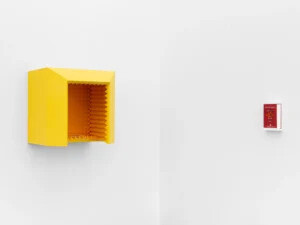
The exhibition begins with Five-minute prison, a gesture inspired by the writings of Lech Falandysz, Nils Christie, and Monika Płatek, all of whom questioned punishment grounded in suffering. Rycharski brings this idea into the space of art and asks whether punishment must necessarily involve isolation, humiliation, and revenge. Yet the exhibition points toward something even more unsettling: contemporary society no longer relies solely on prison walls. It produces its own everyday micro-prisons through economic dependency, bureaucracy, institutions, and the language of judgment and exclusion.
In this sense, the exhibition itself becomes a trap, the titular wolf’s hole. You enter as a viewer, only to realize that no safe distance is possible. The artist is not simply asking who ends up in prison. The real question is: who ever truly has a chance not to? A strong class dimension runs throughout the exhibition. Freedom is not distributed equally. It is easier to preserve for those who possess money, social networks, cultural capital, and fluency in the language of institutions. Those who are poor, isolated, excluded, or from marginalized communities more often become raw material for the penal system. The law presents itself as neutral, but the exhibition reveals how often it strikes those with the fewest tools to defend themselves.
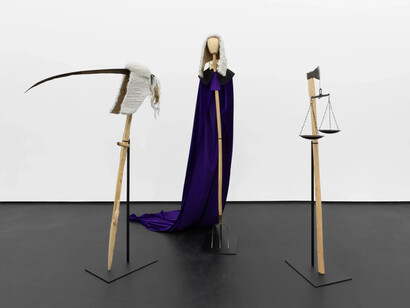
In Thieves of conflict, conflict is taken away from people and absorbed by institutions. Instruments of revolt—scythes, pitchforks, and axes—become burdened with the symbols of law. Lived experience is transformed into legal code; conflict ceases to exist as a relation between people and becomes procedure instead. A similar mechanism appears in Polityka passport award, a project rooted in the artist’s own experience. Freedom here does not simply derive from rights, but from access to culture, status, and recognition. Not everyone possesses a “passport” that allows them to leave confinement, whether literal or symbolic.
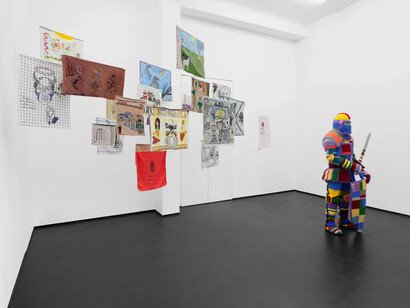
Meanwhile, Tender armor and Rags restore visibility to those reduced by the system to the role of inmates. Rycharski juxtaposes disappearing prison culture with the erasure of peasant culture. In the soft, crocheted armor, the myth of strength fractures, vulnerability replacing protection. In drawings made on prison rags, art becomes a means of reclaiming voice and subjectivity.
At the center of the exhibition remains the question: who is really the criminal? Banner of the Podlasie Janosik evokes the figure of the folk outlaw who broke the law in response to injustice. Crime here is not portrayed as an individual pathology, but as a response to a system that itself produces inequality. The law structures conflict and then punishes those who lack the strength or fluency to speak its language.
This logic is pushed even further in Casting for Judas, a performance in which participants speak about their own betrayals. Guilt ceases to appear exceptional. Instead, it emerges as something woven into social relations themselves. The icon accompanying the performance, Jesus carrying Judas, painted directly onto a criminal code, does not abolish the law, but exposes its limits. The law knows how to punish. It does not know how to carry the full weight of a human being.
Wolf’s hole operates like a factory of guilt. You enter as a viewer. You leave understanding that the label “criminal” speaks not only about the individual, but above all about the system that assigns it.
This is not an exhibition about “them.”
It is an exhibition about you.
(Text by Taras Gembik)