English
 Español
 Français
 Deutsch
 Italiano
 Português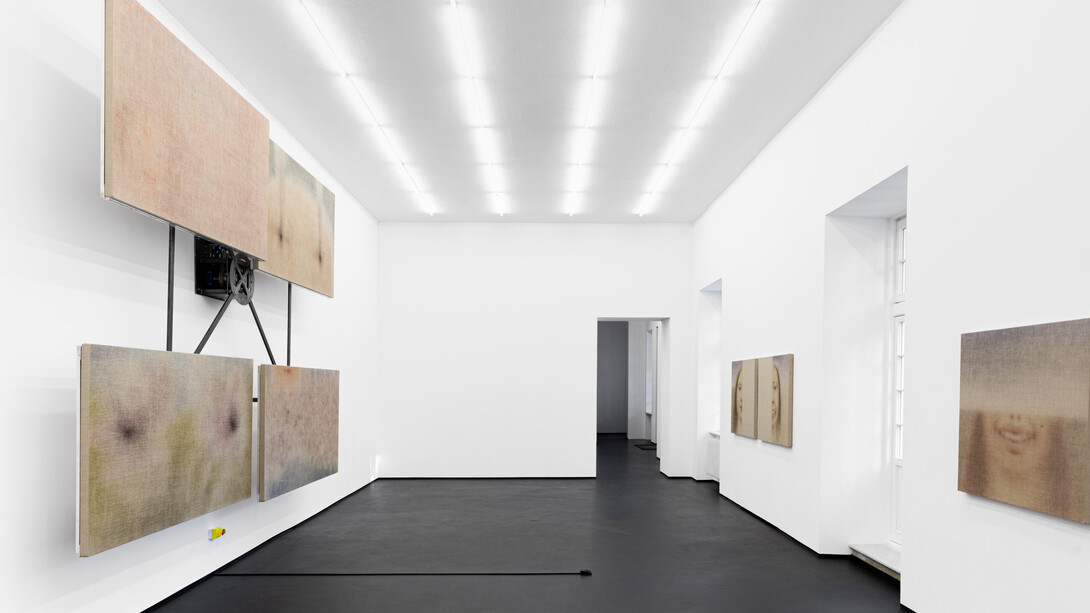
When observing a painting, particularly a figurative one, the eye tends to move between its formal elements (the “how”), its subject matter (the “what”), and its context (the “why”). Beyond these layers, however—perhaps without our awareness—we are also looking at a vehicle that captures, compresses, or even transcends us through time. Painting’s temporality (let’s call it the “when”) can be represented in the image itself, allow ing past, present, and implied futures to coexist on its surface. But perhaps more subtly, it can also be registered as a physical fact in the way the materials and medium age. The fading of pigment, the cracking of paint, scuffs on the edges, or the wear of the frame are unintentional, circumstantial traces that make the painting both an image of time and an object marked by its passage.
As an agent that binds time and space into a single, condensed field of meaning, painting can be observed as a chronotope. In this sense, the canvas is not merely a relic or a moment frozen in place, but a site where multiple tem poralities are held in suspension and activated through looking. For Jędrzej Bieńko (b. 2000, Warsaw), this activation and the recognition of painting’s temporality are fundamental aspects of his practice. Interested in how meaning is produced, he creates works that surprise and confound, presenting them in ways that challenge habitual modes of viewing. Drawing on personal experiences, life dynamics, emotional states, and imagination, he distills these sources into what he considers their most universally legible form. The resulting images remain deeply personal while becoming open to being anyone else’s. On the one hand, they feel universal while emerging from a very personal place; on the other, they appear timeless and perhaps antique, yet are often presented in a technocen tric, perhaps neoteric fashion.
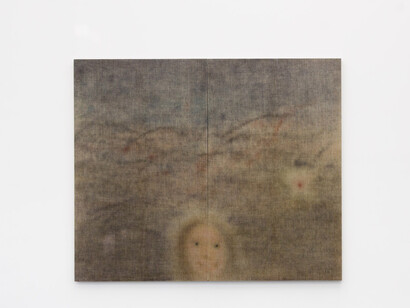
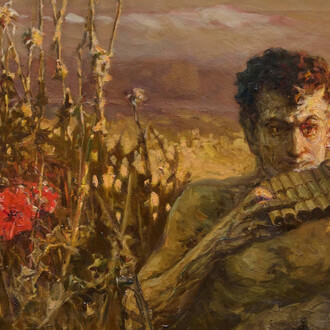
The idea of making the work feel archaic, however, does not mean that the images or materials produce a prop-like appeal of something old and timeworn. Instead, Bieńko employs a resolutely modern tool—the airbrush—to apply the thinnest spray of synthetic acrylic paint onto a raw, unprimed linen surface. The friction between these two disparate aesthetics produces a familiar yet uncanny object that seems to anticipate how something might look as it ages into the future, approaching or surpassing its Best Before date. Almost like a specula tive sci-fi artifact, the paintings embrace a “less is more” approach, keeping their imagery reduced and their reading deliberately open. This visual restraint offers a moment of rest and stillness, slowing down the act of looking and inviting introspection.
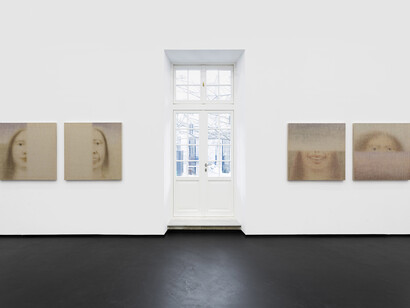
Frequently centered on the human face as the most universal symbol in figurative painting, the works evoke the atmosphere of Renaissance portraiture. Reinforced by chiaroscuro, which lends a three-dimensional, almost sculptural weight, and sharing its focus on idealized realism, the paintings invite the viewer to connect through a soulful, communicative gaze. Accentuated with brushstrokes, the eyes’ lifelike shimmer draws the viewer in, further turning the image into a site of reflection. This contemplative equilibrium is often quietly unsettled through repetition, obscurity, play with proportion or ratio, and the addition of other, potentially cryptic elements. These may include flowers, which offer a break from the focus on humanity and create an opportunity to consider nature and our place within it.
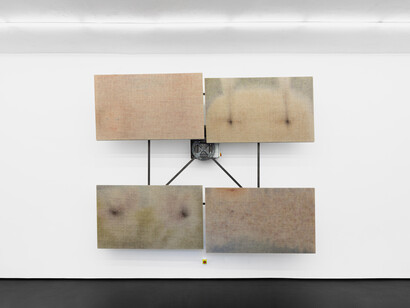
Although interested in pushing modern painting away from its established position, Bieńko remains firmly committed to the act of applying paint to canvas. He is dedicated to creating his own idiosyncratic work that is in conversation with the past while remaining, above all, contemporary. What remains negotiable is how we experience, think about, and relate to these works. Thus, going beyond the convergence of temporalities on the can vas’s surface, the presentations frequently incorporate an installation element as an essential component. Elaborating on the idea of painting’s temporality, Bieńko evokes the past through the appearance of the works, as well as through the large, counterclockwise-moving installation (Best Before 2, 3, 4, and 5, all 2026). The present is suggested through the depiction of a figure immersed in an unsettled moment, emphasized through the diptych format (Best Before 0, 2026), and together these mechanisms lay the groundwork for speculative projections of the future.
It is Bieńko’s background in architecture and his ongoing interest in our relationship with space that drive his fas cination with unshackling painting from its flat, square format mounted on a wall. Eager to enable it to communicate with the viewer, the surrounding space, and other works in new ways, the paintings are often presented away from the wall’s flatness. This idea culminates in a four piece moving cluster whose rotating system functions as a primitive algorithm, placing different visuals in dialogue and, in doing so, proposing new, partially generated images. This approach not only affects how the archaic-looking objects are observed, but also plays a significant role in shaping the relationship between subject matter and context. By present ing paintings within a kinetic installation, Bieńko shifts the idea of exhibition from a static showcase to a dynamic performance. Here, time becomes part of the work, directly conditioning what and how it is displayed, observed, and ultimately experienced.
(Text by Saša Bogojev)