English
 Español
 Français
 Deutsch
 Italiano
 Português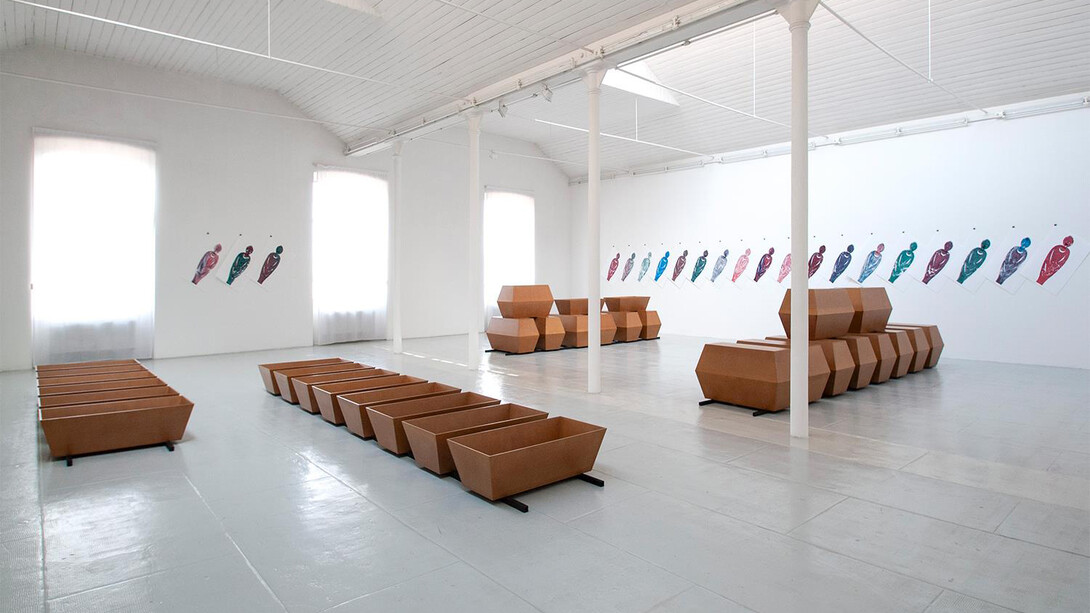
The exhibition by Thomas Schütte, opening at Galleria Tucci Russo in Torre Pellice on Saturday, June 6, from 4 pm to 7 pm, reveals itself to be of great and dramatic relevance today, despite having its roots in 1992. It demonstrates how the painful and devastating theme of conflict continues to tear through humanity, yesterday as today.
“Every morning I wake up and hear the news from around the world, then the day goes on. Art welcomes me but does not erase anything, and everything enters into dialogue, so I think about works created over time. Thomas Schütte’s 1992 exhibition, Untitled (coffins), is art and is what shows us that elevated thought is still possible,” reflects Lisa Tucci Russo, emphasizing how artistic action is never detached from reality, even if it is not limited to contingency and current events.
“I think about the beginning of the 1990s, with the Gulf War, the war in Yugoslavia, and I think about today… Hence the decision to present Untitled (coffins) again, with a different installation, in agreement with Thomas,” Lisa adds, revealing the origins of the exhibition, whose corrosive denunciation of the madness of war has lost none of its relevance or force.
The catalogue of Thomas Schütte’s 1992 exhibition included a text by Francesca Pasini entitled The inside-out glove of history, now republished with only a few additions by the author, who already at the time wrote: “Thomas Schütte starts from himself, from his own images, from his own language, in order to question the archetypal symbol of death. And, without expressionist drama, he provokes renewed attention toward this mystery. (…) Schütte seems to suggest the search for places of pause, eloquent spaces that allow us to continue reading, behind every death, a life. He creates them using historical and traditional signs, such as the sarcophagus and the mummy.” Yesterday as today, that vision is neither aseptic nor merely imaginative, but reveals a startling and unsettling realism.
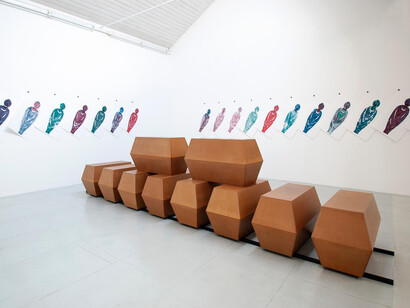
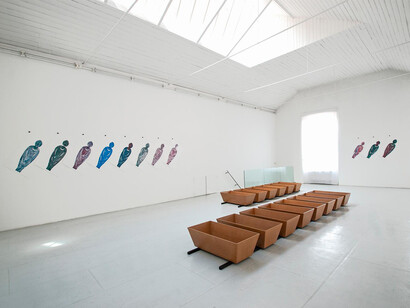
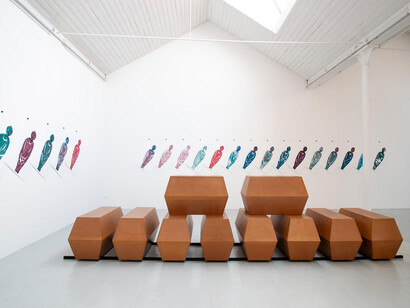
“These 50 sarcophagi, surmounted by sheets of paper bearing the drawing of a body wrapped in undefined bandages, which at first glance we associate with a mummy, acquire another interpretation. They become witnesses of reality. For Schütte, in fact, they also represent the thousands of anonymous deaths in Yugoslavia and point to the almost complete disappearance of mausoleums and funerary monuments through which death could find space within cities of the living,” adds Francesca Pasini, projecting that poetic and artistic message into harsh contemporary reality.
From all this emerge urgent, unavoidable questions: “We are in constant communication, but is that enough to put us into real contact with the other, with life, with death, with history? Or must we find another dimension so that this expansion can be perceived beyond the surface, in the depth of the skin?”
To grasp The inside-out glove of history may suggest a less distracted, less empty and less meaningless way of looking at the uncomfortable everyday reality that surrounds us.
(Text by Tonino Rivolo, L’eco del chisone, wednesday, june 3 2026, p. 3)