English
 Español
 Français
 Deutsch
 Italiano
 Português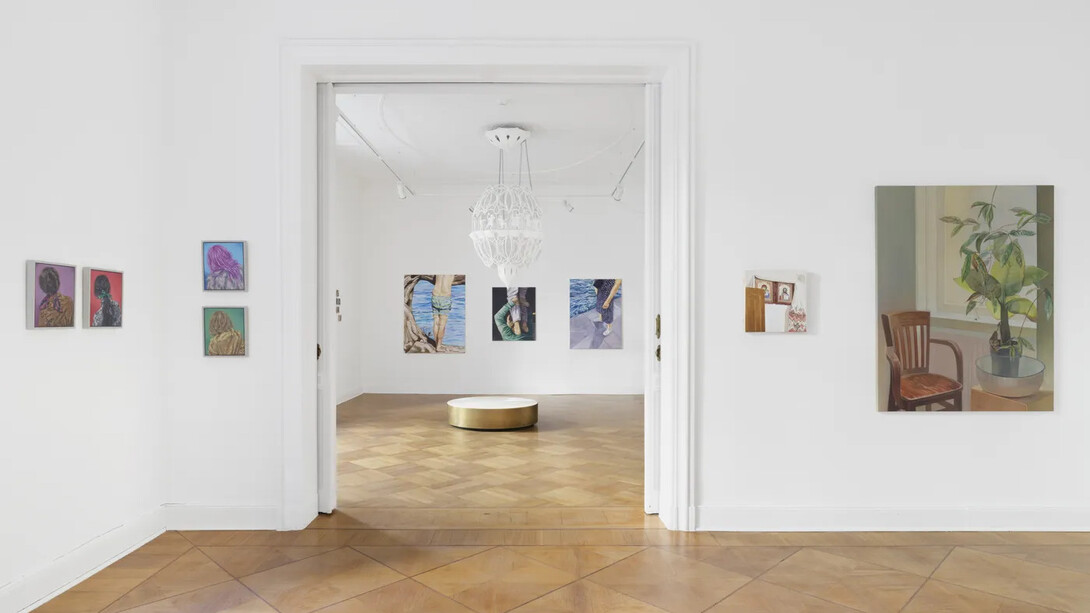
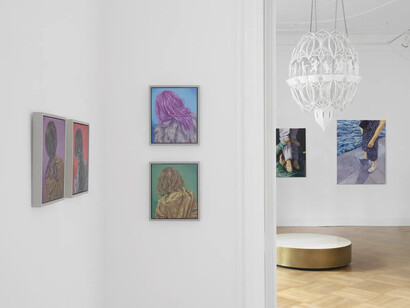
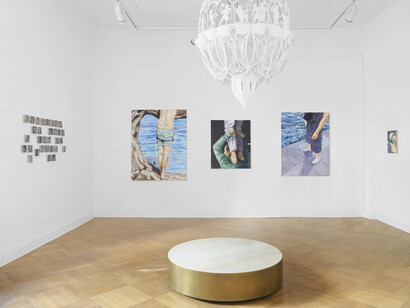
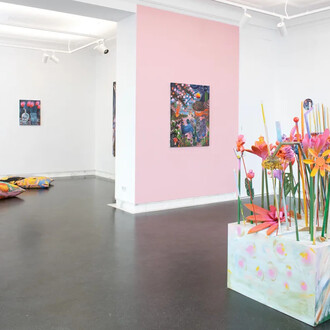
With the exhibition Popcorn and pickles, 69salon by Kornfeld presents four international female artists who engage in diverse and profound ways with the act of seeing and being seen in our image-saturated world.
The title deliberately plays with a contrast: "Popcorn" symbolizes the sweet allure of the mainstream and the spectacle of grand cinema, while "pickles" represent a different, more uncomfortable perspective—a cinema beyond Hollywood, perhaps one that is Eastern European, peripheral, and resistant. The works of Eugénie Didier, Roxana Halls, Christine Brey, and Viktoriia Oreshko navigate this very tension between attraction and irritation, proximity and distance.
Their paintings and drawings combine painterly precision with a captivating cinematic atmosphere. The works feel like scenes from films that are never fully narrated, thus opening a vast space for individual interpretation. At their core is a fundamental question: How does our gaze change in a world defined by the permanent visibility of social media and a new economy of attention?
The artists challenge conventional viewing habits and open up new perspectives by refusing to replicate the historically male-dominated gaze, instead reinventing the act of looking itself:
In the photorealistic works of Viktoriia Oreshko, everyday objects become silent bearers of memory and history. They speak for those who are absent, offering stability in times of turmoil without ever fully satisfying the viewer's voyeuristic gaze.
Eugénie Didier depicts bodies, but no faces. Her fragmented representations are a radical gesture in a visual culture dominated by selfies. Unlike the classical male gaze, which dissects the female body for sexualization, Didier’s fragmentation aims for universality and identification.
In her oil paintings, Roxana Halls stages precisely what the gaze desires, only to push it to the point of absurdity. From a queer perspective, she exposes the gaze as a construction, revealing gender for what it is: masquerade, performance, and repeated gesture.
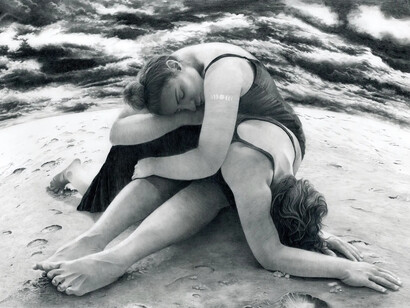
The atmospheric graphite drawings of Christine Brey create intimate scenes of great proximity, making the viewer part of an encounter. She inverts the hierarchies of the gaze, creating a genuinely feminine perspective that refuses consumptive voyeurism.
The result is an exhibition that not only shows images but takes looking itself as its subject. It asks what happens when women take the director’s chair and wield the brush. The answer lies in four powerful artistic positions that generate a participatory rather than a hierarchizing gaze, a look that touches instead of possesses.
![Various artists, [ materialistin ], exhibition view. Courtesy of Hamburger Bahnhof](/attachments/fd8f4fd76b73be0a02d398535c29d017e1309b65/store/fill/330/330/3f54331fd7869a13166dfe67a9e91306c6e180b2e29b9fd308d958b87ad2/Various-artists-materialistin-exhibition-view-Courtesy-of-Hamburger-Bahnhof.jpg)