English
 Español
 Français
 Deutsch
 Italiano
 Português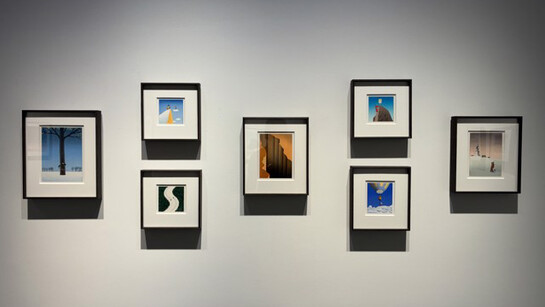
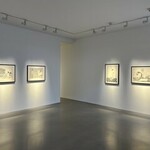
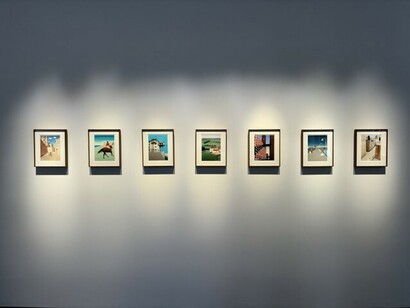
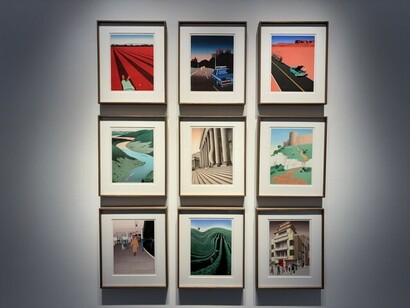
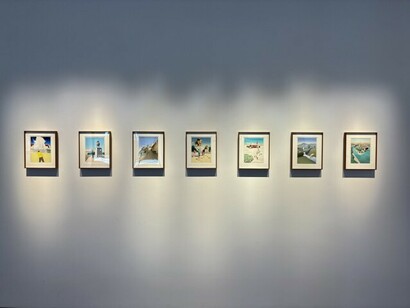
Philippe Labaune Gallery is pleased to present Quiet catastrophes, a comprehensive solo exhibition celebrating the work of acclaimed illustrator Guy Billout. The exhibition brings together original drawings and editorial works spanning Billout’s career, including a significant selection from his remarkably longstanding collaboration with The Atlantic Monthly. This collection highlights Billout’s decades- long influence on American and European editorial illustration, while simultaneously showcasing his craftmanship: the ability to use precise geometry, flat gradients, and the ligne claire (clear line) style to create a universe where disaster doesn't strike with a bang, but with a perfectly rendered, humorous and ironic silence.
Arriving in New York from Paris in 1969 with an obsession for the American idea and a desire to work in the world of illustration, Billout is credited with bringing a distinct, minimalist approach to the traditional mode of editorial work. Specifically, his use of precise geometry and serene atmospheres was novel, resulting in scenes that quickly captured the attention of art directors and publications like Time, New York Magazine, and The Atlantic Monthly. Central to his practice is his highly refined airbrushing technique, an exacting and notoriously difficult process that demands extraordinary control of tone, edge, and surface. Compositionally, his landscapes are not done in excess, but with crisp silhouettes and flat colors. Alongside his structural precision, Billout is a master of staging "quiet catastrophes," using the contrast of a peaceful setting and a surreal twist to upend expectations. Rather than depicting overt destruction, he introduces a single, physically impossible element into an otherwise mundane environment, forcing the viewer to reconsider their initial perception of the scene. Billout describes his approach as looking for a way to "derail that reality with a little pun."
The serene nature of his art is so distinct that the viewer is immediately drawn into his meticulously crafted universe. Relying heavily on free association, Billout understands the value of trusting the subconscious and embracing the "accidental." As an educator, Billout brings this unplanned method of creation into the classroom, advising his students to rely on spontaneity. Influenced by Jean-Michel Folon, Hergé, and 19th-century Japanese woodcut artists, Billout’s clean aesthetic captures the intrigue of the audience, drawing upon a fascination with spatial impossibility. There is no chaos in his catastrophes; instead, one feels the subtle twist if done well, he engrosses the viewer even as he breaks the basic rules of physics. This quality, as well as his ability to create captivating single-panel narratives, was highly utilized during his twenty-four years at The Atlantic Monthly, where he was granted a bi-monthly “carte blanche”. He was one of the only illustrators to have ever had such a longstanding, independent run at a major publication.
As Billout himself has noted, his goal is simply "finding a twist, a little detail that would change the reality of that picture," demonstrating an ability to combine a highly structural mind with a grounded sense of humor. Through his expansive portfolio, Billout explores themes of visual paradox, the absurdity of scale, and the disruption of the ordinary. The subtle cognitive dissonance his landscapes evoke elicits thoughtful, intellectual responses from his audience, contributing to the distinct narrative depth of his art.