English
 Español
 Français
 Deutsch
 Italiano
 Português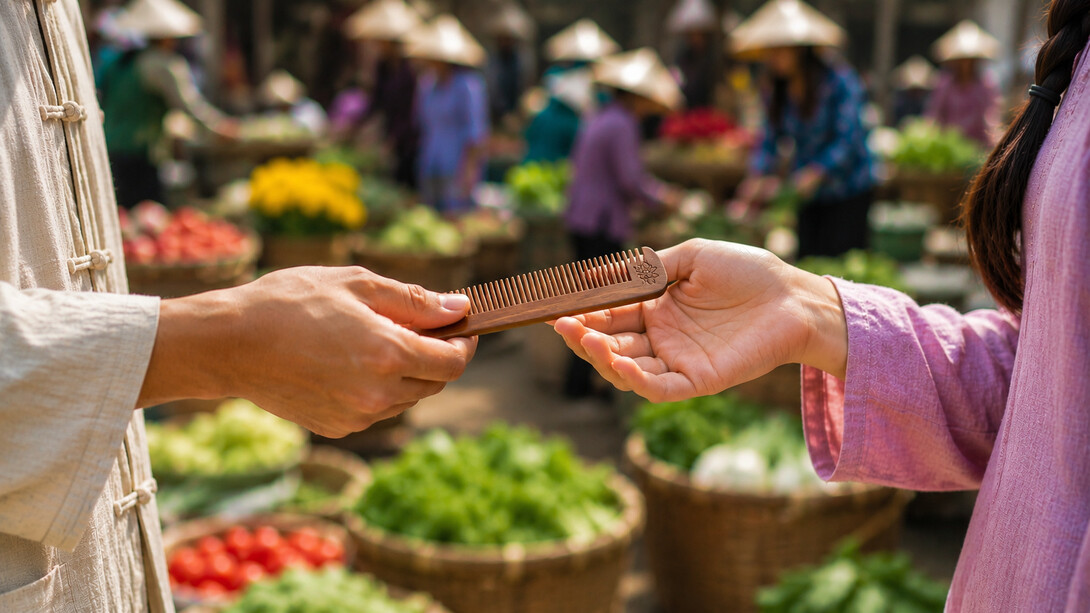
Memory is as slippery as the giant mottled eels of the Mekong Delta: hard to catch and even harder still to hold. We remake and rearrange our memories without noticing, filling the gaps with stories others tell us, stitching together what we lived with and what we longed for. Digging up the past is never simple. Old grief lies buried like silt at the bottom of a river; disturb it, and the water clouds again with pain.
My parents were originally from the small coastal village of Tân Thành, where its villagers lived by farming and fishing. Their house stood opposite the village market and beside a river that carried the scent of salt and mangrove. It was in this village market that my father first saw my mother. He was seventeen then, a young Hakka war refugee from southern China, carrying the weight of a lineage shaped by centuries of displacement. “Hakka” means “guest,” and perhaps that is the quiet tragedy of his life, that he remained a guest wherever he went, even in the country where he would marry, raise children, and eventually die.
He arrived in southern Vietnam alone, leaving behind his mother and younger sister, unaware that this new land was itself caught in a long, destructive struggle, first against French colonial rule, then against the gathering storm of civil war. Refugees often believe they are fleeing danger toward safety, but history sometimes has other plans.
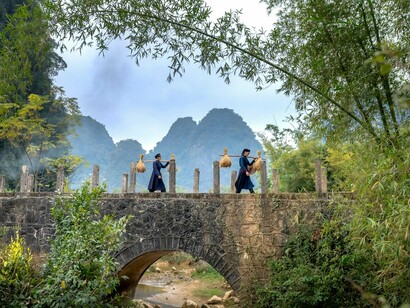
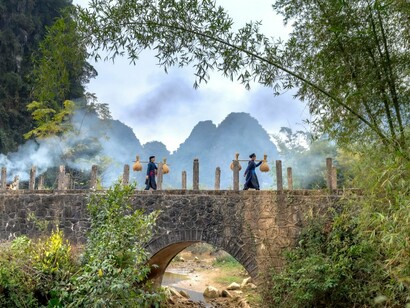
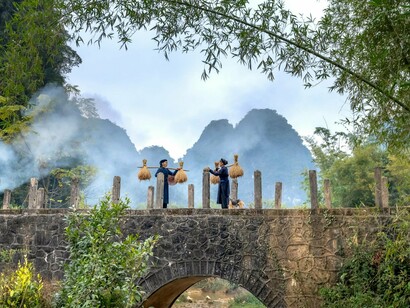
Initially, he worked as a waiter in a Chinese restaurant, saving every cent for his plan. He bought a small stock of everyday goods and walked from village to village with two baskets balanced on a bamboo pole, selling his wares cheaply to Vietnamese peasants. In a world where borders and identities were rigid, he carried his livelihood on his shoulders, step by step, across unfamiliar soil.
One morning, he arrived in Tân Thành and laid out his goods in front of the village market. In his broken Vietnamese, he called out to the villagers, praising the usefulness and low price of his items. His accent must have been comical, because he drew a crowd, among them my mother, then a sixteen-year-old girl named Mót. Her name meant “gleaning the leftover grain after harvest,” a humble name for the youngest of ten children, born into a life where nothing was wasted and everything was earned.
She came with a group of friends and stood watching the young Chinese peddler. She wanted to buy a mirror or a comb but had no money; like most girls then, she worked tirelessly on the family’s land without pay. Perhaps she laughed at his awkward sales pitch. Perhaps he noticed her smile. Whatever the reason, when the crowd dispersed, he quietly handed her a comb: a small, unexpected gift. Two shy young people, each carrying their own burdens, meet by chance in a marketplace.
After that day, my father returned regularly to the village. My mother worked harder before market day, so her family would allow her the morning off. They exchanged only a few words each time – nothing that could be called romantic in modern-day vocabulary, yet he always gave her a small present: a roll of thread, a sewing needle, something simple but chosen with thoughtful care.
But longing has its own calendar. Across cultures, people say time flies. The late Vietnamese poet, Thanh Nam, captured it beautifully: “Days are like leaves and months like clouds.”
Time, when one is waiting for someone, becomes weightless yet unbearably slow emotionally. And from The Book of Songs of old China, my father surely knew the ancient line: “A day without seeing you feels like three autumns”.
My father wanted to marry my mother. But an enormous barrier stood between them, as if they were two lovers on opposite banks of a river. He was Chinese, whereas she was Vietnamese. The thousand-year history of Chinese domination had become a core part of Vietnamese identity: a wound that shaped suspicion, pride, and the boundaries of the heart.
To prove his sincerity, my father settled permanently in Tân Thành, becoming the only Chinese resident in the village. He learnt Vietnamese quickly and became well-liked for his generous nature. Villagers advised him to ask a respected elder to speak to my mother’s parents on his behalf. They rejected him immediately, not because of his character or his means, but because of his ethnicity.
Yet my father did not give up. Persistence is its own form of faith. He continued to treat my mother with the respect due to a young, unmarried woman at the marketplace whenever she could come. His quiet dignity eventually softened her family’s resistance. When the elder returned a second time, her father relented, and the marriage was finally allowed.
After the wedding, my father used his savings to build a tiny house on the riverbank opposite the market. It served as both home and shop. With my mother’s warmth and his generosity—he always slipped a small gift into the customer’s hand—the shop soon became a beloved place in the village. People came not only to buy things but also to be greeted by my mother’s gentle words and my father’s bright smile.
But happiness, like the tide, never stays. It ebbs just when we begin to trust its presence.
In 1963, their peaceful life in Tân Thành came to an abrupt end. One night, the communist insurgency launched a surprise attack on their village. They used the houses along the riverbank, including theirs, as cover to shoot at the government military post across the water. During the fierce battle, the house caught fire and was burnt to ground. My parents fled with only the clothes on their backs, six children, the youngest just one, and my maternal grandmother.
Some memories do not fade. They become the architecture of who we are.