English
 Español
 Français
 Deutsch
 Italiano
 Português
Aya dreams of her father. She sees her father in her dream, or you know what?-- how about it’s not a dream this time around?– How about that? How about this?-- Aya lost her arm in the explosion, yeah, but her father didn’t die, no. He was blasted to shit, yeah, but he didn’t die, no. And then what happened was you see the marriage between Aya’s mother and father had actually been a little rocky before that point for all these reasons and reasons, and the house getting hit by a missile and their younger daughter losing an arm was exactly the thing that was going to really tip the shit– so here go Aya and Sara and Fatima, to Lebanon, and then Turkiye, and then the United States, and here is Aya’s father, after he eventually gets out of the hospital, staying right where he is.
“You can come to us,” Aya’s mother tells him, over the phone. “I want you to come to us,” she tells him. “But you have to let go.”
She doesn’t really mean it, of course. She doesn’t really want him to come to her, and she knows he won’t. Their daughter has already lost an arm because of him; she knows he won’t come, she doesn’t want him to come– he knows she doesn’t want him. “They’ll never let me come to you,” he says, which is true– there’s no airport that will let him fly– but what he’s really saying is that he can’t let go. He doesn’t even want to try to let go. He is the first little tear in a cotton shirt, and he wants to just keep ripping and ripping and ripping open until everything is bits and string. He thinks of himself like Batman, a little bit, but he doesn’t say that. “You don’t have to want me back,” he says, because there is a part of him that really is kind. “Please take care of our girls.”
What Aya’s mother, Fatim, does is tell her and her sister Sara that their father is dead. He died in the blast. But then Aya has all those dreams that she has, you know the dreams, and she has that breakdown that she has– you know the breakdown– or maybe it’s an awakening, or a reawakening, or a rebirth, or maybe you could say that she’s hatched– I like that– and off she goes, with the stars in her eyes, instead of her eyes, with the moonlight in her hand. Off she goes across the sea, maybe by sprouting wings, or sneaking onto an airplane– or maybe a boat– or maybe she folds herself into an envelope and mails herself to Europe and walks the rest of the way, or maybe she sends herself an email instead. Maybe she steps through the Veil, and then back again, somewhere else.
She makes it to Palestine, which is what she does, instead of getting dragged into one of her other misadventures– she makes it to Gaza. Never mind that all the Crossings are closed; maybe crossing the Veil is really the only way to do that, but if anyone can do that, she can do that, with her whole head italicized and line-broken the way it’s been. She can come strolling right on through, and that’s how she finds her father. Maybe she’s come here looking for him because she knows her mother lied to her, or maybe she’s just come here to save the world and she’s stumbled upon him because all she can ever seem to do is stumble– across the Veil instead of strolling, let’s really be honest with ourselves, and now here she is, stumbling into a room in a building and here he is– and here they are.
He’s relaxing here, her father, for a moment, here. He’s between things. He’s just sitting. Someone told me once that a man needs to spend at least twenty minutes a day going nowhere, doing nothing, and talking to no one, and I think it might have actually been Aldonza’s father who taught me that.
This is a tiny room. This is a dusty room. This might be a room down in one of the tunnels, come to think of it, instead of up in a building. Aldonza’s probably stumbled in here trying to get to someplace else or find something. Even if she’s come to Gaza looking for her father, she hasn’t at all expected to find him yet, so somehow, it’s embarrassing for her to succeed. She isn’t ready. She thinks about turning away, walking away back through the door, and coming back a little later. She thinks about making an appointment, maybe– does he take appointments?
What is he wearing? I don’t know– why do you care? I don’t know. This page cannot carry the weight of what I don’t know; it cannot bear the weight of what I don’t know. It rips through the paper and falls onto the floor. Here is how it rips through the paper: take a piece of your own paper and place it under the back-left leg of a dinner table or the back-left leg of a horse if you’re luckier. Not an old and bony one, but a real horse, a proper horse, you know the kind of horse. Put the paper under the hoof and hold it by the edges, and then what you have to do is try and use the paper to lift the horse-- you can lift the horse, can’t you?-- or the table. Don’t quit. Pull and pull and pull upwards on the sheet of paper until you’ve lifted the horse, and then you’ll see how everything I don’t know ends up on the floor. Try using a sheet of paper to stop a bullet, and you’ll see how the words just fall through it, and aren’t I just a fucker? What the fuck am I doing, trying to write about any of this? Let me go back to poems about the colors of my childhood bedroom, or the way the snow looks on the branches outside my window-- I know all about that. I don’t know shit about fathers and missiles and disappointment and culture-- fucking culture, man, what the fuck is that? Where the fuck is all that? Who’s in charge of that?
I can’t tell you about the color of the cloth on the table, or the color of the towel, or the pattern. I can’t tell you about the color of the scent in the air– it’s not unpleasant, actually; it’s only just heavy; it’s only just familiar– but I can’t tell you about it.
Aya’s father is wearing whatever they fucking wear, eating whatever they fucking eat. When Aya finds him, he's listening to whatever the fuck they fucking listen to in this neighborhood, which is different from that neighborhood, which is different from that neighborhood but from an older generation, which is different from this neighborhood, but the family makes more money, which is different from this neighborhood, but the family's dad is a fisherman, which is different from this neighborhood, but the family is a bit more religious than the others here– and you take all these different people and you put them all down into the tunnels together and then what all will they be like? Whatever the fuck-- I don't know.
Maybe this isn’t even her father– I don’t know. But he has the same face that Aya has been dreaming of, that’s the same face, and maybe someone else has gone and painted it onto his skull, or not– I don’t know. And look at that little photograph that he has on that little table; there’s a baby picture of Sara– not Aya, in that picture, but she knows her sister’s face well enough– she’s seen baby-pictures of Sara, before, and she’s seen Sara, before, plenty of times– and here’s a picture of Sara in this man’s arms. Smiling. Sara is just starting off into the distance, past the edge of Creation– but the man is smiling. And there is another photograph– there’s Aya, there she is. She knows herself. There she is, with both her arms, and both her hands are reaching for this man’s face, and all ten of her little bean-fingers are squishing his bean-nose– that’s her, and that’s him.
Here is a photo of Sara, Aya, and their mother from just a few years ago, all standing together in the living room on Eid. Look at how happy they are. Look at the beautiful clothes they are all wearing. How did he get this photo? How did Aya’s mother ever get this photo to him? Why did she do that? Aya hates, right now, that she did that.
Here is a man in a dusty little room under the ground with photos of his daughters and a woman who was his wife, and here are the other things in this dusty little room: -A small chest of drawers– quite small– filled with clothes and things. -A mini-fridge. -A laptop. -A cot, beige, not a bed. Not many blankets. -A calendar. Flowers. A different kind of flower for every month. This month is Peonies. It’s lovely. Each day has a little check-mark in it– not being crossed off, but being checked off, like “Alright, I’ve woken up today”. -A CD player from 1995. A few CDs, still with their original jewel-cases, cracked and faded and scrawled on in thick black marker, thick Arabic letters that you can’t really read, but at least you can tell the difference between one case and another with those. -Crumbs– too many crumbs. -Dust– too much dust. -A rifle, leaning up against the side of the little table, where the photographs are. -A pistol in its holster, on the little table, where the photographs are.
There are a hundred other objects that mean things to people, that a real human person might know about and notice, or even just someone who’s learned something, but my eyes go straight to the guns on the little table, and they stick there. There is a blue stain on one of the off-blue walls behind the little table– spilled soap, it might be. There is a bare bulb lodged like a tooth in the concrete ceiling; the light isn’t flickering, but it feels like it’s flickering, or it feels like it should be flickering– that kind of light. The light isn’t warm or cold– neither– and isn’t that odd? Find me a light that really isn’t either– really, truly isn’t one or the other. Really, truly, right on that line. Maybe this is a dream after all.
Aya says to her father, “You’ve got two guns on the little table where you’re keeping all the photos of us.”
He is misshapen; he has been misshapen. Aya can see the chunks missing from his face, neck, and chest, like melon scoops. Here are the spots where his father and his sister have been carved out of him. Aya’s grandfather? Her aunt? Maybe– she has never met them; they were cavities in this man when she wasn’t even born yet.
She can recognize the pit of her left shoulder in his stomach. She begins to recite Nassar Rabah poetry for him, which is what people do– it’s just what they do. “You’re the one who sat my heart on your knees the day it was a bird,” she says.
“I knew you were a soldier the day I was born, but why did you carry me like a rifle?"
Here is a story about Aya, and her father never died, actually, that’s just what her mother said, and he’s alive somewhere, and he’s just like some guy you know? Like no, not just some guy like he’s nobody and doing nothing, he’s fighting is what he’s doing, but he’s still just some guy-- he’s not like the general or the commander or a great killer, he’s just a brick, and maybe he’s a part of something that someone is building, or maybe he’s in a sack and getting smashed down over somebody’s head, or something, or something. Maybe he’s part of the street, and he’s getting walked on. Aya goes and finds him. Says a bunch of stuff. “Yeah, well,” he says back. “Yeah,” he says. Aya imagines the conversations before marriage– her mother’s words tracing like fingertips across her father’s heart, trying to find his lumps and bruised bones; what can he do? What can she rely on him to do? What is he strong enough to carry? Where is he crumbling? Aya imagines the nights and mornings after marriage, her mother’s fingertips like words across her father’s skin, feeling the marks from shrapnel and old burns– do you know what those feel like? Fingertips like questions– “Do you know me?”-- “Do I know you?”-- “Do you love me?”-- “Have you let go?”-- “Will you really stay?”-- “Can you ever let go?”-- “Are you just staying because you love me?”-- and what a strange question to worry about, isn’t it? Why shouldn’t a person stay for just that?
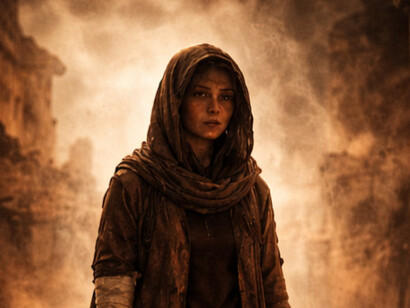
Alright, alright, fine, here’s a story of it for you, here’s what’s going on: Aya has come to Gaza as Carcayona, tapada and all, to try to save the world, and she doesn’t have any special powers or anything. She isn’t able to strike with lightning or fire, and she isn’t able to fly– she came around the other way, long, she walked across the Bering Strait and shuffled through Asia to come here– and she isn’t able to stop bullets with her skull, like some girls, or even with her fingers. The story of it is that she put out her right hand between a gun and a child’s ribs to try and stop a bullet, and now she has no fingers on her right hand. She’s got bandages, and isn’t that funny? Here’s the joke, we can laugh together: she’s come all this way to Gaza to try and save the world, and all she’s saved is nobody, and all she’s done is add just another person to the list of people who need saving, and used up a whole bunch of bandages while she’s at it. There aren’t enough bandages– nowhere– nobody has enough bandages. Do you know how many bandages it takes to treat burns on a child?-- and here she is getting her fingers shot off.
In this story, Aya has come down into these tunnels to try to find a fighter– not her father, a different fighter– whose son is dying from a full-body burn that nobody has bandages for, and the radio is out, and the internet is out, and so the man has no idea, and his wife wants him to come up and say goodbye to their child while he still can, and so Aya has come down looking for him. These are the kinds of problems that she can solve instead of bullets and tanks and water. She’s been searching and searching down here, and it’s only by complete accident that she’s come stumbling through this door, and her father is staring at her, and she is staring at him, and isn’t it embarrassing?-- it really is. It is like she has come in on him naked, is what it is like. He is not supposed to be alive. He is not supposed to be here. He is not supposed to be doing this. Why couldn’t he ever just let go?
For us? Why couldn’t you just let go? Wasn’t it enough that you had us? You could have just let go and been with us. Why didn’t you just want to be with us? And what about you? Why are you here now? What are you doing here, in this place? Why did you come here? You could have let go. You could have stayed home. You could have stayed quiet, even, and then imagined all the ways that life could be. Why aren’t you writing a book report? Why aren’t you studying for college? Why do I have to be the one to let go? Because you are my father and I am your daughter, and rocks roll downhill, you should let go of the whole world for me. Rocks don’t roll downhill when the world is sideways. That’s a stupid, ridiculous thing to say. Rocks roll uphill when the world is sideways; picture it; do the geometry in your head. Stop it. You’re just saying stupid things because you don’t really want to talk.
Of course, I want to talk. Listen to what I’m actually saying. You can’t let go when the world is sideways, or else you’ll just fall and fall and fall forever and never hit bottom because there’s no such thing as bottom in a sideways world. Wouldn’t you eventually hit like a tree or a building or something? Of course I want to talk– I haven’t seen you since you were small enough to fit in my mini-fridge– of course I want to talk. I want to hear everything about your life. I want to hear everything about your sister’s life. I want to hear everything about your mother’s life. And what about you? What about me? Do you want to tell me everything about your life, here?-- all of this that you couldn’t let go of? You’re talking like a jealous wife.
You’re talking like you’ve just been caught fucking the maid. What the hell do you think you’re doing, going on like that? Who the hell taught you to talk like that? How the hell old do you think you are, talking like that? How old am I?-Dodo, you even know how old I am? I don’t care how old you are, who the hell taught you to talk like that? Well, it wasn’t you. Obviously, it wasn’t me! Obviously!-- do you want me to go through a list of all the parts of my life you’ve missed? No, I’ve seen this movie before. All the birthdays and graduations? You haven’t even left high school, have you? What graduations have I missed? Maybe I’m married, and you missed my wedding, you don’t know! Are you married? Are you?-- do you have some other children with some new wife? Do you keep their photographs on a different table, without any guns on it?
“Do you know where I can find ‘Ali Hassan’?” asks Aya, in an apologetic tone of voice. “Sorry,” she says, for some reason, and then she says it again– “‘Ali Hassan’– I’m looking for ‘Ali Hassan’.” Who is this man here? His face looks so familiar. His face looks so much like her own face, doesn’t it?-- doesn’t it? She blinks. She does her best to just keep her eyes on the man’s face, not to look around his dusty little room– it would be rude to just come stumbling in some stranger’s door like this and then start glancing around his little room while you’re talking to him.
“I don’t– who is ‘Ali Hassan’?” the man asks. He asks like they are just two people here in this room, just talking to each other. Isn’t that what they are? “I don’t know any ‘Ali Hassan’.”
“‘Ali Hassan,” Aya repeats. It sounds a bit like a made-up name, doesn’t it? She is feeling a bit strange saying it, over and over– it really does sound like a name that somebody would just make up in a hurry. “His son,” she starts to say, and then she stops. She shakes her head. “Sorry,” she says, one last time, and she backs out of the door to the little room, and she closes it gently behind herself. What a stupid idea she’s had in her head, thinking that everyone down here would just know each other and where everybody is, where to find everybody. She feels like an idiot– she feels so stupid for thinking that she could find what she is looking for by just looking in dusty little rooms, somewhere, and asking.
Why couldn’t you just let go? Do you have even the first idea what I’ve been through?-- even the first idea of what I’ve lost? And you went and chose to have a wife– you went and chose to have two daughters. You chose that. And I would choose it again. You are so beautiful. You look so much like your mother. I am so proud of you. What was wrong with me? Please just tell me what was wrong with me; why wasn’t I worth letting go for? What? Was it because of my arm? What are you talking about? How could you ever say a thing like that? Was it because of my arm?-- Was that why you couldn’t let go of me? Because I was misshapen?-- because I had been misshaped? Do you think I blame myself for that? I don’t think you blame yourself for anything; that’s what’s wrong with you. You don’t have the first idea of what I went through– not even the first idea. You don’t have the first idea of what I’m going through. You just don’t understand.
She feels so embarrassed; this has been so embarrassing.