English
 Español
 Français
 Deutsch
 Italiano
 Português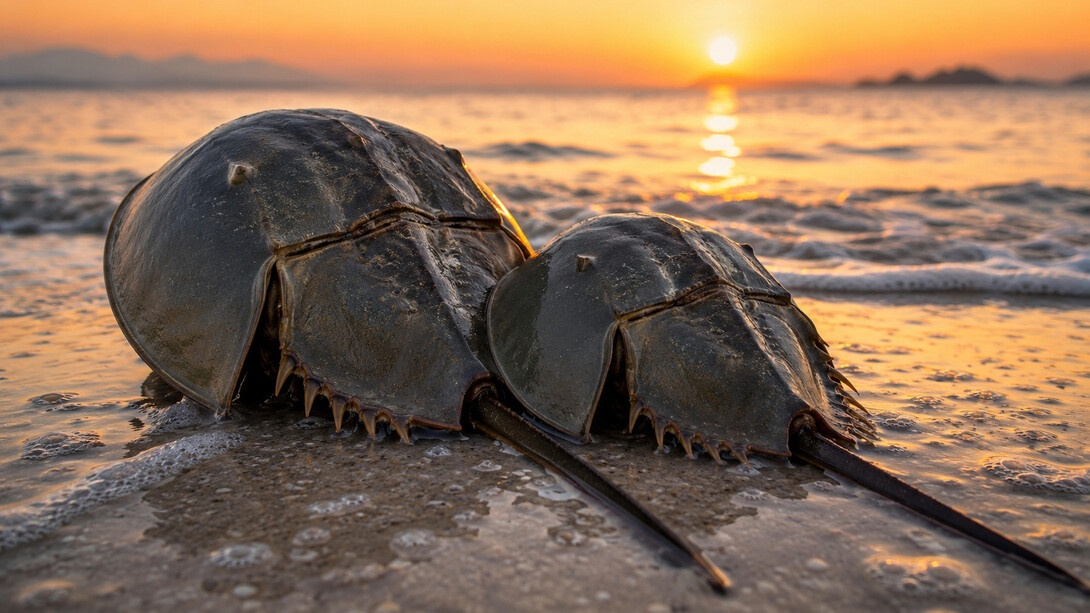
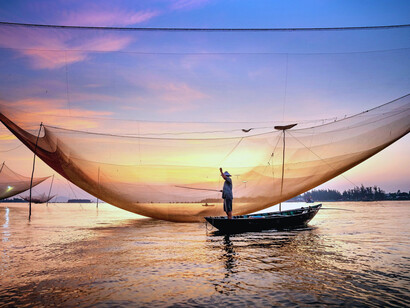
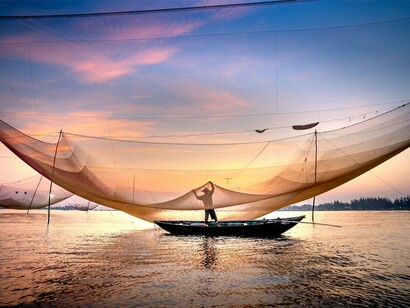
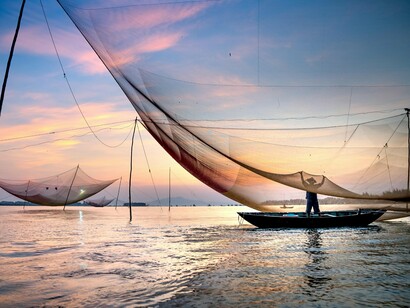
My family was originally from Tân Thành, a fishing village. Due to the war, we were uprooted to settle into the provincial town, Gò Công, just 15 kilometres inland.
In 1978, I started my tertiary education. During one summer break, I returned to the old village to visit my elder brother. He then introduced me to Tiến, a fisherman whose life was woven into the sea’s rhythms. Tiến reminded me of Hemingway’s old man not because of age, but because of that quiet, stubborn dignity that comes from wrestling with forces larger than oneself.
On that visit, by chance, Tiến had caught a female horseshoe crab. His wife, a skilled country cook, turned the sea creature into a delicious salad.
He said, eyes bright with mischief:
“The female was caught alone without a male clinging to her back. Very unusual. Maybe the strong waves tore them apart. The male horseshoe crab is half the size of the female. Did you hear the saying ‘clinging like horseshoe crabs?’”
I shook my head.
Seeing the puzzlement on my face, Tiến explained:
“Fishermen never keep lone male horseshoe crabs. Usually, we would release them back into the water; hopefully, they would find their lost partners. Keeping them would bring bad luck. ”
In the logic of fishermen, superstition and wisdom often blur. What they call luck is sometimes simply an instinctive respect for the unseen order of things. And the idea that harmony is fragile and that separation of a pair, even of creatures, invites imbalance of yin and yang.
Tiến interrupted my thoughts:
“Have you ever seen a female horseshoe crab?”
“What an ugly creature,” I exclaimed.
“But before having that form, it was a beautiful lady.
Tiến gave me a wink and then proceeded to tell me a Vietnamese folktale about the origin of horseshoe crabs. A fisherman lost at sea. His devoted wife never gave up but kept looking for him along the coast. Buddha was moved by her love and gave her a magical stone to keep in her mouth; its power would help them fly across the sea to return home. In her joy at finding him, she opened her mouth to speak to him. Unfortunately, the stone fell off, and the couple fell into the water, transformed into a pair of horseshoe crabs forever clinging to each other. A tragic ending, yet also a kind of eternal union.
Not long after that meal, I left Vietnam. After nearly a year in refugee camps, I resettled in Melbourne, Australia. In this vast new land, I have never again tasted that special salad. But the image of the horseshoe crabs and their tale of clinging has followed me across oceans.
Fast forward, when my children were young, we took long road trips every summer. One journey brought us to a small town in the Australian outback, a place so remote Australians simply call it “the middle of nowhere.” The motel pool was filled with steaming water from underground springs. After a long day of driving, I sat by the pool, letting the heat loosen the knots of the road.
Across from me sat a man, weary and anxious. We exchanged a nod, then drifted into conversation about weather, sports, politics, etc.—the small talk that allows strangers to circle slowly toward something more substantial and serious.
Eventually, he revealed, “I’m a businessman. My ex-wife and two children live interstate. The oldest son will graduate tomorrow. I’m driving home to attend it. Honestly, I’m exhausted from the long drive.”
“Why don’t you work closer to home?” I curiously asked.
“That’s the tragedy I brought on myself,” he shook his head.
He told me of the young secretary he had married, the child in kindergarten, and the fatigue of repeating a life he had already lived once. He sighed.
“I’m just over forty. Do I look older?”
I didn’t answer. His weariness was answer enough.
“I wish I hadn’t gone to this state for work,” he said quietly. “I wish I’d stayed in my old city with my family.”
I saw the image of the horseshoe crabs again – creatures bound by instinct, yet humans are often bound by desire, regret, and the consequences of our own choices. We cling, we let go, we drift, we return. Fate is not always imposed, but sometimes it is simply the sum of our decisions.
I hesitated to judge him. Life is rarely that simple. People lose their way not because they are wicked, but because they are human.
I wanted to pat him on his back to console him, but there was a distance between us. I said gently:
“I believe that if you recognise a mistake, it is never too late to turn back.”