English
 Español
 Français
 Deutsch
 Italiano
 Português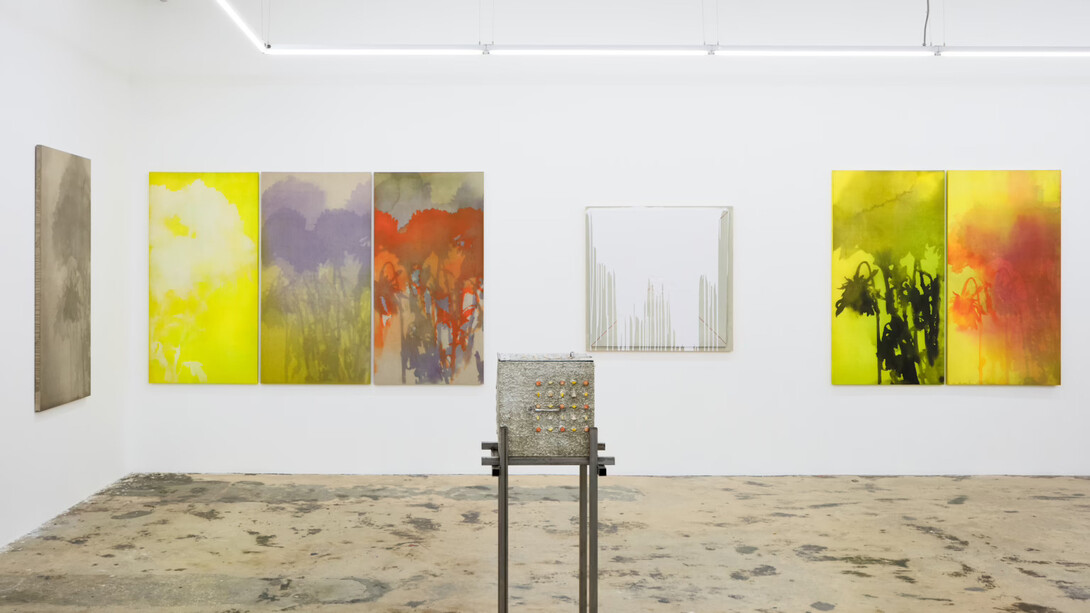
Nina Johnson is pleased to present Good dog, Seth Cameron’s fourth exhibition with the gallery.
Over the past decade, Cameron’s exhibitions have placed painting and narrative in generative friction. For Good dog, he extends that structure, bringing together three distinct bodies of painting, an artist book, and a selection of works by The perfect nothing catalog, each operating at a different order of scale. In interweaving these bodies of work, Good dog dwells on the ways we are formed within forces beyond our measure.
The stranger (Chrysanthemums)
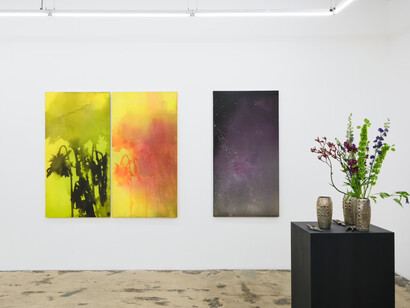
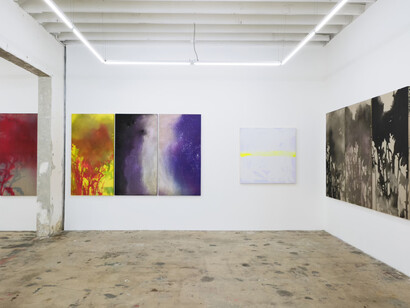
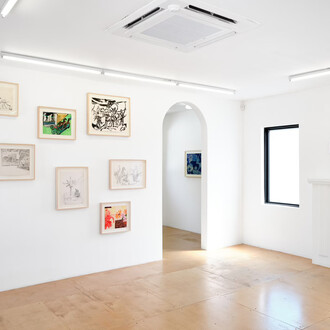
Cameron’s ongoing series The stranger (Chrysanthemums) takes its title from Camus’s landmark novel of mourning and detachment and draws on traditions of literati painting, where image and language share a common field of apprehension. In sumi ink on linen, shadows of the funerary flower appear at different scales, as if cast by distinct light sources. Set against natural linen or intense yellow grounds, in shades of black, magenta, and cyan, the shadows shift in position, opacity, and focus from canvas to canvas: the only constant, the absent flower.
Good dog
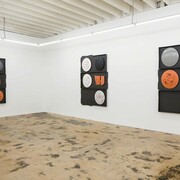
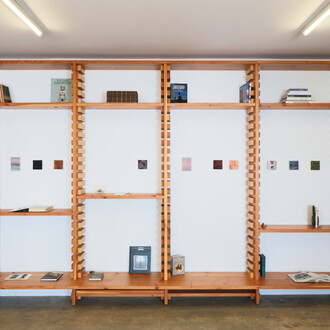
The four paintings titled Good dog mark a formal break within the exhibition. Square and flush-mounted, their surfaces are secured visibly with screws and organized through pre-determined procedures. The language of process-based abstraction approaches an almost bureaucratic impersonality. If the other bodies of work position the viewer as observer, these insist on contact: the traced arc of a thumb, the touch of fingertips, the weight of an absent body held against the surface.
Stars
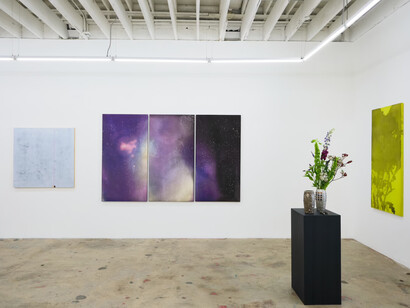
In the gallery, Stars interrupt The stranger, reversing the relation of figure and ground. Resist and alcohol dispersal work across dyed and bleached linen; constellations emerge. Each panel presents a bounded fragment of an implied expanse. Continuities of constellation patterns and color fields carry across panels, while shifts in opacity and hue assert the earthbound point of view, infinity held in suspension.
Good dog (book)
Good dog, the artist book, situates the exhibition within Cameron’s broader practice, in which painting and narrative have long operated in relation to one another. Composed through juxtaposition rather than plot, it assembles historical fact, scientific description, institutional procedure, weather reports, and accounts of the artist’s mother without commentary or hierarchy. An eye operation, a hurricane, a prison corridor, a kennel, a pop singer’s dismissal from a donut shop: each statement stands complete and unadorned. Though the book appears expansive in subject matter, it is narrowly conceived. The account of the artist’s mother functions as a veiled form of autobiography, held in tension with the wider systems of discipline, labor, and inheritance that surround it.
Frank Traynor and The perfect nothing catalog
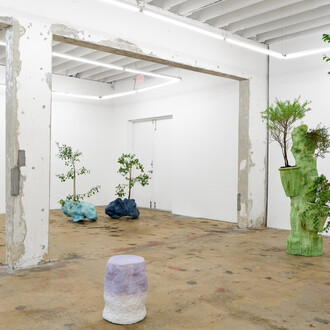
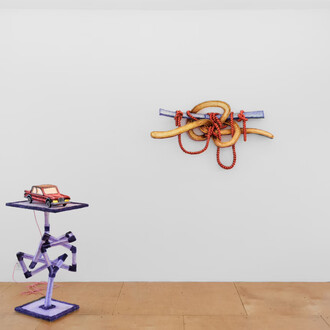
Frank Traynor’s sculptural works bring Good dog’s attention to obedience and structure into the everyday handling of ordinary objects. Presented here are five tabletop vases, three freestanding vases, and five sets of clippers drawn from Traynor’s long-running project The perfect nothing catalog, begun in 2012.
Fabricated in hand-shaped metal and stone, the works are brazed in a mixture of tin and silver—what Traynor calls astrakhan tin—with found and semi-precious stones set throughout. These sculptures suspend functional objects between use and preservation, making maintenance visible as form and orienting the exhibition’s concerns to the scale of handling, repetition, and care.