English
 Español
 Français
 Deutsch
 Italiano
 Português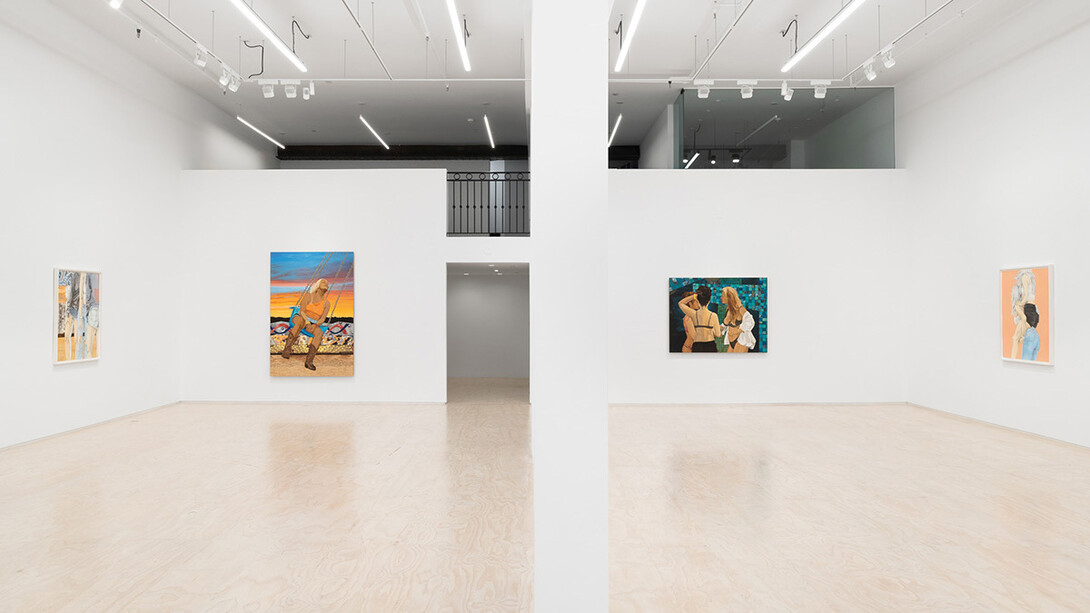
Jessica Silverman is pleased to present I’ll be your mirror, Alison Elizabeth Taylor’s first solo exhibition on the West Coast, running from April 24 to May 30, 2026. Featuring new wood inlay paintings and multimedia works on paper, the exhibition explores young women’s social worlds, particularly moments when performance and vulnerability collide. In these works, Taylor captures buoyant, charged atmospheres—fleeting instances of laughter and liberation.
Taylor is a virtuoso with wood. Adapting marquetry techniques, she expands the traditions of wood veneer inlay by combining it with oil painting and collaged materials such as vibrantly pigmented sawdust to create a unique hybrid art form. She first began experimenting with cut wood while studying painting at Columbia University, New York. In 2009, she received a Smithsonian Artist Research Fellowship, which enabled her to investigate the rich history of marquetry.
Wood inlay appears in ancient Egyptian architecture and Renaissance cathedrals. In the 17th and 18th centuries, marquetry flourished in France, becoming closely associated with the luxury of the decorative arts and elite European interiors. Despite its long history, it has rarely been used to depict human forms. In this new body of work, Taylor explores various species of wood— selected for their texture, color, and grain—to render figures’ skin and hair, building up complex surfaces from dozens of fragments of individually cut veneer.
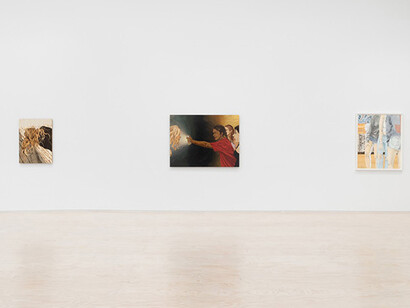
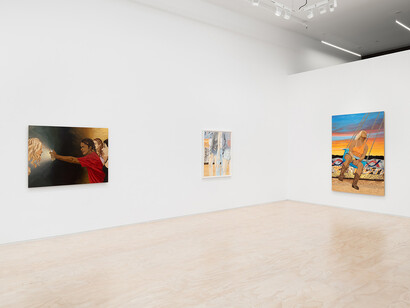
A glowing iPhone shines like a divine apparition into a young woman’s face in OMG (2026). Moody and atmospheric, the work reminds of Rembrandt’s dramatic use of light and shadow. In the foreground, four figures are made entirely of cut veneer. Walnut, beech, oak, holly, tamo ash, and movingui are among twenty-two kinds of wood that form the blond and surprised features of the face encountering the screen. Across from her, the woman thrusting the phone that divulges the epiphany is draped in a red, painted wood T-shirt. The composition is reminiscent of art-historical scenes of revelation, where Greek gods or Christian angels act as messengers.
Cascading locks are the focus of Untangled (2026), a masterful collage of curvaceous wood against abstract planes. The wallwork pays homage to monochrome, composed of countless shades of brown marked by the sinuous patterns of wood grain and Taylor’s intricate cuts, suggesting a Pop or meta version of Cy Twombly's scrawling compositions. The upper portion features a fictional veneer that Taylor made by abstracting and digitally manipulating real wood veneer. Produced as a pigment print, she also incorporates these elements into her works on paper.
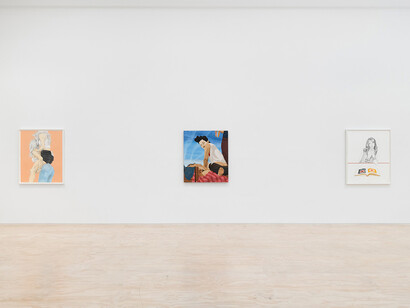
Drawing is the starting point for each one of Taylor’s work. The exhibition includes four largescale graphite and gouache collages. Grahamsville fair (2026), for example, is a tightly cropped image of three feminine bodies from the shoulders down. Torsos and legs dominate the image, where tonal graphite shading and muted shades of gouache render faded denim and flesh. Collaged strips of printed wood grain and signage make up the fragmented background, creating a subtly affecting scene that feels both observed and invented. As in many works in the exhibition, unconventional framing evokes an uneasy relationship with the standards of selfie-driven visual culture.
Throughout I’ll be your mirror, Taylor positions contemporary experience within a broader history of representation, reworking wood inlay to petrify characters in the present. Her works question the distinction between intimacy and exposure—revealing adolescence and young adulthood as both a site of freedom and a moment shaped by social and political forces beyond one’s control.