English
 Español
 Français
 Deutsch
 Italiano
 Português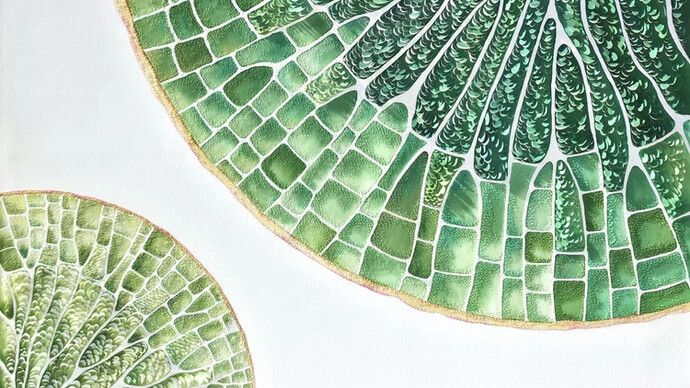
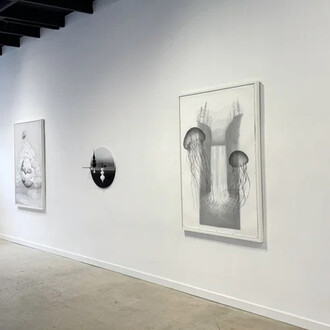
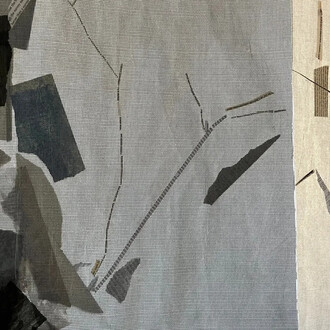
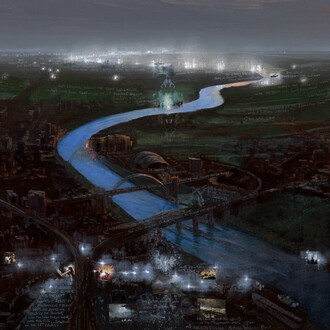
Tint is pleased to announce Worlds apart, featuring new works by Lis Costa and Vero Reato. This marks both artists’ second time exhibiting at Tint. In their new works, nature once again takes center stage, with a new emphasis on micro/macro elements appearing together within individual works. Though their materials, paper and concrete, may seem worlds apart, both artists’ study of nature moves between terrestrial and aquatic worlds, seamlessly shifting in scale. What appears microscopic opens into the vast, and what feels cosmic contracts into intimate detail.
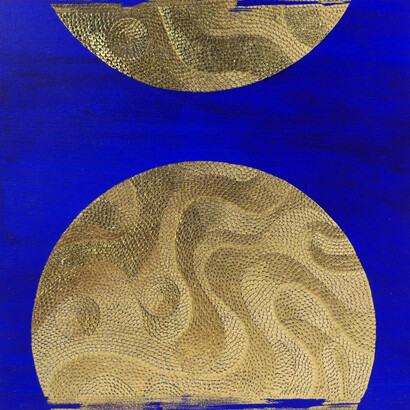
Taking inspiration from her native Brazil, Lis Costa delves deeper into her exploration of color in her new body of work. From vibrant greens to bright pink varietals, to densely packed blues, Costa brings the Amazon to life. Her works draw inspiration from flowers to canyons, from rivers to coral. Land and water converge in her piece “Amazonia”: a forest of trees with a fluid river running through it.
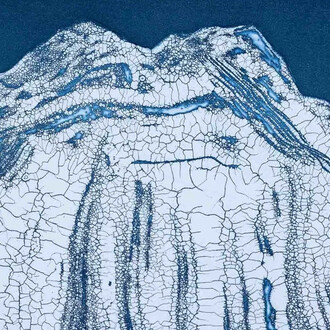
Costa’s piece Vitoria regia II exemplifies the micro and macro coexisting within a single work. The Vitoria Regia is a massive Amazonian water lily known for its giant floating leaves and night-blooming, color-changing flowers. Costa’s composition suggests both close observation and vast distance: petals seen under magnification, then expanding outward into planetary fields. Costa’s works flow like water, bloom in color, and capture the heart of the Amazon.
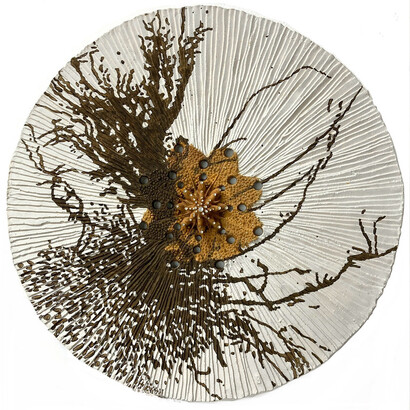
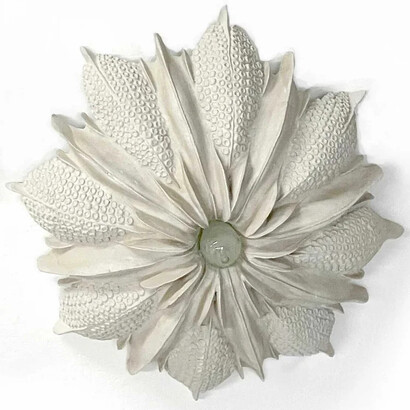
Vero Reato similarly moves between land and aquatic worlds; her works evoke coral, sea urchins, flowers, pollen, life on a cellular level. In her new series, Coeur de Méduse, Reato presents modular works, designed to be arranged in any configuration. At the center of each piece sits a luminous glass bead. While the concrete flowers feel very much grounded in land, the phosphorescent glass center recalls marine life, combining the two realms in one piece.
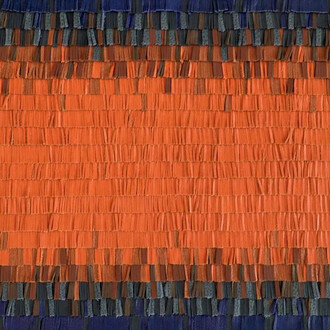
Reato’s works also shift between the macro and micro. Her Plisado pieces feel like looking at a cell one minute, and the next, an entire organic ecosystem. These two are worlds apart, appearing in the same work.
Across both practices, scale becomes fluid. Though materially distinct, Costa and Reato’s works meet in this oscillation—where nature is not represented as a fixed subject, but experienced as something alive, continually shifting between inner and outer worlds.