English
 Español
 Français
 Deutsch
 Italiano
 Português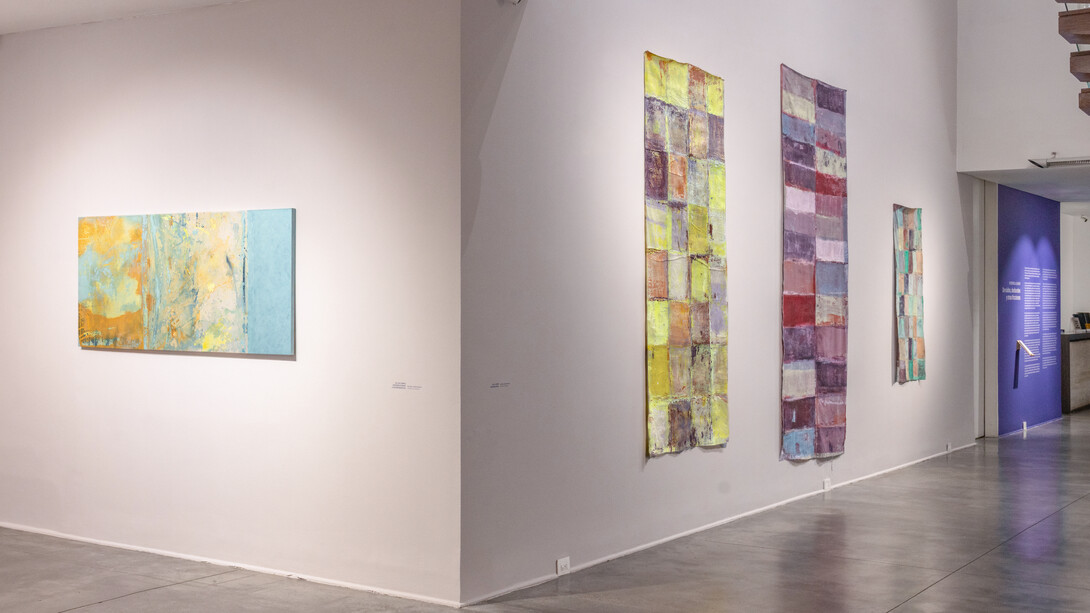
There is something in painting that almost always remains out of sight: what falls, what is left over, what does not fit within the stretcher. In the practice of Verónica Lehner (Cali, Colombia, 1980), these conditions are the starting point for her material inquiry, and they have been guiding her for more than a decade.
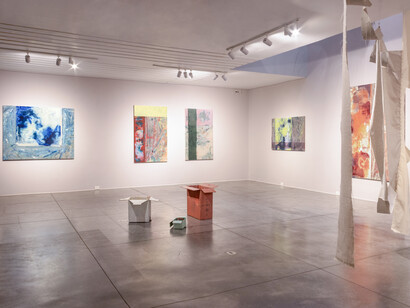
Painting, in its most conventional form, draws a clear boundary between what happens inside the stretcher and what remains outside. The process erases the process, and the surface closes in on itself. Lehner's practice moves in the opposite direction: the surface is also index, a physical record of what produced it. In the series Superficies múltiples and Intersecciones, she developed a method of double image -one part worked directly, built up in controlled successive layers; another, accidental, that hung outside the stretcher and gathered the impressions of the studio. When the canvas was stretched to its full size, both entered the same plane. The materiality of the process remained inscribed in the surface, like sedimented time, without hierarchy between what was made and what was chance.
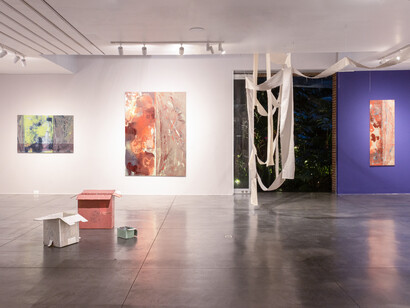
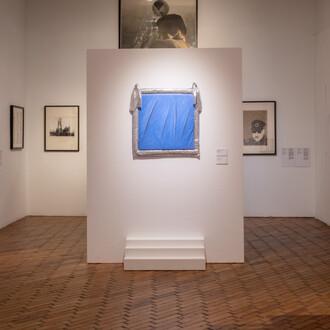
In On noise, overflow, and other frictions, the leftover fabric from the roll -the residue of the productive process, normally discarded before the work begins hangs in the gallery and frames the space itself. It moves as you pass through it and shifts depending on where you stand. The residue of painting becomes a device; a flexible structure that borrows the permanent architecture of the room to propose other paths, other behaviors, other ways of situating perception. What once framed an image now seems to frame an inhabited volume of air.
In the Desdoblados series, painting enters the packaging that circulates through the world: cardboard boxes made for transport, storage, and stacking. The box imposes its dimensions, its proportions, its folding logic. But these containers are not neutral -they are spatial forms that silently organize our relationship with objects, our ways of producing, circulating, and forgetting. Space is produced in the relationship between bodies, objects, and movement. As painting folds itself into the packaging, it makes that production visible. The residue here is more perceptual than material: what we discard before we see.
What this exhibition proposes is perhaps another form of attention, one that situates itself at the margins. Verónica works with what the pictorial process generates and with what the work, in its final form, normally expels. What this show makes visible is precisely that. How much is there in what we do not see?