English
 Español
 Français
 Deutsch
 Italiano
 Português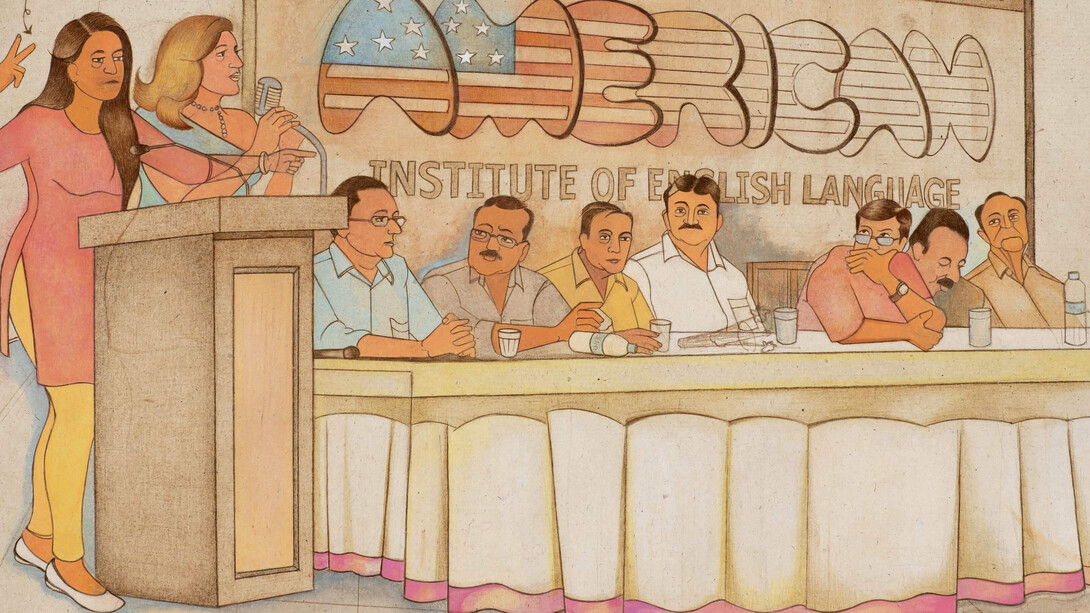
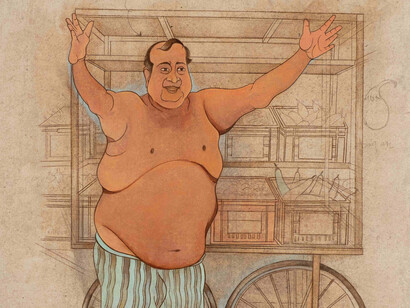
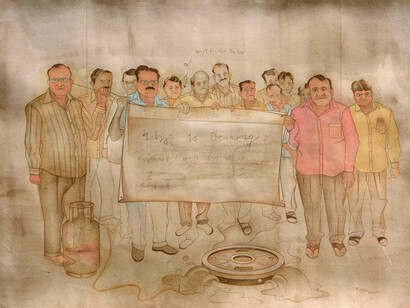
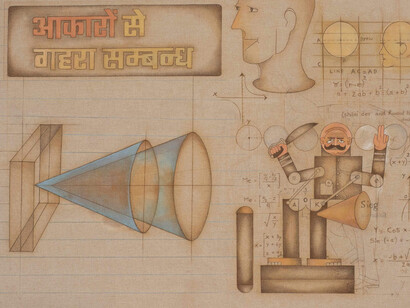
In A misbehaviour of form, Roshan Chhabria presents a new body of work that expands his long-standing engagement with the visual and social codes of Indian middle-class life. Rooted in close observation and informed by memory, humour, and everyday encounters, the exhibition unfolds across two lines of strands: one narrative, the other formal.
Roshan's practice is steeped in observation, informed by early experience of looking in his father's cloth and tailoring shop in a narrow alleyway in Baroda. As a child, he spent hours observing customers, many of them from the Sindhi community, taking note of their gestures, their postures, and their negotiations of class and self-presentation. Across drawing, installation, and object-based assemblage, Roshan continues to mine these lived observations, transforming them into reflections on identity and cultural performance.
The first strand of the exhibition centres on narrative. Here, Roshan's figures emerge from the textures of everyday life: from local magazines, cheap printed books, signboards, and fragments of popular culture. His works channel the wit and social insight of artists such as Bhupen Khakhar while also absorbing the disruptive impulses of Pop and Dada traditions.
Running alongside this narrative impulse is an investigation into form and geometry. Roshan references the legacy of artists such as Raoul Hausmann and Oskar Schlemmer, key figures of the Dada and the Bauhaus school, in their explorations of the body through abstraction, mechanisation, and constructed forms. While Bauhaus rested that form follows function, Roshan often inflects these lines of thoughts with the Indian vernacular, where forms resist conventional codes.