English
 Español
 Français
 Deutsch
 Italiano
 Português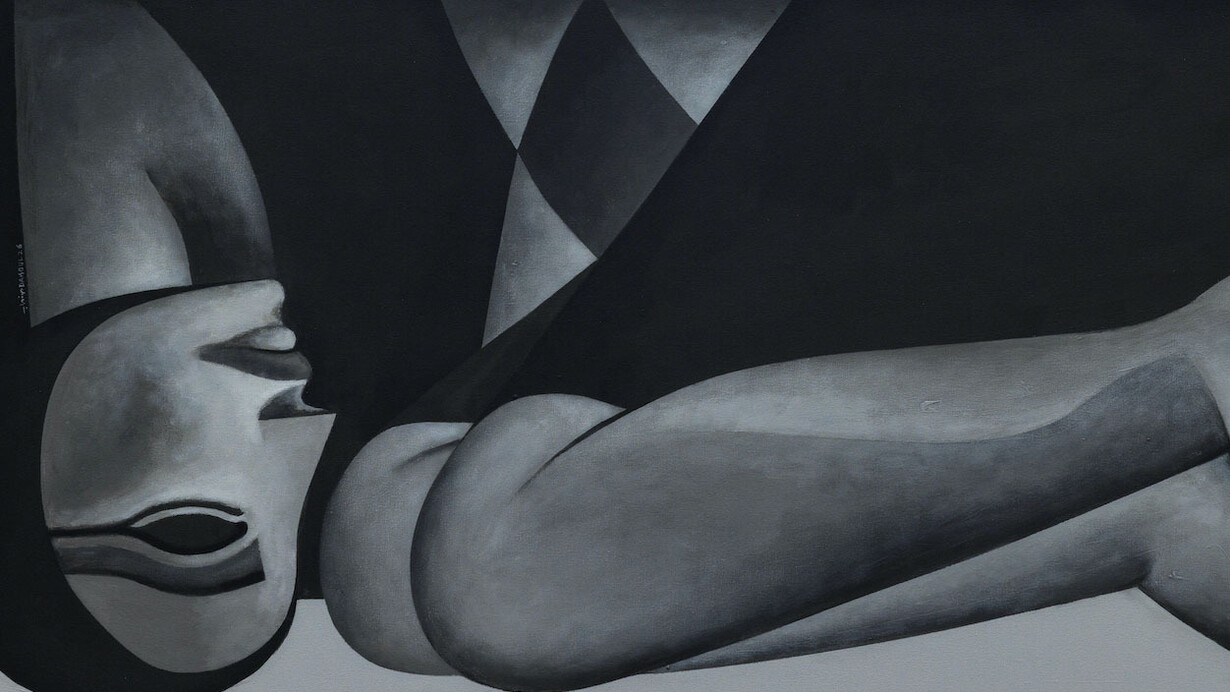
For much of the past three decades, Safwan Dahoul’s work has consistently taken shape within the same austere interior: a sparse, almost anonymous, monochromatic room, most often empty of any narrational or descriptive detail. Within this pared-down room, different phases and events of life consistently emerge at its center, coalescing into the focal point of a silent interior that is otherwise emptied of any distraction, only for this movement to disperse and return, thus rendering the room itself a quiet axis around which life, in all of its stages—its challenges and its celebrations alike—continuously circles and returns. Yet, within the very movement that it permits the figures within it, the room remains paradoxically closed—without entry, without exit, such that everything that emerges does so only within its own limits. Its figures circulate freely within it—able to live, to relate, to endure—yet they remain bound to a space that cannot be crossed, rendering their freedom conditional and their existence enclosed, suspending them in a state of being that is free insofar as it remains bound to the limits that define it.
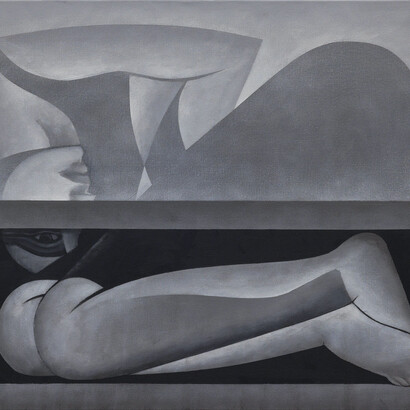
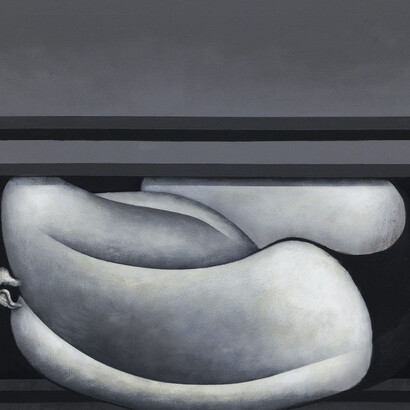
But what would become of this room were the paradox that once sustained its balance—and with it the illusion of freedom—to collapse? Dahoul deliberately challenges this condition by compressing this once open room into an enclosed, box-like chamber, where any sense of openness that was once present within it is now entirely withdrawn, thereby confronting its figures with the immediacy of its condition—a space that is defined by absolute boundaries, within which any illusion of freedom is entirely eliminated. And what was once a room that contained several figures moving freely within it is now compressed into a confined, box-like interior, forming an enclosure where a now singular figure—folded inward upon itself—is physically confined to a space that seems both protective and oppressive.
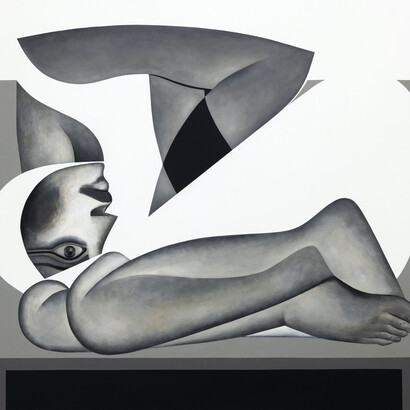
From within this newly enclosed condition, the figure’s confinement no longer permits it to fully open itself outwards into the world as it was once able to. Yet, the capacity for its interiority to be expressed outwardly remains, but unfulfilled, thus rendering the eye, once disclosed, as the sole gateway through which it can come into view, held in suspension yet undiminished, enclosed within itself and yet not entirely severed from the conditions of its own inward disclosure. As it emerges, under the limits of its suspension, the figure’s interiority can only become momentarily legible. This legibility, as it is sustained within the eye, is carried by an intense charge that continues to gather within its enclosure, briefly disclosing itself without ever fully stabilising, leaving it neither nullified nor fully sustained, as it remains suspended at the threshold of its own appearance. Such that, in certain instances, its interiority appears luminous and animated, with its intensity turned inward, yet not entirely closed off within itself as it remains open to its own disclosure. This luminosity does not resolve its suspended internal state, but rather holds it under a sustained and visible pressure, where the figure remains responsive despite its limits. And as this luminosity begins to fade, it gives way to a still and darkened opacity, not one brought about through violent shock or rupture, but rather one that is brought about by a quiet exhaustion as its charge is gradually worn down to a point where it is no longer reactive, leaving it reduced and flattened into the exhausted condition in which it is now held.
Within this condition, the figure’s interiority remains in suspension, still unresolved, as it begins to settle into a condition that is no longer distinct from what it is. As its interiority diminishes to the point where it can no longer fully disclose itself, what remains, then, is an interior state that becomes depleted, prolonged in its latency and left without any assurance of its return to itself. In time, the figure subsides into a prolonged state of waiting; a state in which its interiority remains present, disclosing a self that remains unactualized and unable to move beyond itself. As this state of waiting persists, it no longer holds the possibility of its return to itself in reserve, but instead wears it down over time as it recedes towards a point beyond return, thus rendering its return to the self progressively untenable.
As this state of waiting endures and deepens, and the prospect of the figure’s return to itself becomes increasingly improbable; what, then, remains once this uncertainty is no longer concerned with the question of that return, but rather with what remains of its interiority, once its return is deemed no longer possible? What remains is not a self in the process of becoming, but one that is neither able to project itself outwards nor resolve itself inwards, leaving it in an indefinite state of suspension, entirely contained within its own persistence. From within this persistence, the self, now diminished to scarcely more than its own existence, remains only in itself, reduced to nothing more than an indefinite state of waiting bounded only by the limits of its own finitude.
(Text by William Kaprielian, 2026)