English
 Español
 Français
 Deutsch
 Italiano
 Português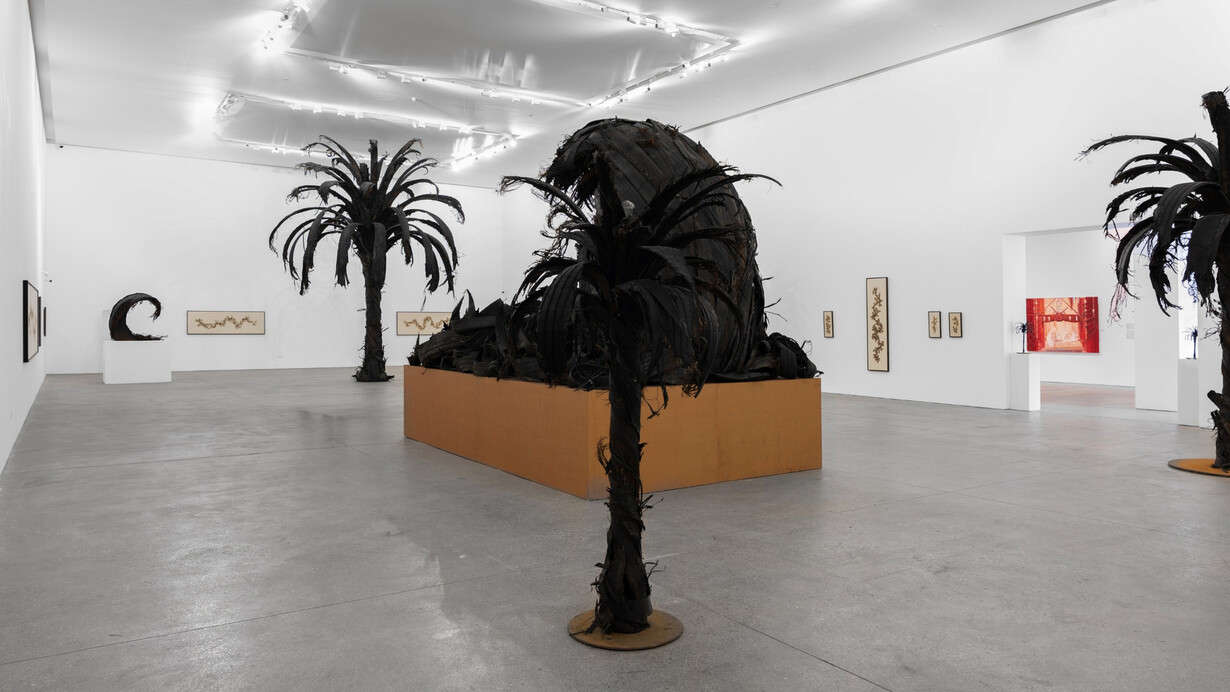
Leila Heller Gallery is delighted to present The great wave, a solo exhibition by British artist Douglas White. The exhibition opens in Dubai on 14 March 2026.
It may feel as though we are all living beneath The great wave. First depicted by Katsushika Hokusai in his famous woodblock print under the Great Wave off Kanagawa, the towering breaker has become one of the most recognisable images in art history—often read as a symbol of nature’s power, but more accurately understood as a moment of impending force poised above fragile human lives.
In The great wave, Douglas White translates that charged image into monumental sculptural form. Constructed from fragments of blown-out tyres collected from roadsides around the world, the work captures the instant when immense energy gathers before release—an image that resonates uncannily with a historical moment marked by accelerating ecological, technological and geopolitical upheaval.
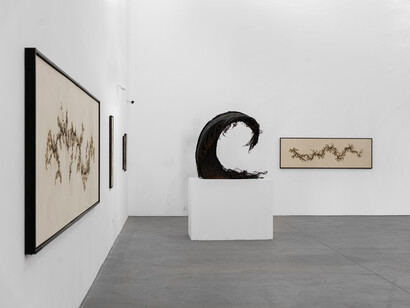
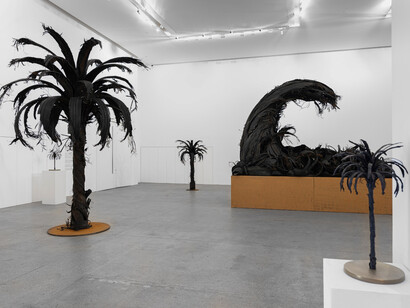
At the center of the exhibition stand two monumental sculptures: The great wave (after Hokusai) and a towering example from White’s celebrated Black Palm series. Together they form a charged environment in which industrial materials appear to take on the forms and energies of natural phenomena.
In The great wave (after Hokusai), fragments of torn tyre rubber gather into a dense, turbulent crest that rises above the viewer. Walking around—and beneath—the sculpture, visitors experience the unsettling sense of standing under a vast suspended force, poised at the moment before its release. The material itself carries the traces of its previous life: rubber shaped by kilometers of friction, pressure, and sudden rupture on the road.
Nearby, the monumental Black Palm rises through the gallery like an improbable organism. Assembled from lengths of discarded tyre rubber, its trunk and fronds appear simultaneously, vegetal and industrial, suggesting a strange convergence of natural growth and manufactured matter. What once functioned as waste takes on the presence of a living structure—an artificial tree grown from the residues of global mobility.
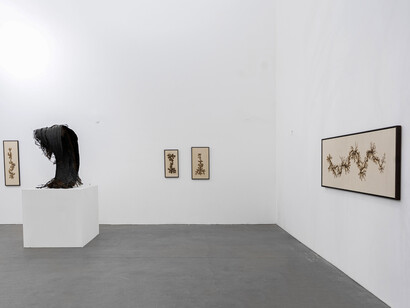
Across the exhibition, White’s works reveal the hidden energies that shape material form. In the Lichtenberg drawings, high-voltage electrical discharges burn branching patterns directly into the surface of wood, creating lightning-like structures that emerge through the interaction of energy and resistance. The electroformed Black sun works develop slowly through the accumulation of copper in electrically charged baths, allowing metallic surfaces to crystallise over time.
Throughout his practice, White approaches sculpture as a kind of material alchemy—transforming discarded or overlooked substances into forms that appear uncannily animate. Industrial debris becomes wave, tree, or cosmic surface, revealing unexpected continuities between natural forces and technological systems.
In this exhibition these transformations take on a broader resonance. Like the image that inspired it, the exhibition captures a moment of suspended energy—an instant when immense forces appear to gather, leaving us to wonder what form their release might take.