English
 Español
 Français
 Deutsch
 Italiano
 Português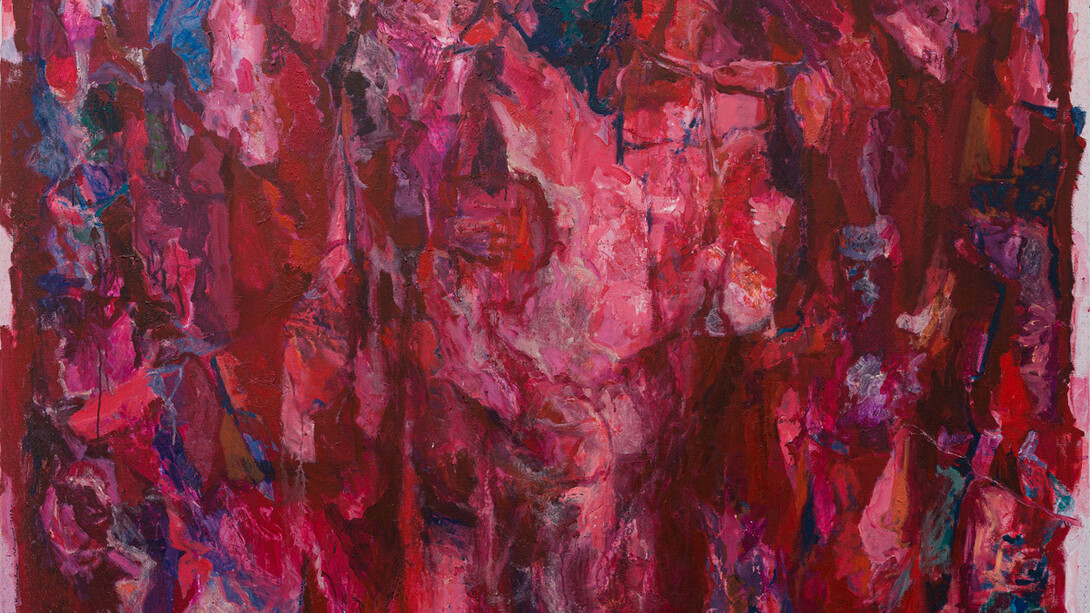
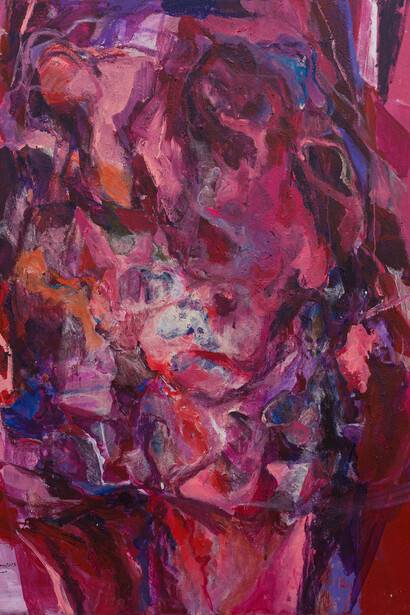
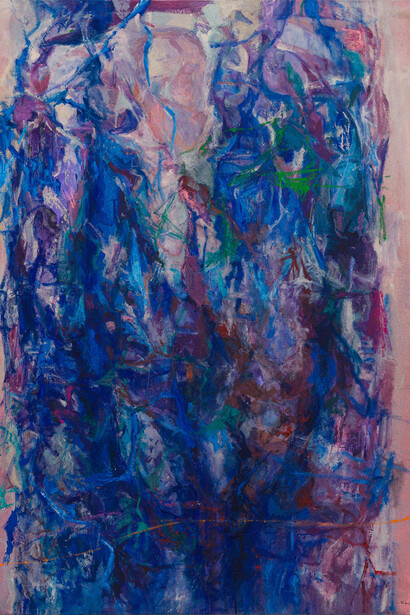
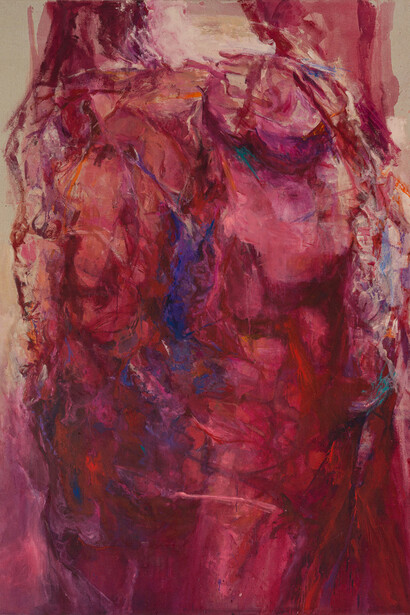
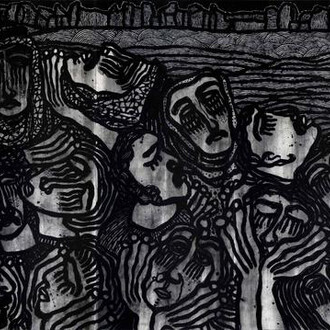
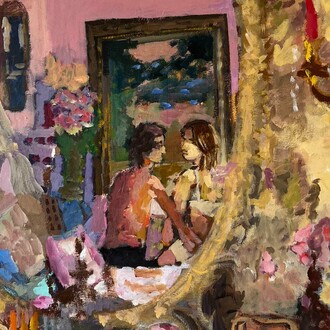
Kais Salman places his audience among ruins, his recent body of work acting as a pile of forgotten images buried beneath decades of historical buildup. The canvas becomes a space for reclaiming memory through a visual archive that has survived the wreckage of existing narratives. Faces emerge through Salman’s energetic brushwork, only to fade back into the walls and dissolve into material debris. Therefore, rendering his paintings as spaces of loss - as we try to uncover the imagery embedded in Salman’s work, forms appear and vanish at once, withholding themselves even as they emerge. Stepping away from lingering romantic nostalgia, Salman reconstructs thoughts and visuals from fragments he collects, driven by a deep awareness that the history of painting is composed of cracks, interruptions, and gaps clinging to the surface, impossible to mend.
Using abstraction, Salman destabilizes visual perceptions that dictate sight. The fragments emerging from within the debris create a voyeuristic feeling beneath the layers of paint—a face that refuses to emerge fully, suggesting that perception is not possession but an uneasy experience. The tension between abstraction and figuration is key to this body of work; this ambiguous stance sets this series of work apart from his previous ones. This in-between state prompts Salman to rethink the face as a site of introspection: How can we understand the face as a “bearer of meaning” without reducing it to a presumed model or fixed identity?
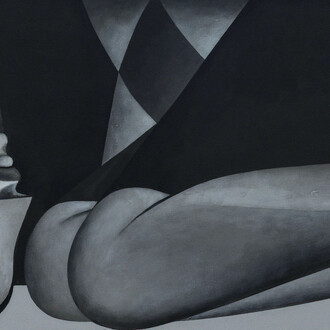
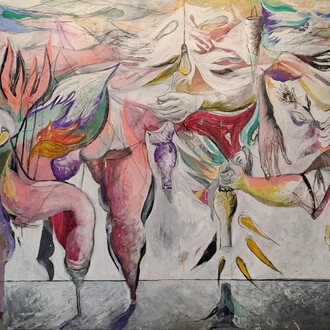
Salman investigates the body, aiming to untangle the intricate boundaries between past and present, searching for the unseen, the marginalized, and the forgotten, allowing them to inhabit a fragile structure he carefully tends to. Aiming to rethink the painting process as a troubled relationship between loss and absence. The material and chromatic weight of his work emerges as an accumulation of acts of erasure, his scenes shift from purely material loss to a kind of aesthetic absence, concerned only with what can express an inner void that cannot be filled. Testing the limits of perception and the darkness that surrounds it, Salman explores the body as a history of wounds, a field of emotions and fractures rather than merely a subject for contemplation.
The artist considers his paintings cultural entities, and in his practice he critiques the hidden impulse to turn every image into a readable form that resembles us, as though the face were both the first origin and the final destination of every painting. Several questions arise throughout this process: What makes a form recognizable as a face? Which material or compositional choices, and which visual or historical biases, facilitate or hinder this transformation? Traditionally, portraiture is understood through the rules of perception, shaped by how we are taught to see and interpret matter. Essentially, it requires that images follow the principles of narrative, figuration, and clarity. Instead of conforming to this need for completion, Salman provides space for questioning. The painting does not display the face as the final form, remaining open to interpretation. The “aura” that usually surrounds a portrait and gives it significance fades, leaving only its ethical aspect: the commitment to preserving the body’s right to ambiguity, far from the logic of instant consumption. It’s as if the artist is reminding us that images aren’t made for us, but exist within us.
The artist works as if plowing a field and turning its soil, as if preparing ground for encounter, without predetermined promises or prefigured images, but instead creating an event of a special kind through which he tries to dismantle the “mechanism of promise” within the painting. Energetic brushstrokes appear on the surface of the works, placing us before a moment where the visual system itself fractures, with the face appearing each time as a different form of its previous self. The artist positions the viewer under a watchful gaze through the gaps and cracks, repeatedly reshuffling our relationship to the scene, keeping our eyes wandering and our minds wondering.
(Text by Maisam Mallisho)