English
 Español
 Français
 Deutsch
 Italiano
 Português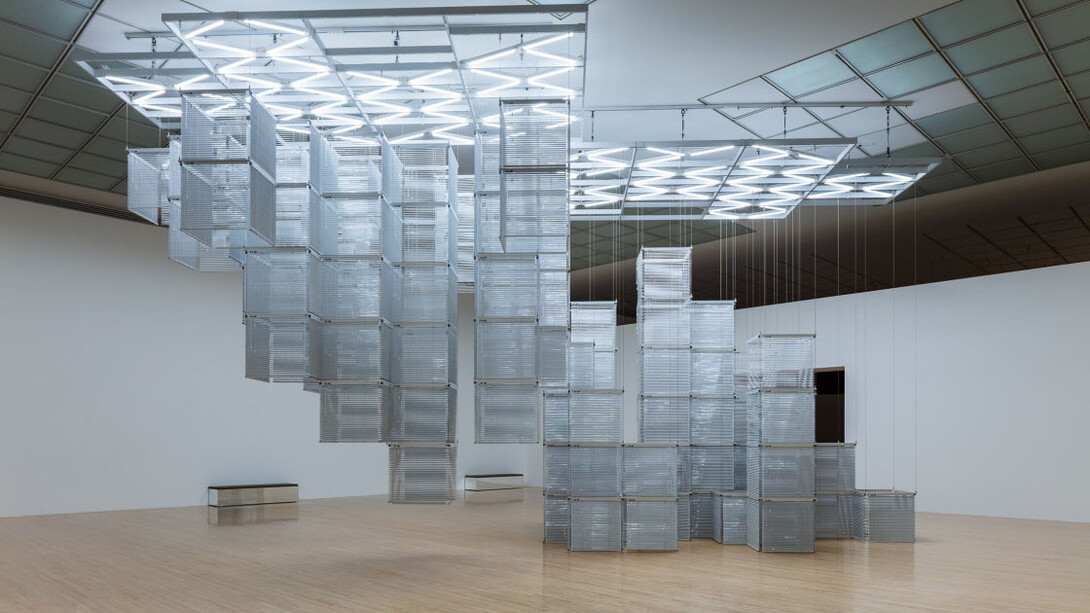
Haegue Yang (b. 1971, Seoul; lives in Seoul and Berlin) is known for large-scale installations that employ utilitarian objects. Motivated by the generative power of abstraction, Yang choreographs immersive encounters with light, color, and sound, creating heightened sensory environments that communicate beyond language. Her works often draw on specific historical narratives and figures, yet these sources remain mostly concealed. Through what the artist describes as “incubated abstraction,” historical references function as latent structures for the work, creating a porous relationship between past and present where new possibilities emerge.
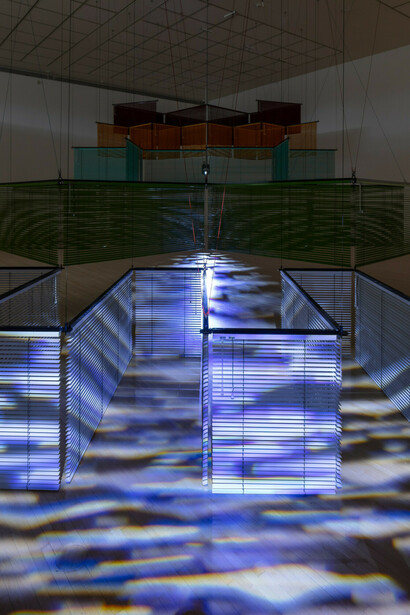
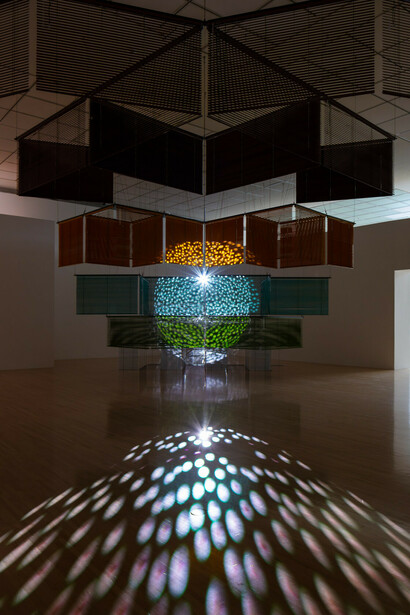
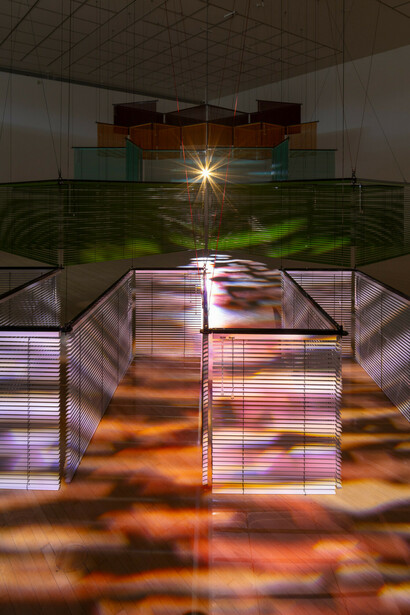
Star-crossed rendezvous brings together two major installations executed using customized venetian blinds, a window treatment designed with adjustable angled slats that filter light and structure spatial relationships. This material has been central to Yang’s practice since the mid-2000s, allowing the artist to engage with the viewer’s perception and movement. Made nearly a decade apart, these markedly different works appear as two halves of an imperfect whole, foregrounding Yang’s interest in asymmetry and doubling, both recurring principles in her practice.
On one side of the exhibition, Sol LeWitt upside down – K123456, expanded 1078 times, doubled and mirrored (2015) is a monochromatic installation inspired by the cube structures of American conceptual artist Sol LeWitt (1928–2007). Yang adopts LeWitt’s open cubes and replaces them with a dense accumulation of blinds, with layers of slotted angular forms that oscillate between transparency and opacity. On the other side, Star-crossed Rendezvous after Yun (2024) pays tribute to the life and work of Isang Yun (1917–95), a pioneering composer and political dissident. Moving lights synchronized to Yun’s Double concerto (1977) animate vibrant geometric structures, producing a shifting, multisensory encounter with the musical composition.