English
 Español
 Français
 Deutsch
 Italiano
 Português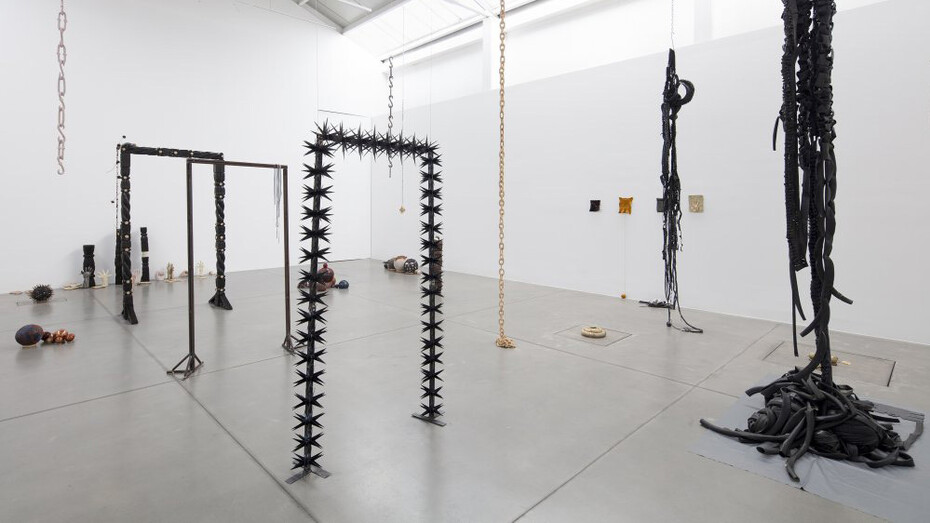
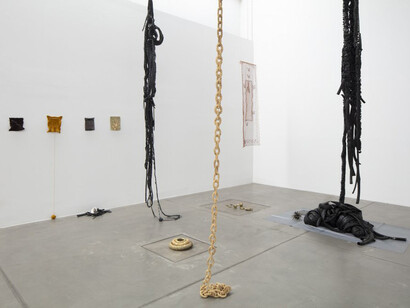
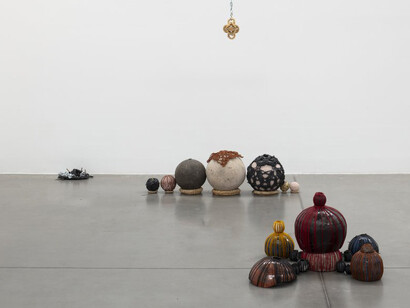
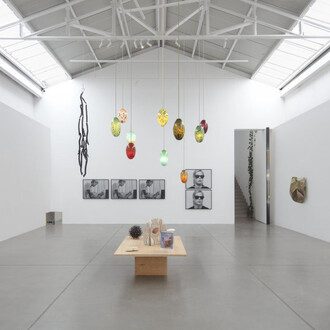
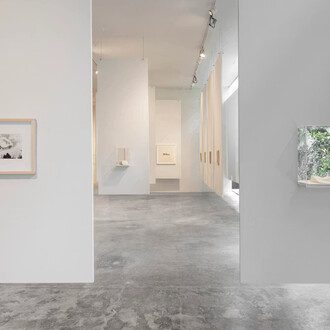
En la boca del lobo is the first solo exhibition by ektor garcia (Red Bluff, California, 1985) at Galerie Nordenhake Mexico City. In his practice, garcia explores historically marginalized craft techniques, revalorizing them through a dialogue between materials of seemingly antithetical natures: ceramics, crochet, metal, leather, and rubber, integrating them into sculptural and spatial reflections.
The exhibition brings together various works produced in Tzintzuntzan “place of the hummingbirds”, Michoacán, a site that articulates the exhibition and serves as the artist’s current residence. garcia has explored Tzintzuntzan through the lens of daily lived experience: the intersection of memory, Purépecha history, proximity to local artisans and neighbors, the exploration of plastic traditions, and the bicycle journeys that allow him to map the region.
With a father from Michoacán, the artist’s cultural and artistic inquiries are directly influenced by the geographical environment. In this sense, his imaginary has been shaped not only by national crafts but also by international traditions; his travels across different continents have allowed him to identify commonalities and disparities within this vast spectrum of handwork. His current residence in Michoacán has framed his interest in Purépecha culture, whereby Tzintzuntzan ceases to be a decontextualized site and becomes a terrain for horizontal dialogue and continuous learning between the artist and local artisans.
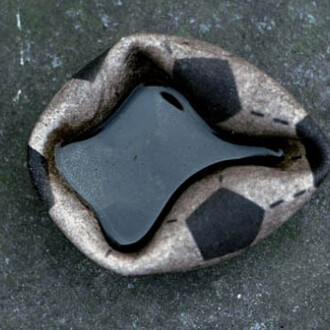
Several artworks featured in En la boca del lobo revisit processes and materials used by the artist in 2011, in which garcia constructs textiles from the rubber of punctured bicycle inner tubes after removing their valves. The exhibition also includes chains carved in cantera stone, carved pine pillars, and various crochet weavings made from diverse materials such as copper wire, cassette tape, and natural wool, interwoven with objects found on the road.
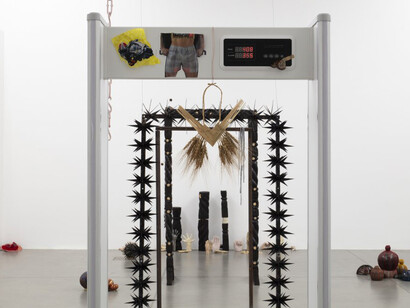
Other works explore the anatomy of human hands, referring to the primordial tool that allows for the transmutation of almost any matter. This action was observed and learned alongside the artisans of Tzintzuntzan. Hands carved in cantera or eucalyptus wood, or woven in popotillo, palm, chuspata, and copper wire, do not merely refer to the body and its creative capacity; they reclaim the identity of those who perform artisanal labor, a task frequently obscured or marginalized.
garcia’s practice is defined by the constant juxtaposition of diverse materials, a language that forces the coexistence of the seemingly irreconcilable: metal and ceramics, casting and modeling, wire and varied textile fibers, bicycle rubber and valves. In this oscillation between extremes, the exhibition presents several thresholds, physical or symbolic structures that divide the interior from the exterior. En la boca del lobo is a colloquial warning about leaving one place to enter another where danger is imminent. Having crossed this threshold, what emerges is a song of survival that overcomes punctured tires and violent territories, a song that finds its echo in the shared and learned practices of Andrés López, Diego López, Isidro López, Paula Juan Flores, Don Guzman, Aimé, Paula Guzmán, and Raúl Cortés Melo artisans and neighbors.