English
 Español
 Français
 Deutsch
 Italiano
 Português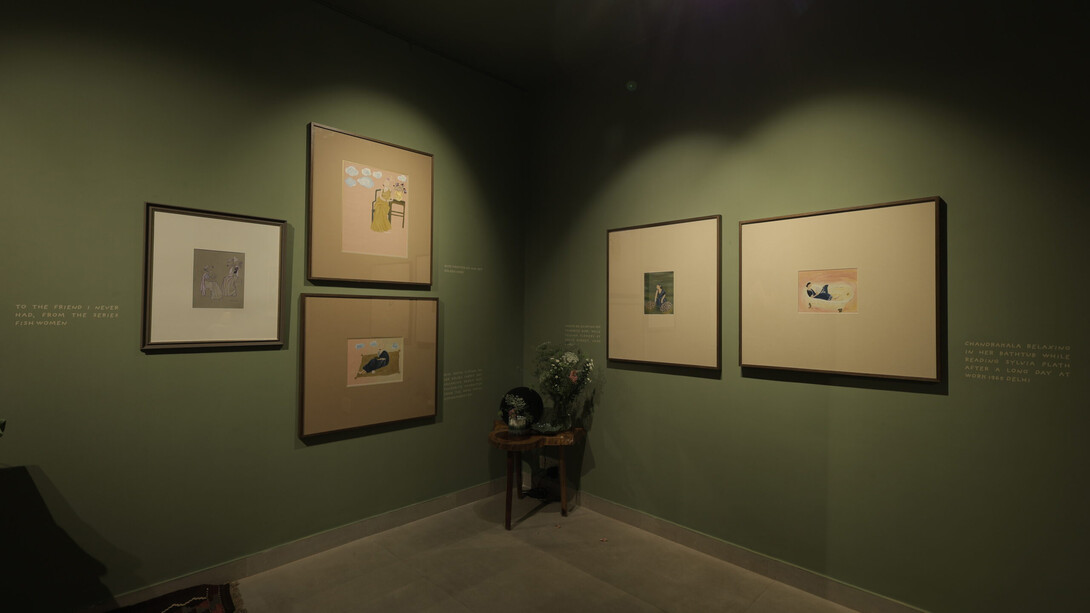
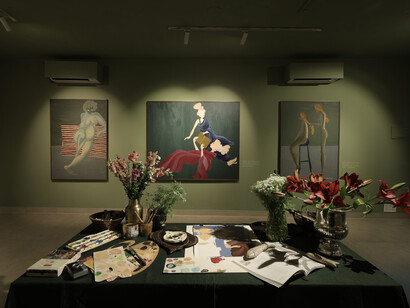
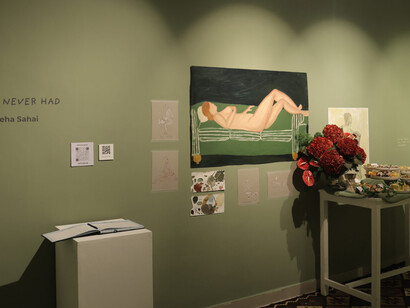
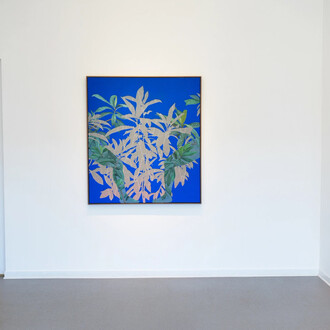
The exhibition unfolds through a sustained enquiry into relation, intimacy, and the forms companionship takes when it cannot be fully realised within the structures of everyday life. Across Sahai’s paintings, figures gather in states of nearness that remain unresolved. Bodies lean, turn, and pause within flattened expanses of colour that offer no horizon, no setting, and no narrative continuity. What emerges is a pictorial field in which relation is held without conclusion.
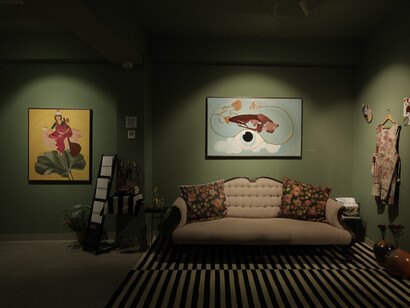
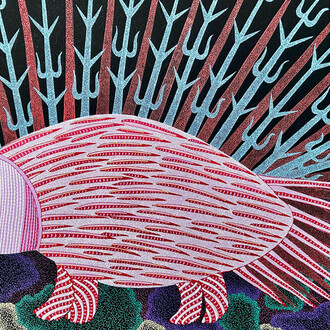
Sahai’s visual language is shaped through reduction. Softened contours, unmodulated planes of colour, and the withholding of descriptive detail keep the image at the surface, concentrating attention on posture, distance, and the charged space between figures. Within this field, hybrid presences recur. Human and animal forms coexist with ease, their proximity unfolding without rupture. A fish assumes the posture of a body; a face recedes from the certainty of recognition. These figures move through the work as emotional presences, carrying projection, attachment, and substitute intimacy. “I didn’t understand the language around me, so I made my own and painted it,” Sahai notes. Painting, in this context, becomes a process of language-making. Images emerge through repetition and return, arriving before they are fully understood. Meaning gathers gradually, held in suspension across the surface of the work.
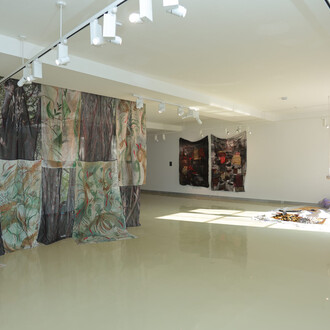
The project extends beyond the canvas through the presence of Sahai’s studio within the gallery. The space in which these paintings are made enters the exhibition as part of its internal structure. Objects, references, and working conditions remain in view, situating the paintings within a lived environment of making. The studio holds the rhythms through which these figures are returned to, adjusted, and allowed to persist. Its inclusion brings the viewer into proximity with the conditions under which these presences take form.
The friend that I never had brings these elements together into a single field of encounter. The exhibition holds space for forms of closeness that remain partial, for relations that do not stabilise, and for figures that continue to exist in quiet, sustained proximity.