English
 Español
 Français
 Deutsch
 Italiano
 Português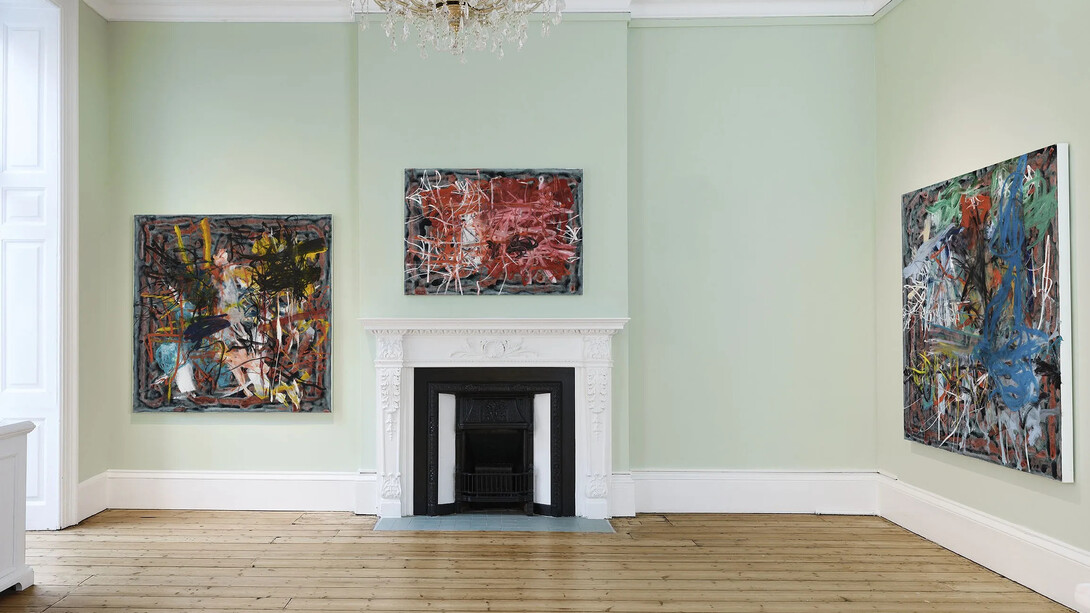
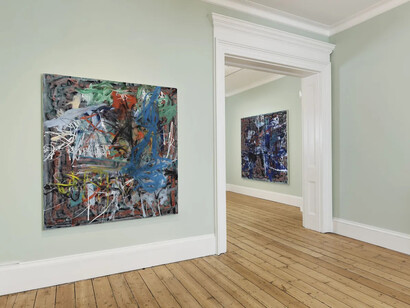
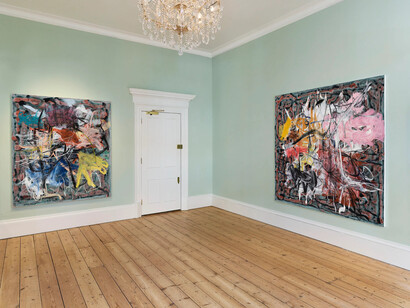
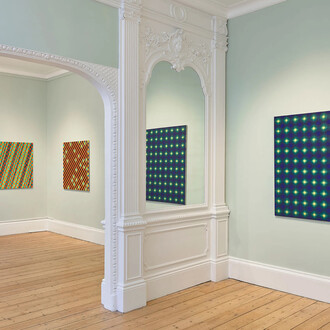
Massimo De Carlo is pleased to present Cameo woods, a new body of work by Aaron Garber-Maikovska.
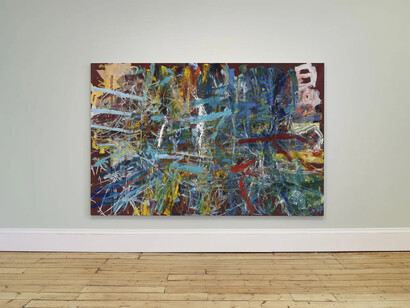
Working exclusively with pigment and oil, Garber-Maikovska is a painter preoccupied with the act of painting itself - with how much a surface can hold, how physical a mark can become, and what happens when industrial logic and painterly history are made to occupy the same canvas.
Since the early 2010s, Garber-Maikovska has worked on Coroplast - the corrugated plastic used for construction and temporary signage. It was cheap, came in large sheets, and took paint with a directness that canvas, with its history and resistance, never offered. "Canvas is like starting from a thousand," he has said. "Coroplast was like starting from minus ten."
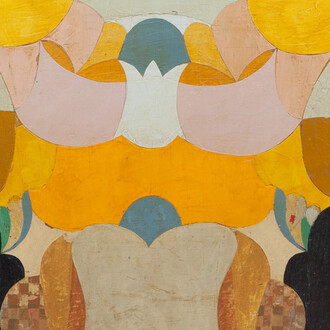
In Cameo woods, Garber-Maikovska does not abandon Coroplast so much as internalise it. Each painting begins with canvas mounted over the corrugated board. Through rubbing and pressing, the ridged surface beneath imprints itself into the paint - a frottage, an embedded rhythm, an industrial logic that persists in the finished work even after the canvas has been lifted and restretched onto aluminium bars. The Coroplast leaves before the painting is complete, but not before it has fundamentally shaped what the painting will become. The support becomes a structural memory.
Beneath everything lies the wash — a ground that Garber-Maikovska does not fully control, spreading as it dries into amorphous, cellular formations somewhere between the biological and the geological. A terrain that exists before any other decision is made. He describes the feeling it produces as similar to stepping out of a car and suddenly being in a place. It illuminates the weave of the canvas, gives the work an expansiveness beyond its physical dimensions, and establishes a world from which everything that follows emerges.
There is no brushwork in these paintings. Everything is applied through direct physical contact - rubbing, pressing, dragging - or through tools of Garber-Maikovska's own devising, engineered to make oil paint behave in ways it ordinarily resists. The resulting marks carry the appearance of something mechanically produced. But they are, as the artist insists, extremely analogue - the outcome of an intensely physical, durational practice in which the body remains the primary instrument throughout.
Cameo woods feels like a culmination. The bodily directness of Garber-Maikovska's earlier practice is still there, as is the sense of pressure and friction in the surface. What has changed is the structure - the way the wash now establishes a ground like a landscape, the way canvas holds and absorbs differently than Coroplast, the way the edge sliver reveals the full painted field and makes each work feel like a constructed tablet rather than a window. These elements have been building for years. Here, they come together.