English
 Español
 Français
 Deutsch
 Italiano
 Português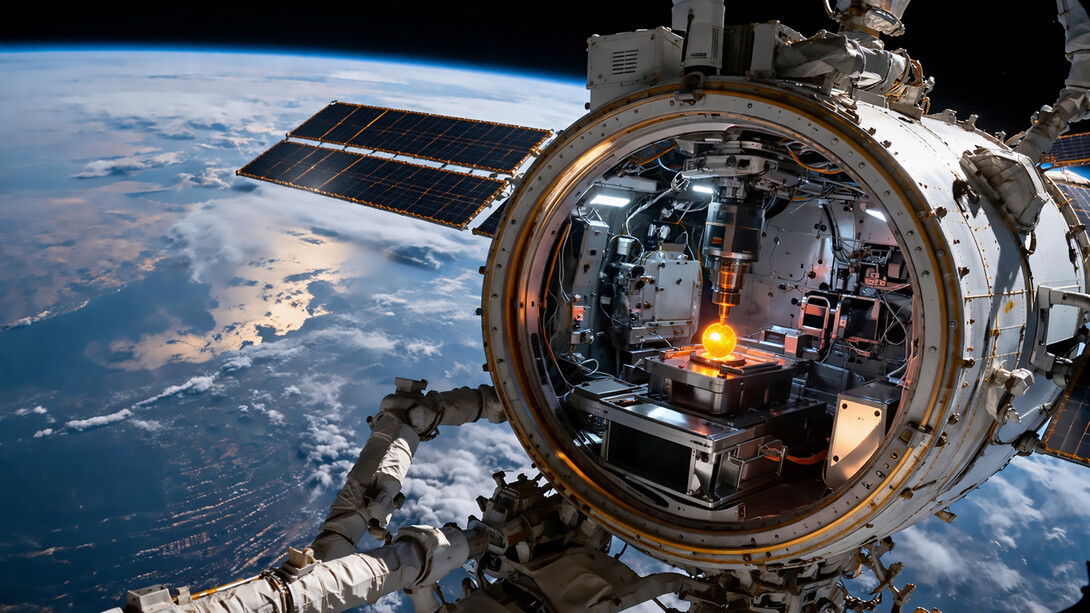
There is a short video recorded aboard the International Space Station that most people scroll past without noticing. In it, a droplet of molten metal floats freely, perfectly spherical, glinting under laboratory lights. No sagging. No convection ripples. No sediment settling. Just a flawless liquid sphere suspended in silence.
To a materials scientist, that video is not curiosity. It is a revelation. Gravity, something we never question, quietly interferes with almost every manufacturing process on Earth. It drives convection currents in molten alloys, causes sedimentation in fluids, introduces structural stress during solidification, and limits how large or delicate certain crystal lattices can grow. Engineers spend enormous effort compensating for gravity’s interference. Remove gravity, and an entire category of manufacturing defects disappears instantly.
For decades, microgravity manufacturing lived in the realm of academic experiments. A few research payloads. A handful of crystal-growth trials. Interesting scientific papers. But not an industry. The missing ingredient was economics. Launching material into orbit and returning finished products to Earth cost far more than any performance gain justified.
That equation is now shifting.
Reusable launch vehicles have reduced transport costs. Autonomous spacecraft can return small payloads safely and routinely. Meanwhile, certain advanced materials have become extraordinarily valuable. A kilogram of specialty optical fiber, quantum-grade semiconductor substrate, or pharmaceutical precursor can be worth tens or hundreds of thousands of euros. When product value density rises, transport cost stops being the dominant factor. Orbital manufacturing moves from scientific indulgence to commercial logic.
We already know which products benefit most from microgravity. Optical fibers grown in orbit show dramatically lower attenuation, enabling higher-capacity data transmission. Protein crystals grown without sedimentation allow clearer structural mapping for drug design. Metal alloys solidify without convection-driven segregation, improving uniformity. Semiconductor wafers grown in microgravity exhibit fewer lattice defects. These are not marginal improvements. They unlock next-generation telecom, medicine, sensing, and computing markets.
On Earth, we compensate for gravity with complex machinery: rotating furnaces, magnetic levitation, vibration control, and elaborate filtration. In orbit, nature quietly removes the problem.
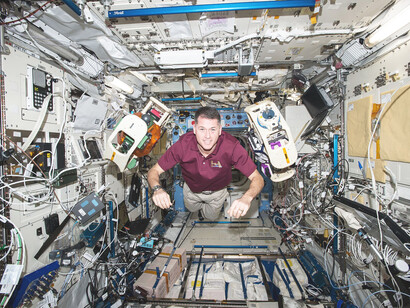
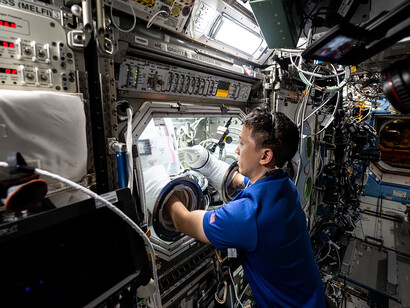
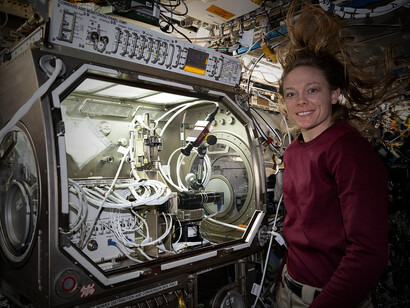
The factories that will exploit this will not look like astronauts floating with test tubes. They will resemble autonomous industrial racks bolted inside pressurized modules. Feedstock cartridges inserted. Robotic arms moving methodically. Furnaces glowing. Cameras inspecting surfaces. AI systems comparing real-time telemetry against quality models. Finished products sealed into reentry capsules. Engineers on Earth supervising dashboards rather than lab benches.
The first commercially viable niches are already visible. ZBLAN optical fiber for ultra-high-speed communications. Pharmaceutical crystallization for improved bioavailability. Biological tissue scaffolds for regenerative medicine research. Advanced semiconductor substrates for quantum sensors. Small volume, enormous margin — ideal for early orbital production.
But the deeper transformation arrives when orbital factories stop producing only for Earth and begin producing for orbit itself.
Once factories in space manufacture trusses, antenna reflectors, radiator panels, shielding tiles, replacement electronics, and structural components for other orbital infrastructure, dependency on Earth-based launch supply chains diminishes. Power stations repair themselves with locally manufactured parts. Data centers replace failed modules without waiting for Earth shipments. Fuel depots receive replacement valves printed in orbit. A closed industrial loop begins to form.
At that moment, orbit becomes not just a destination, but an industrial zone.
Regulatory institutions are already preparing. Pharmaceutical agencies are exploring certification frameworks for microgravity-grown products. Space agencies are drafting in-space manufacturing standards. Insurers are modeling risk for autonomous production platforms. None of this activity happens around fantasy projects. It happens around emerging markets.
Challenges remain significant. Fluids behave differently in microgravity, requiring new process controls. Contamination is harder to manage. Automation must approach perfection, because human intervention is expensive. Orbital debris rules must be obeyed. Reentry capsules must meet aviation-grade safety. But these are engineering problems, not impossibilities. And engineering problems, once funded, tend to get solved.
The likely progression mirrors terrestrial industrial revolutions. First, laboratory experiments. Then pilot production on multi-user stations. Then dedicated free-flying factories. Then orbital industrial parks serviced by logistics fleets. By the 2030s, commercial orbital production lines. By the 2040s, clusters of factories in stable orbits. By mid-century, supply chains spanning Earth, orbit, and the Moon.
It will not feel like science fiction. It will feel like procurement contracts, quality audits, delivery schedules, and quarterly earnings calls. The extraordinary always becomes mundane once infrastructure takes hold.
And one day, a medical implant fitted in a hospital on Earth may contain a component that has never experienced gravity — born, shaped, and sealed entirely in the weightless dark above our atmosphere.
Factories in the sky will not announce themselves. They will simply exist, quietly manufacturing the materials of the next technological era.
Industrial revolutions have always followed new production environments: steam factories, electrified assembly lines, and automated robotics. Microgravity manufacturing is the next environment shift — one where gravity itself is removed from the equation. The early markets will be narrow, the margins high, and the learning curves steep. But once orbital factories begin producing for orbital infrastructure, a self-sustaining industrial ecosystem emerges above Earth. At that point, space stops being a destination and becomes a production zone. And the materials that define tomorrow’s technologies will quietly originate in factories that never touch the ground.