English
 Español
 Français
 Deutsch
 Italiano
 Português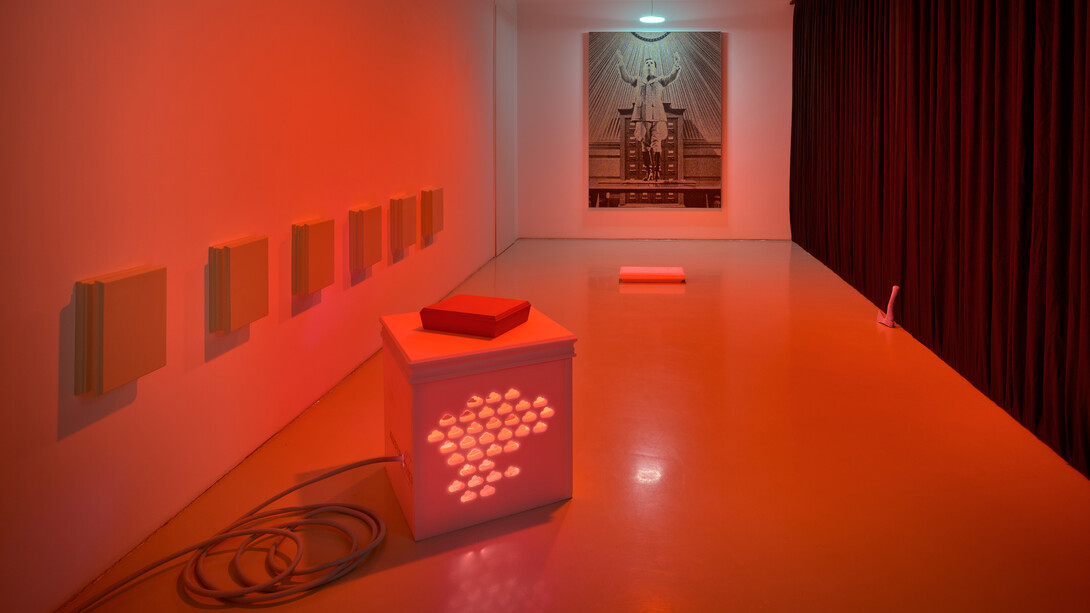
The central focus of Mio Zając's artistic practice is media diversity and the distortion of content. The Cologne-based conceptual artist engages with socially critical and existential discourses, transforming them into images that, at first glance, appear coherent, yet simultaneously contain an unsettling absurdity. Provocation takes center stage and becomes an instrument of multi-layered perception processes: a second, third, or fourth glance becomes a prerequisite for supposed understanding. Disruptive elements refer to the fragile relationship between virtuality and reality, whose permeable boundaries influence our perception.
Across two floors, Zając’s works explore the power of images by raising questions about the credibility of what we can see. Do our perceptions match reality? Reading between the images, deciphering codes, and critically questioning what is depicted becomes the central principle. Emoji-based distortions and a painterly pixel technique deliberately play with the viewer's perception. The emojis, symbols of the digital age, function in their mass arrangement detached from individual emotions and merge into new or seemingly familiar, ‘old’ images whose meaning we believe we know. Humorous elements provide moments of pause and bring lightness to the otherwise serious topics that deal with important social issues.
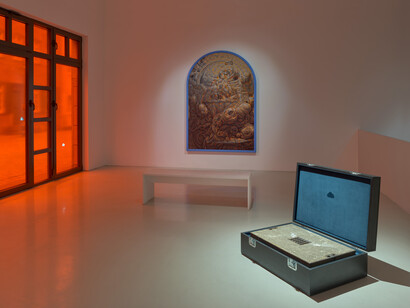
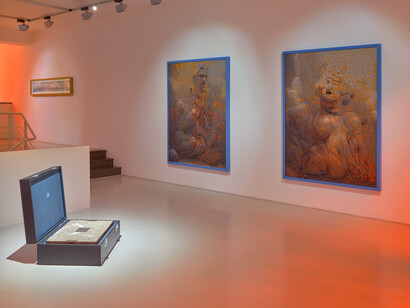
Immersed in a cinnabar light, the works are imbued with an almost sacred aura, while Zając employs the ambiguity of cinnabar: a vivid red and simultaneously a symbol of worthlessness or exaggeration. The interplay of light, colour, format and material contributes to an ambivalent perception. The artist also heightens the degree of irony by denying objects their original meaning and assigning them contradictory attributes. A manhole cover from a public space in a box is lined with royal blue velvet and deliberately glorified. In Gloria, the deliberate placement of contradictory attributes transforms the overlooked banality of everyday life into a means of fundamental shifts in meaning.
References to old masters, especially Caravaggio, are evident in the dramatic use of light and shadow. These contrasts stage the works and guide the viewer’s gaze without fixing it. Existing visual structures are deconstructed, while motifs from classical art history are revisited to open new narrative possibilities. The large-format works encased in blue foam, which are designated as protective images, initially evoke the quality of their content, namely Baroque motifs that appear to merit protection. Like an orange-red filter, the light lays itself over the works and the concealed frames, casting doubt on their high-quality character. The partially wrapped state of the images creates an ambiguity: it is unclear whether they have not yet been unwrapped, or whether they have already been rewrapped.
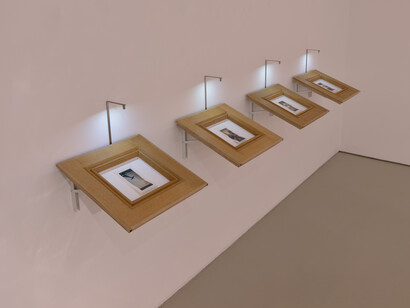
Irony also plays a part in the transformed photograph of an open book in Reading is fundamental. The work refers to the well-known proverb, but undermines its apparent clarity. Who reads what, and how are roles distributed within systems of knowledge production? What is seen becomes refracted and renegotiated as a question of access, authority, and value. In contrast to analogue reading, scrolling has come to symbolise the accelerated flow of information in the digital age. In the series Wipe and go, Zając transfers selected screenshots printed on toilet paper, presenting content as fleeting phenomena whose meaning disappears the moment the user swipes onward. Rustic oak frames both emphasise and contain the works, negating any possibility of escape.
Entering an atmospherically illuminated chancel, a installation unfolds in the basement. Here, Zając refers back to his final thesis at the Düsseldorf Art Academy in 2024. Only a nail likes something like this, as Charlie Chaplin shows in The great dictator, where this satirical character rises powerfully into the air. Ein Altarkissen lädt auf übertriebene Weise zum Gebet ein. Together with luminous accents, the pixelated Chaplin is given a ritual character, which is broken by the booming sounds of the soundbox. Both the perception and interpretation of power, authority, and media representation are questioned with a view to Made in Germany in the present day.
In this exhibition, the artist addresses the key question of the purpose of art and for whom it is created. Not for me for ma becomes an expression of an attitude that understands art as an open process whose meaning is constantly being redefined through the interplay of perception, insight, and critical questioning.
(Text by Sena-Marie Cirit)