English
 Español
 Français
 Deutsch
 Italiano
 Português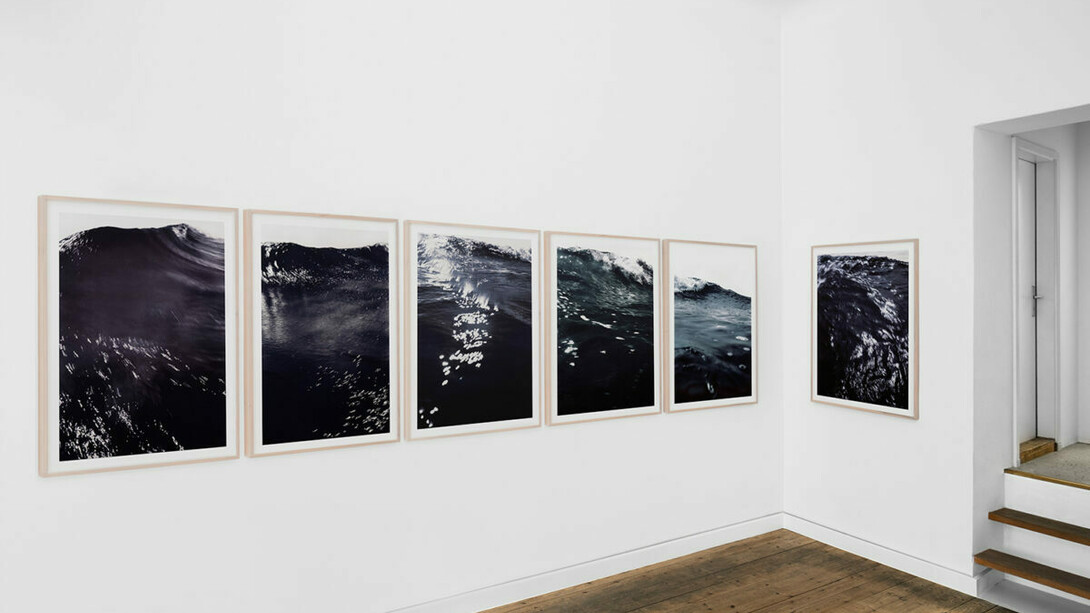
And there is a breath,
inhale. Expire, and,
there is touch, oh
water body.(Conil)
Whenever I immerse myself in water, I close my eyes.
Only after few moments have passed do I dare to open them to take in the particles of the sea, its salt, its microplastics, its phytoplankton in their smallest, finest details. These details, that I cannot perceive from the breathable world, are now the blurry surroundings that I leave after a short time to draw in air.
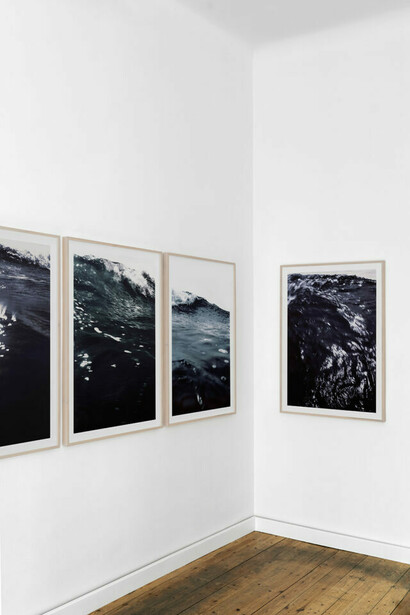
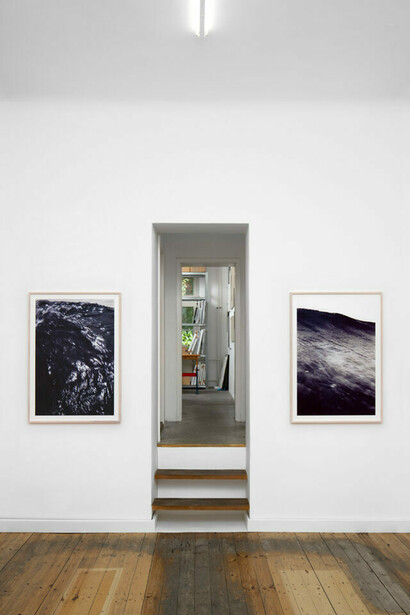
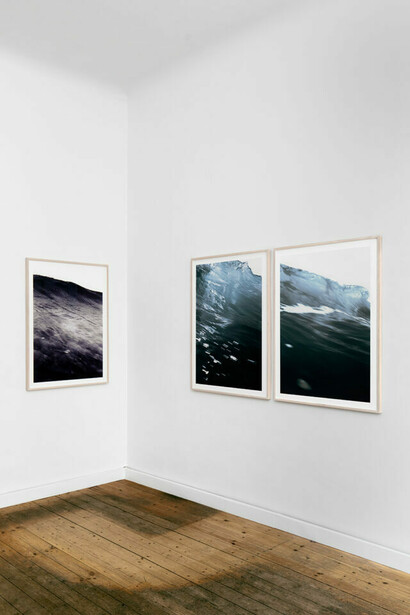
Just as it did when the series was photographed in 2003 on the Costa de la Luz in southern Spain,01 Conil presents a gaze between the breathable and the suffocating world. This series captures my gaze with a restiveness that drifts upward and downward, and, at the same time, each individual picture is still, mountainous, embracing. And in capturing this instant, as Bergson wrote about photography, there is no recording of the metamorphoses themselves. But did he think of the shock that follows an abrupt interruption of the wave? This transformative moment in photography in which the documentary and the inventive are one?
In the water, Eißfeldt writes on the series Conil, “for me it’s about testimony to being involved, presence, contact.” In the quiet air between me, the beholder, and the prints, dust particles circulate. I suck these in, close my eyes, and allow an after-image of Conil to form. Particles in my lung, water in my eyes. Water in the camera.
“Photography and Liquid Intelligence,” Jeff Wall’s essay from 1989, comes to my mind. While writing, I explore it, again, and with my eyes still closed Wall whispers: “I think of this sometimes as a confrontation of what you might call the ‘liquid intelligence’ of nature with the glassed-in and relatively ‘dry’ character of the institution of photography. Water plays an essential part in the making of photographs, but it has to be controlled exactly and cannot be permitted to spill over the spaces and moments mapped out for it in the process, or the picture is ruined. You certainly don’t want any water in your camera, for example!” Dörte Eißfeldt has tested this by immersing herself and the underwater camera in the sea and subjecting everything to the transformative power of the waves. In her work, she repeatedly treats our perception of what is palpable. Waves, flashes, foggy mountains, nature in all its unreliability, the lines of the horizon broken by the end of the film, matte black, shimmering lacquer.
In 2023, I drove from the Bedouin town of Tayma to Al Ula in northern Saudi Arabia. I recall the moment when the first rocks emerged from the flat, desert-like plains, and I saw the sea that had dried out so long ago before me. Huge, petrified coral reefs in their most complex formations towered up from the sand. Without suffocating, I was able to explore the underwater world. It reveals gigantic testaments to a sea that has become breathable.
In the gallery space, standing before the framed archive pigment prints of the series Conil, this strong impression returns. And from these works, which also evoke saltiness, spitting, and bubbles blown with our noses, something that exudes less security emerges. These discussions that Conil triggers inhere in the transformation that lies not so much within the visual world of the moments captured, but hovers in the space and, through the inhaled particles and closed eyes, penetrate deep inside the body, making a moment from 2003 once again available to experience. Until tomorrow comes.
In this series, by way of captured movement, something that could end fatally for the camera and for us becomes palpable, something that at the same time is the center of all life. Sea. Metamorphosis. Enfin.
(Text by Susanne Kriemann, February 2026. Trans. by Brian Currid)
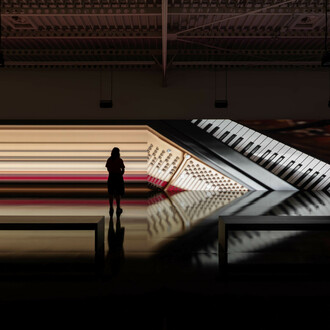
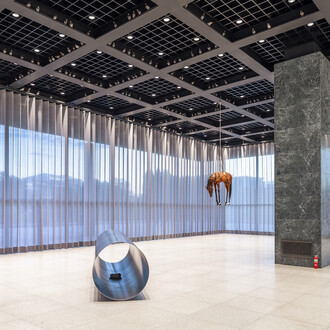
![Various artists, [ materialistin ], exhibition view. Courtesy of Hamburger Bahnhof](/attachments/fd8f4fd76b73be0a02d398535c29d017e1309b65/store/fill/330/330/3f54331fd7869a13166dfe67a9e91306c6e180b2e29b9fd308d958b87ad2/Various-artists-materialistin-exhibition-view-Courtesy-of-Hamburger-Bahnhof.jpg)