English
 Español
 Français
 Deutsch
 Italiano
 Português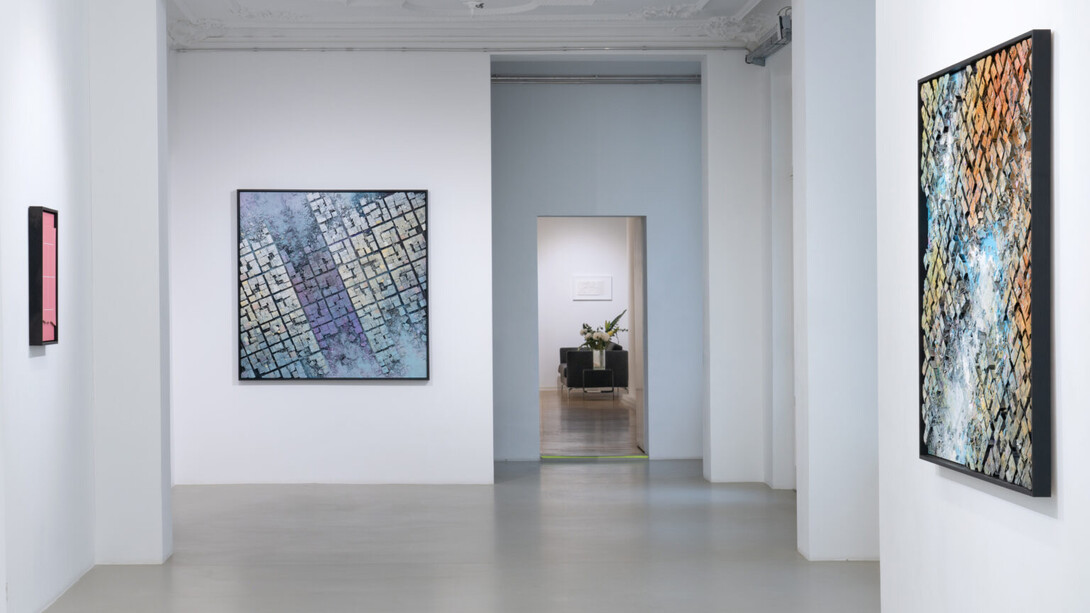
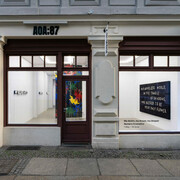
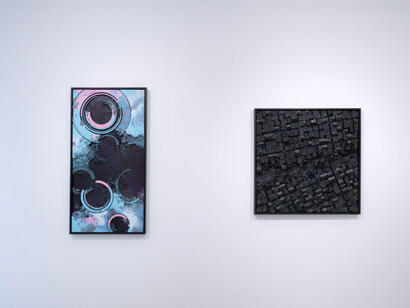
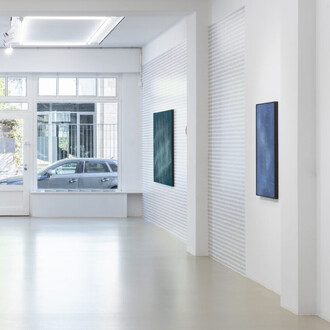
AOA;87 presents the solo exhibition Was bleibt, wenn es kippt by Hendrik Czakainski.
The exhibition explores states of transition within social structures and interpersonal relationships. It focuses on moments in which familiar orders become unstable and meanings begin to shift without being clearly defined.
These conceptual displacements are reflected on a formal level: representational elements begin to move and transform into abstract structures. Here, tipping appears as a productive condition in which perception, form, and social legibility are renegotiated. Instability is understood not as an exception, but as a constitutive element of contemporary experience.
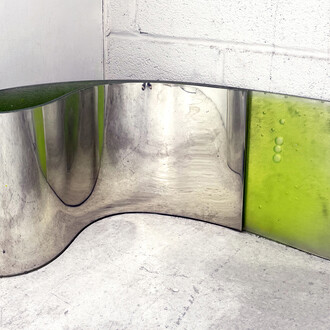
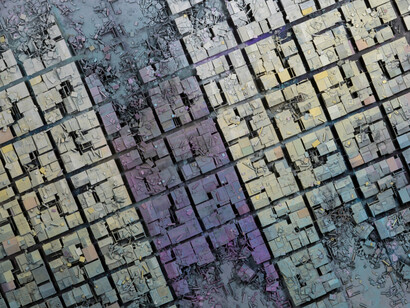
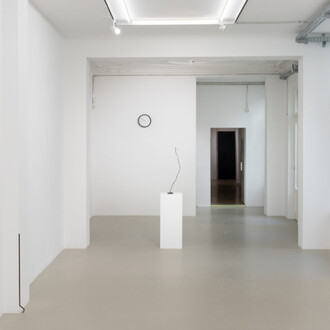
This condition becomes spatially tangible from the outset. In the entrance area, a sculptural curve runs horizontally across the corner of a wall. Its surface is densely covered with minute, closely set fragments—a constructed texture that recalls compact urban formations without ever becoming representational. The curve seems to “bend” the architecture while at the same time supporting it: a quiet indication that systems become visible precisely where they deform under pressure.
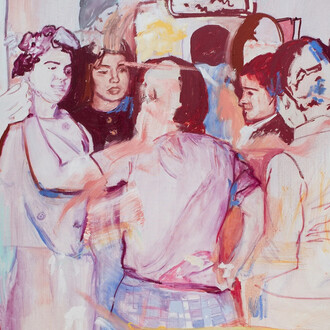
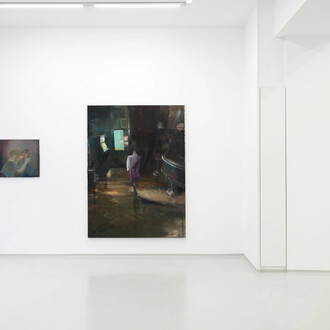
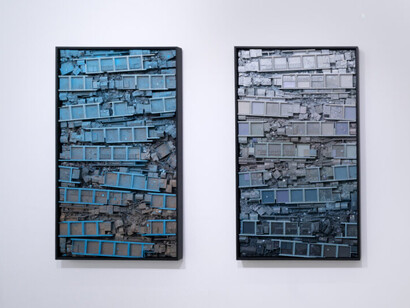
The remaining works also operate through a dual mode of perception. From a distance, the image appears ordered: zones, lines, clearings, an apparent clarity, as if a logic had inscribed itself. At closer range, this order begins to shift. The system loses its coherence and dissolves into its smallest components—edges, joints, fractures, overlaps, traces of pressure and provisional construction. The surface becomes active: layers emerge, edges cast shadows, the calm turns fragile, the comprehensible unsettled.
In this way, pictorial spaces emerge that do not soothe but keep the viewer alert. They do not present fixed assertions but open situations: density and emptiness, support and yielding, cohesion and rupture intertwine. What appears stable reveals itself as provisional—something constructed, capable of tipping at any moment.
Was bleibt, wenn es kippt presents instability not as a defect, but as a condition. Not as an end, but as a movement: a rewriting, a yielding, a reordering. And perhaps this is what remains—a space in which meanings do not disappear, but change their form.
![Various artists, [ materialistin ], exhibition view. Courtesy of Hamburger Bahnhof](/attachments/fd8f4fd76b73be0a02d398535c29d017e1309b65/store/fill/330/330/3f54331fd7869a13166dfe67a9e91306c6e180b2e29b9fd308d958b87ad2/Various-artists-materialistin-exhibition-view-Courtesy-of-Hamburger-Bahnhof.jpg)