English
 Español
 Français
 Deutsch
 Italiano
 Português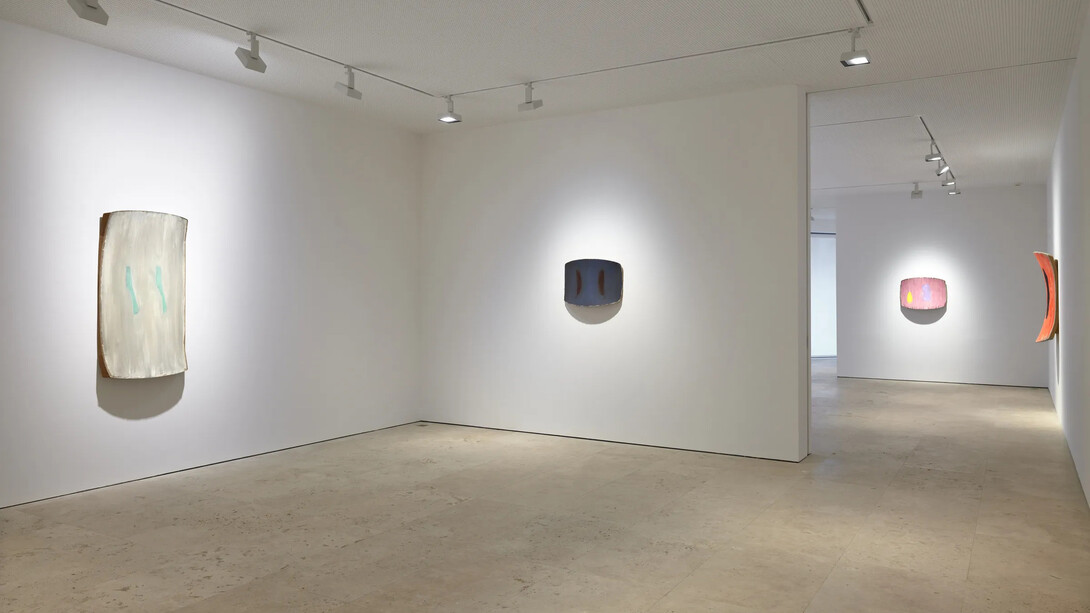
Maruani Mercier is delighted to present Ron Gorchov: painter, sculptor, painter, an exhibition of important works by the artist spanning four decades of his artistic production.
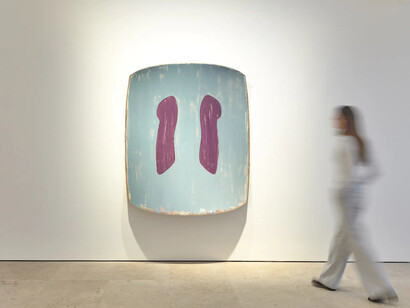
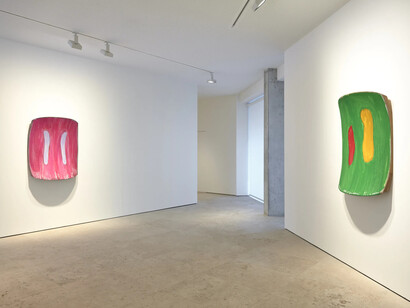
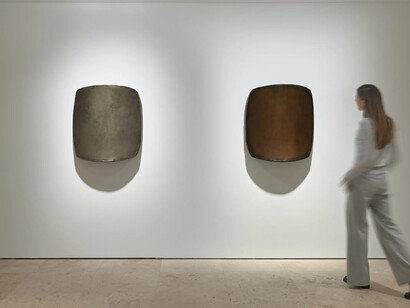
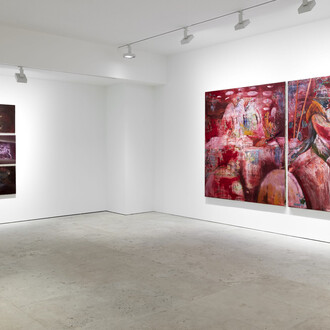
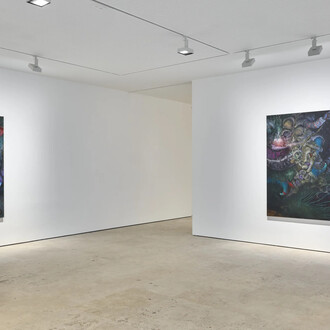
At once advancing and retreating, convex and concave, Gorchov’s spatially dynamic works manifest the materiality of painting and powerfully probe the notion of the pictorial plane. Gorchov created his first shaped canvas in 1967, at a time when Clement Greenberg’s assertion of ‘flatness’ in modernist abstraction was being dismantled by artists associated with Minimalism. Integrating curved supports with painterly abstract surfaces of stretched canvas, Gorchov’s works offered a nuanced response to the critical debates around abstraction at the time, advancing an intentionality of shape and an awareness of the relations between volume and surface.
Establishing a palpable physical presence, each painting stages a corporeal, rather than purely visual encounter, making the viewer become aware of their body in space. Gorchov considerably varied his works in scale – in smaller works, he intuitively heightened the curvature and volume of the support, echoing modes of rendering architectural and bodily proportions. As the artist remarked in a later interview, “I'm very interested in Palladio and his idea of asymmetry, or where symmetry and asymmetry play. And all these spaces have relations - they have, what in music they call 'rubato', a give and take, so you don't have too accurate a beat. So I keep changing the intervals. All these intervals have to change in order to look the same.”
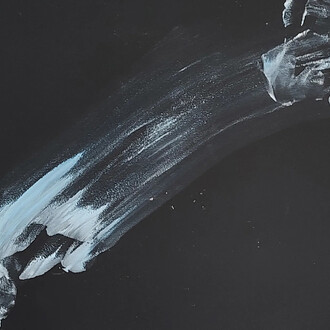
Often featuring dual oblong marks that are inspired by the space between the arm and torso in Ancient Greek kouroi sculptures of frontally posed youths, the compositions present an interplay between symmetry and asymmetry of upright shapes. In Agron (2012), the marks in blue fluctuate between depth and flatness on the curving dark ground, directing our awareness from an illusion of spatial opening to the perception of volume and weight. Thinning the paint and applying the pigment in layers, Gorchov achieves a luminous and fluid quality of surface, foregrounding the physicality of marks and drips in the composition. Considering the spatial possibilities of both painterly and sculptural mediums, the works in the exhibition thus evince Gorchov’s singular visual language, inviting the viewer to experience abstraction as a lived, physical encounter.