English
 Español
 Français
 Deutsch
 Italiano
 Português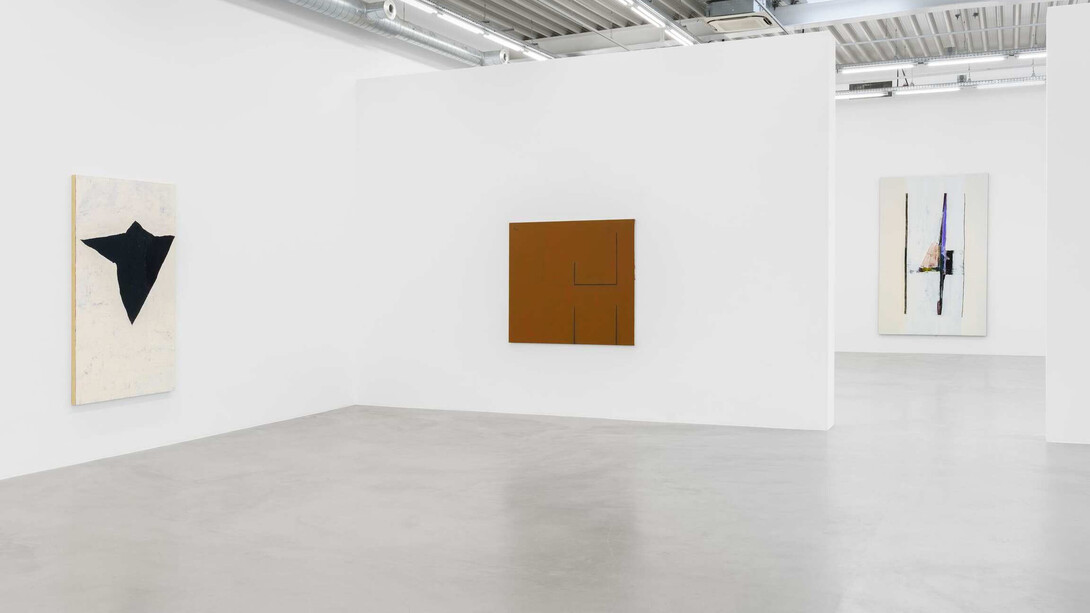
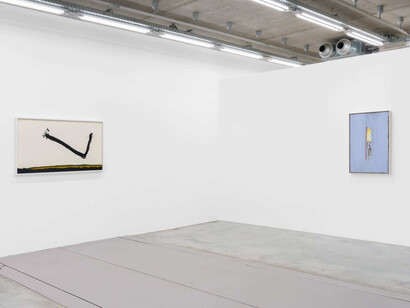
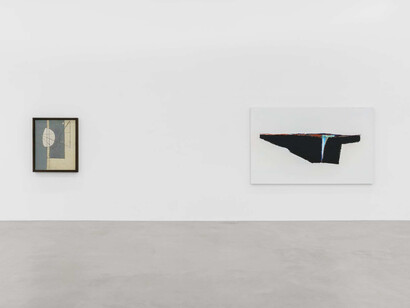
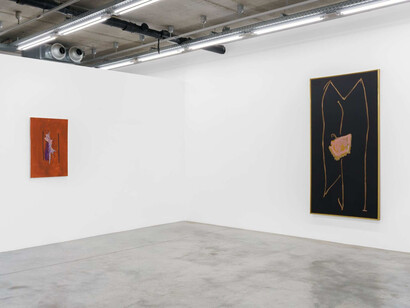
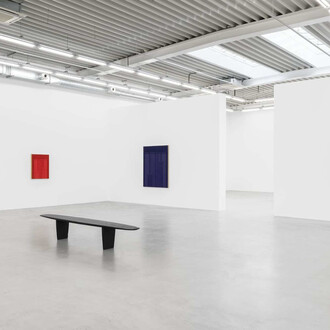
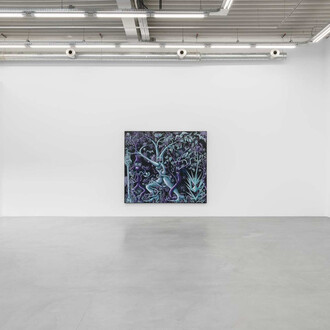
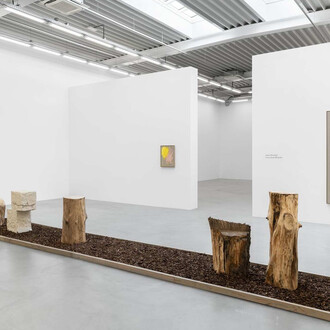
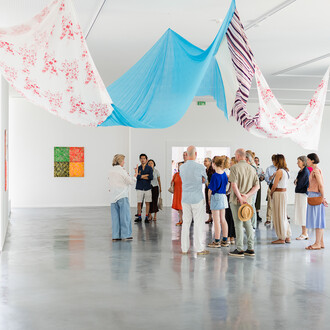
Almine Rech Brussels is pleased to present Open edges: Erik Lindman & Robert Motherwell, a duo show on view from March 11 to April 18, 2026.
For the length of the exhibition, the Fundación Almine y Bernard Ruiz-Picasso will be loaning two works by Pablo Picasso, which will be on view and part of the show, grounding the dialogue in the European Modernism that informed Robert Motherwell and, subsequently, Erik Lindman.
More fundamental is the individual problem, the capacity of an artist to absorb the shocks of reality, whether coming from the internal or external world, and to reassert himself in the face of such shocks, as when a dog shakes off water after emerging from the sea.1
(Robert Motherwell, 1944)
Erik Lindman and Robert Motherwell are two artists who, though born seventy years apart, share an interest in using found materials to generate compositional decisions in their work. This can be traced back to their shared lodestar Picasso, and the collage technique he developed at the turn of the last century. This introduced aspects of the real world into the picture plane for the first time. In Picasso’s hands these found elements became devices to generate compositions, radically advancing the modernist project of complicating the problem of authorship. Picasso’s use of collage broadened the understanding of the artist as someone who imagines. The artist is reconceptualized as someone who ideates, selecting elements external to art so as, to paraphrase Sol LeWitt, act as machines that generated the art. For example, Picasso might incorporate the dot pattern of a piece of wallpaper, which might in turn give rise to a stippled passage of paint. These painted dots, abstract in themselves, can be understood as both referencing the pattern of the commercially produced wallpaper and the atomized dots of late 19th century pointillist painting. In this way Picasso was able to approach a form of meta-painting. In this mode elements of the world could be integrated that referred back to elements of painting’s history, even as they provided ways of expanding the painter’s toolbox, and what that toolbox was able to express.
Astute observers of the history of art, Lindman and Motherwell share this approach to painting. Both of them found that introducing elements from the world around them strengthened and pushed their studio activities forward. In their work found materials displace and delineate forms, suggesting how to establish a composition. For example, when Motherwell observed how a smaller canvas leaning against a larger one suggested the outline of a form, which, once traced, though seemingly slight was in fact strong enough to hold a monochrome field. This chance discovery inaugurated the Open series, one of his best known bodies of work, and the one featured in this exhibition.
Once the found form had sparked an idea for Motherwell, as with the leaning canvas in the case of the Opens, the painter was able to generate other compositions based on it. For Motherwell, the serendipitous experience became a blueprint for something that could then be returned to continually over the course of a career. As he put it in 1949, in a quotation Lindman has highlighted in a review of an exhibition of the elder artist’s prints at the New York Public Library: “I dislike painters who talk as though they were carpenters or some other kind of craftsman, who speak as though art is not a question of inspiration—of something in you that rises as simply, beautifully, and unpredictably as the flight of a bird.”2 In this way, the importation of external material is not meant to be a distancing act. It is an alternate route to inspiration, one that holds onto both a classical idea of painterly intuition and the unpredictable nature of aesthetic experience.
Something similar happened for Lindman. He has described his admiration of the ease with which Motherwell worked, and Motherwell’s facility at arriving at new individual expressions within a series premised around a certain shared language, as with the Open series.3 Thus this pairing, triangulated through Picasso, demonstrates the ongoing relevance of artists looking outside of themselves for means by which to motivate the production of abstract works of art.
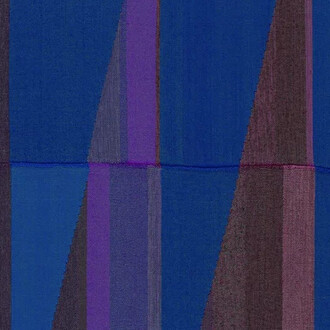
From the beginning of his career Lindman was drawn to the provocative shapes of materials he found around him in the streets of New York. As he has described it, with a clear resonance with how Motherwell arrived at his Opens, “seeking to distance myself from the label of being ‘that guy who makes paintings with found surfaces,’ I turned my objets trouvé over, painted them, and began to use their profile as a central element in large monochromatic fields. I referred to these as Blanks.”4 Appropriately, alongside examples from Motherwell’s Open series this exhibition surveys work by Lindman from the last decade. A carefully selected group of paintings exemplify both how materials made their way into Lindman’s work, and how the compositional lessons suggested by this importation continue to be generative.
This resonates with how, for Motherwell, collage was often a way of opening up new possibilities in painting. Since 1943, when he was invited by Peggy Guggenheim to produce his first collage for a show of the then still new medium at her famed gallery, Art of This Century, Motherwell found that collage provided a new way into picture making. Tearing paper was a way to draw without a pencil or pen, while the torn edge added a heightened sense of tension and even violence to the composition. The torn or broken edge is a source of inspiration for both artists, as in the jagged form that inspired Lindman’s Blanks. Because the exact nature of this tear was, while somewhat determined by the artist, and at the very least selected by them, is ultimately up to chance in terms of its full expression. Thus it is a way of introducing line and drawing without overly dragging the intention of the artist into it. Further, both artists often center the found element and build up their compositions from and around it, working from the center outwards, which is the classically Cubist approach to picture making.
Seeing these works by two artists of different generations alongside one another suggests how what art historian Yve-Alain Bois (following Erwin Panofsky) would call a shared genetic heritage. These artists generate seemingly similar visual styles, but in fact come from very different intellectual impulses, deploying their means towards divergent ends.5 Despite the affinity between their works, with his Open series Motherwell was trying to rejuvenate traditional models of picture making that resonate with the era in which they were made, the 1960s. He incorporated the economy of means suggested by the minimalism of the period, but used it to establish the kind of aesthetic surprise and depth of emotional resonance he had always prized for his work. While Lindman, active since the 2010s, is interested in how a painting can establish an archaeology of meaning that resonates with the endlessly networked condition of our times. Lindman asks us to look intensely and carefully, and in doing so unpack the painting haptically in the present tense of our encounter with it. Thus, a primary distinction that will be noticed by viewers of this exhibition is how Motherwell’s paintings submerge us in a charged field of feeling, while Lindman’s stimulate an investigatory impulse to parse and recombine what we are examining.
(Text by Alex Bacon, Art historian, curator, and publisher)
Notes
1 Robert Motherwell, “The modern painter’s world” [1944] in Stephanie Terenzio, ed. The collected writings of Robert Motherwell (Berkeley: University of California Press, 1992), 27.
2 Motherwell, “A personal expression” [1949] In The collected writings of Robert Motherwell, 58. As quoted in Erik Lindman, "Robert Motherwell: At home and in the studio,” exhibition review. The Brooklyn Rail (May 2025).
3 Lindman, unpublished text shared with the author.
4 Lindman, unpublished text.
5 Yve-Alain Bois, “On the uses and abuses of look-alikes,” October 154 (Fall 2015): 127-149.