English
 Español
 Français
 Deutsch
 Italiano
 Português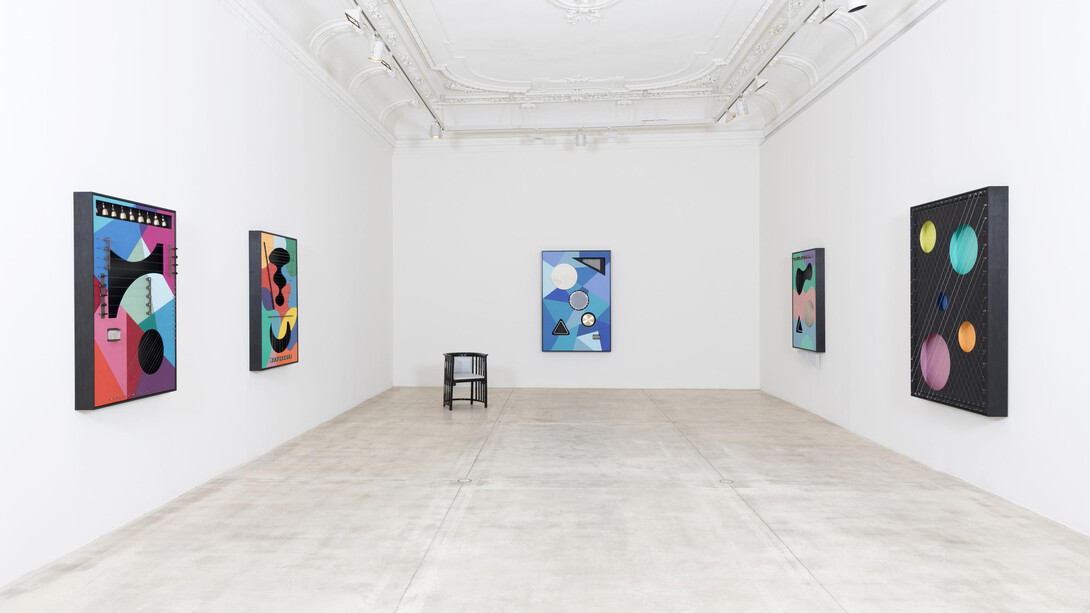
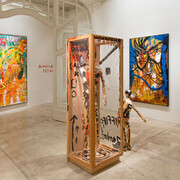
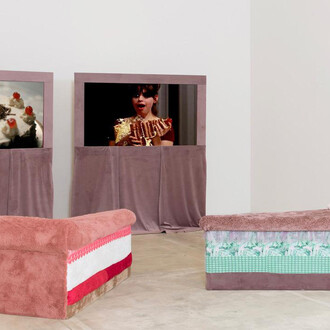
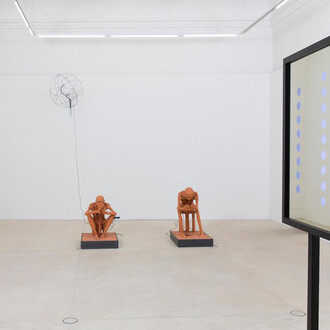
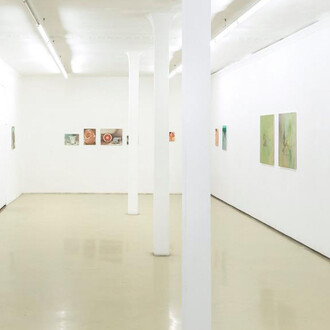
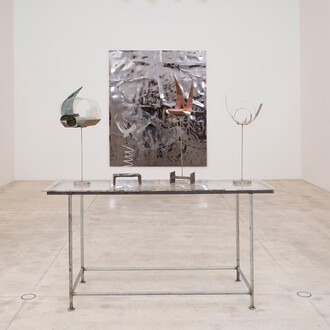
With vibrating images Nevin Aladağ presents her second solo exhibition at Galerie Krinzinger. Aladağ playfully combines sculpture, painting, textiles, video and sound to create multi-layered, multimedia works. Through the principle of assemblage, unexpected connections arise between art and music, as well as between different geographies and cultures. The exhibition is spread across the main space of Galerie Krinzinger and combines works from the series Vibrating images and Music room Darmstadt – these are sound sculptures that Nevin Aladağ first brought together into a complete installation for her solo exhibition Raise the Roof in the exhibition building on Mathildenhöhe Darmstadt (2025/26).
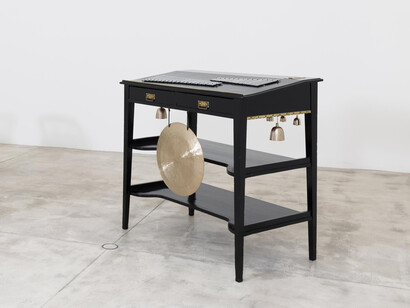
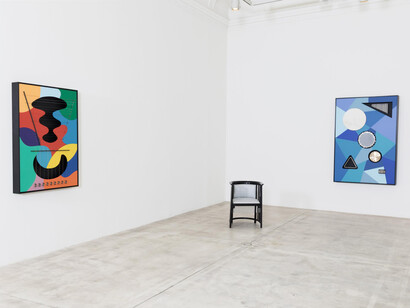
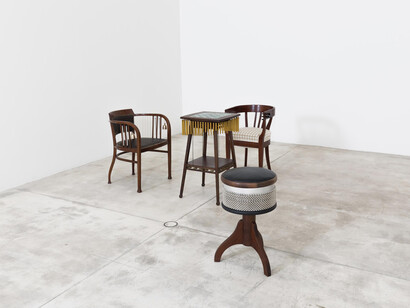
With Music room Darmstadt, Nevin Aladağ continues a series of works she began in 2014 that draws on the European tradition of the music salon. As a type of room associated with bourgeois representation, the music room was a central design task for the artists of the Art Nouveau movement. Through targeted modifications, Aladağ transforms furniture and everyday objects from around 1900 into musical instruments. A glockenspiel, for example, fits seamlessly into an iconic armchair by Viennese designer Josef Hoffmann, its bright sound breaking through the rhythmically austere structure of the wooden struts. In addition, a piano stool is connected to the bellows of a concertina, which can be made to sound when the height-adjustable mechanism is gently activated. With her keen sense for high-quality craftsmanship, Aladağ is in tune with a guiding principle of the arts and crafts reform around 1900. Following the concept of the objet trouvé, however, the artist questions the original function of the furniture, as well as the conventions of bourgeois interior design.The diversity of the objects, which have been combined with musical instruments of different temporal, geographical and cultural origins, also reflects the biographies of the people who once owned the furnishings. In the moment of musical improvisation, Aladağ's music room becomes a meeting place that transcends time and space, revealing the community-building potential of art and music.
With her new series of works Vibrating images (2024/25), Nevin Aladağ explores the materialisation and perception of sound and, for the first time, makes consistent use of the medium of painting. Only from a distance do the rectangular wall objects suggest the impression of static images. Through combinations of intense colour fields, sound holes and various musical instruments, the ‘vibrating images’ become resonating bodies. By experimenting with form, material and sound properties, Aladağ activates a perceptual experience that goes beyond purely contemplative observation: in a state of silence, the works invite viewers to explore sound visually and anticipate it imaginatively. Work titles such as Polyrhythmic sea (2025) or Pastel waves (2024) literally bring to mind the movements of sound waves flowing in all directions. When the wall objects are played by professionally trained musicians, the vibrations of the resonating bodies are transmitted from the wall to the exhibition space, making the sound tangible for the audience as well. The activations do not follow a fixed sequence, but are spontaneous improvisations: the various percussive instruments can set a rhythm to which the wind and string instruments harmoniously tune in, or which is unexpectedly interrupted by experimental sound production. The interplay of the Vibrating Images is therefore always dynamic and polyphonic.
Nevin Aladağ also addresses the relationship between movement and stillness in her new sculpture Cabasa tower (2025), which focuses on the interplay of form. An instrument that appears repeatedly in Vibrating Images enters the exhibition space here as an independent, lifesize figure. The cabasa is a percussion instrument from Central and South America that is held and played in the hand. A traditional cabasa consists of a cylindrical head with tightly fitting bead chains and a handle. Rubbing, turning or shaking it produces a metallic sound on the ribbed surface, which can be used to set rhythmic accents. In her sculpture, Aladağ takes the original function of the instrument to absurd extremes. By expanding its proportions, the sculpture acquires an almost physical presence. Only at first glance does Cabasa Tower appear static like a tower. Several cylinders of varying diameters appear to rotate around their own axes, causing the structure to almost sway. Straddling the line between artwork and resonance chamber, the sculpture encourages viewers to imagine its peculiar sound, even though Cabasa Tower is not intended to be played musically. The playful approach to geometric form is reminiscent of Oskar Schlemmer's Triadic Ballet (1919–1922), which Nevin Aladağ was able to study as a student at the Staatsgalerie Stuttgart.
Through these hybrid combinations of painting, sculpture and music, Nevin Aladağ breaks down genre boundaries and invites us to perceive art and music holistically, as well as our immediate surroundings. The combination of art, music and performance creates spaces for resonance that enable different references to questions of community and globalisation.