English
 Español
 Français
 Deutsch
 Italiano
 Português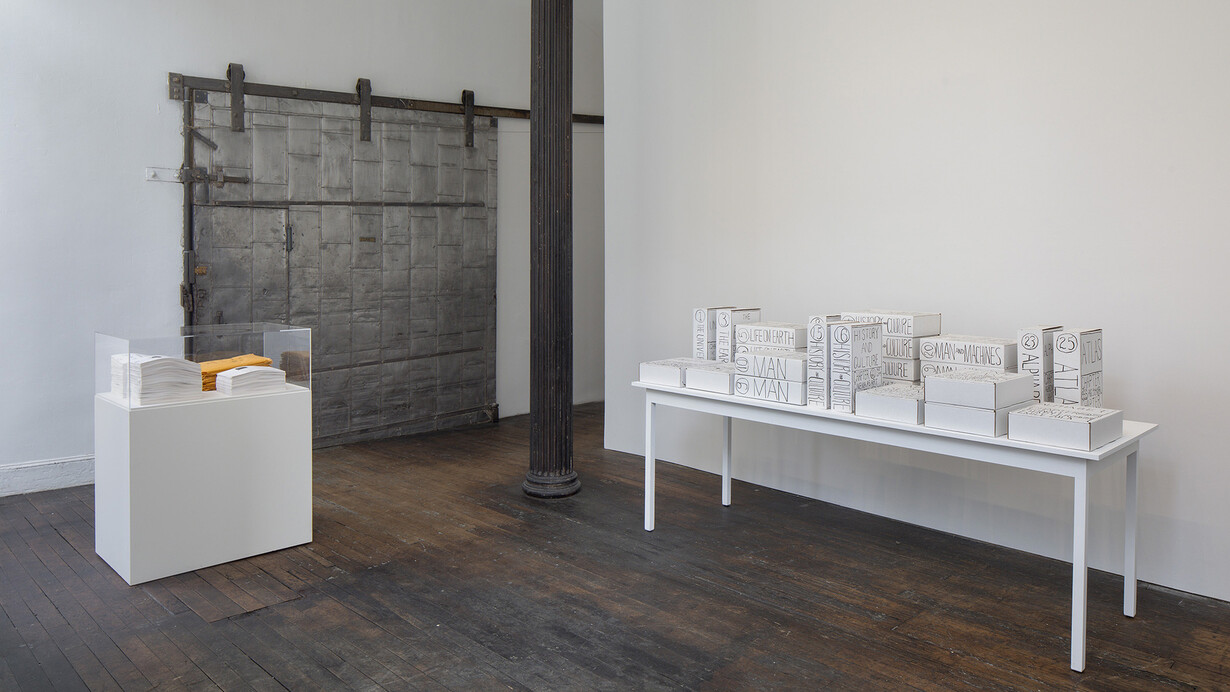
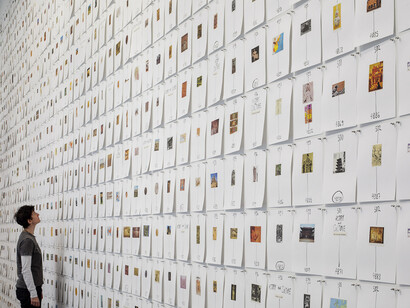
Peter Freeman, Inc. is pleased to present The universe, Matt Mullican’s sixth solo exhibition with the gallery, featuring a single new work comprised of 9,519 collaged and hand-numbered sheets, approximately 6,700 of which are installed in an immersive layout that fills the gallery.
The universe (2023–2025) is Mullican’s latest “book,” a category of artwork he conceived and began using in the early 1970s in various formats, including drawing, collage, prints, photos, lightboxes, and rubbings. Mullican has stated that “everything is a sequence,” and “it is hard to say when it is not a book.” For The universe, Mullican used two copies of the 1990 edition of the Random house encyclopedia (originally published in 1977) as his starting point, cutting out every image or chapter title per page, collaging each onto individual sheets, and numbering the sheets according to their published order.
Mullican retained the encyclopedia’s two-sectioned structure—Colorpedia, which consists of illustrated essays on overarching topics, from “Life on Earth” to “Man and science,” and Alphapedia, which consists of alphabetically arranged summaries on particular subjects. The sheer volume of images isolated from these sections highlight the breadth of information contained within a single reference book and how each image relates to one another without text. This dissection of widely disseminated knowledge continues Mullican’s lifelong exploration into the signs and symbols that make up both his own artistic universe and the real world.
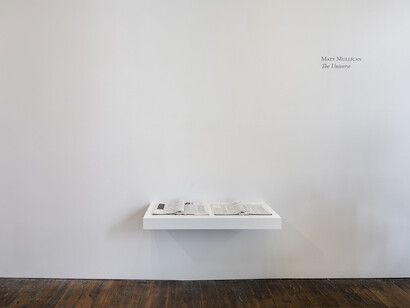
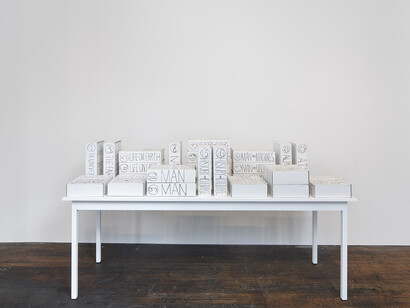
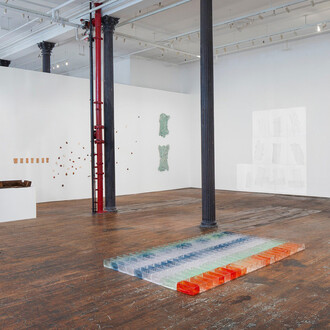
Installed in sequential order, the vast array of sheets wrap around gallery walls, freestanding bulletin boards, and a low platform that nearly fills the floor of the larger gallery space. The rest of the sheets and 101 envelopes that correspond to the encyclopedia’s table of contents are on view in a vitrine near the work’s organizational storage system of 25 boxes, exhibited in such a way that their volume takes on its own sculptural quality. The two copies of the encyclopedia from which the artist sourced his images are on display along with an intact handling copy. While the work consists of 9,519 sheets, Mullican’s page count only reaches 9,496. Discrepancies and miscalculations illustrate the difficulty in processing such an enormity of information.