English
 Español
 Français
 Deutsch
 Italiano
 Português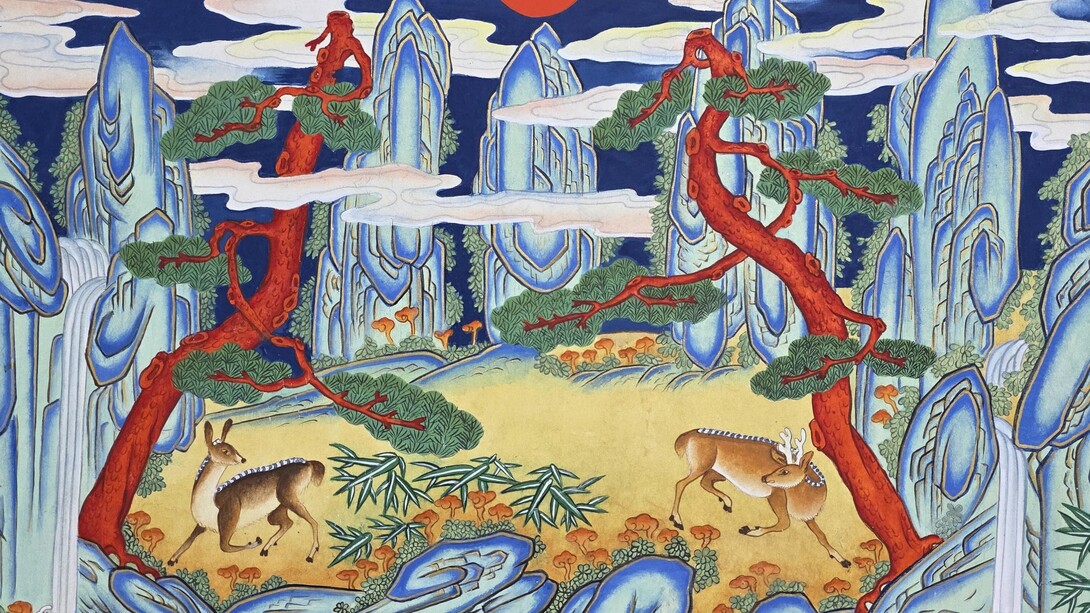
Kate Oh Gallery is pleased to present US longevity, a dialogue between tradition, identity, and the enduring idea of longevity.
This exhibition presents works by Korean artists who reinterpret traditional ideas of longevity through contemporary perspectives. Rooted in cultural symbolism and visual heritage, the artworks reflect on endurance, balance, and the continuity of life.
Ten Symbols of Longevity refers to a group of ten auspicious elements in Korean tradition Sun, Mountain, Water, Rock, Pine tree, Clouds, Turtle, Crane, Deer, and the Mushroom of Immortality that symbolize long life, vitality, and harmony with nature. Frequently depicted in Korean paintings and decorative arts, these symbols express wishes for health, prosperity, and enduring life.
Kate Oh’s newest group show, US longevity, is, in many ways, exemplary of the roots and beating heart gallery, which, at its core, is a venue that promotes traditional and Modernist renderings of Korean art practices, including Dancheong and Minhwa. The gallery accomplishes this without heavy-handedness, never hewing towards any one univocal tendency. In turn, it avoids lapsing into sheer “genre painting” shows without abdicating the traditional themes bolstering time-honored Korean folk painting. Punctuating the gallery’s ecumenical seasonal programming, these archetypal exhibitions enjoy aesthetic and pedagogic value, clarifying how, in our contemporary epoch, seasoned living Korean masters continue to retain and enrich these traditions, working in a venerable genealogy.
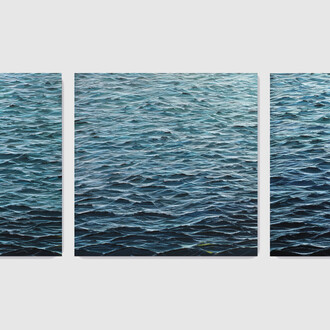
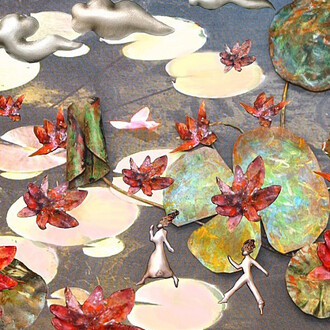
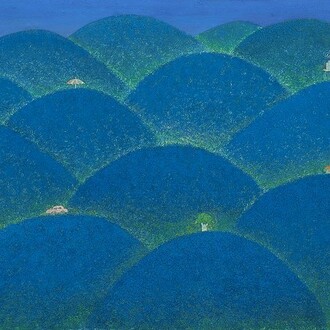
The exhibition, which I highly recommend to prospective viewers, includes a 2025 mineral pigment on Hanji paper landscape, US longevity (from which the show draws its title), by gallerist and artist Kate Oh. Lining the gallery walls are a host of captivating symbolist-scenographic works by Yang Ji Ae, Kim Se-Yong, Kim Ji Eun, Song Yune Kyoung, Lee Jee Sun, Moon Sook Jin, Kim Kyung Ae, and Yoon Eunei; Kim Se-Yong’s soft-olive Goryeo celadon vessel, harkening back to the Koryo kingdom, also bespeaks a related Korean tradition.
Although one can undoubtedly enjoy these works as self-standing, optically sensous objects, some background knowledge can deeper our appreciation. As Bonsoo Park explains in his January 2018 article, "A Study of the Ten Symbols of Longevity Screen in the Collection of the Museum of Art at the University of Oregon," published in the Journal of korean art and archaeology:
Paintings of the ten symbols of longevity (十長生圖, sipjangsaengdo), which represent a desire for health and longevity grounded in the doctrines of Daoism (道敎, dogyo) and a belief in immortality (神仙思想, sinseonsasang), are among the most common types of Korean auspicious paintings (吉祥圖, gilsangdo). The ten symbols of longevity comprise a total of thirteen subjects associated with long life: the sun, moon, clouds, mountains, rocks, water, cranes, deer, turtles, pine trees, bamboo, mushrooms of immortality, and peaches of immortality. The earliest depictions of this group appear in paintings celebrating the New Year (歲畵, sehwa) first produced towards the end of the Goryeo dynasty (918–1392). Throughout the Joseon (1392–1897) period, paintings of this type were especially popular at the royal court. From the late Joseon period onward, representations of these symbols appeared in folk paintings that circulated widely among the broader population.
Despite there have previously been Western museum displays that have focused on these Korean longevity symbols, such as the Korean Exhibition Hall at the University of Oregon’s Museum of Art, it is rare to find such studied presentations in the gallery setting. Kate Oh’s eruditely arranged show is, indeed, comparable to such museum shows. The throughline, as the title implies, is the leitmotif of longevity. This is rendered in various ways and frequently licensed by Minhwa’s traditional symbols that evince the preservation of consciousness vis-a-vis natural elements. The artists’ two-dimensional configurations and wilderness patterns of Minhwa explicitly deploy the genre’s longevity symbols, such as deer and rocks. These are paired with symbols for immortality, such as peaches, and signifiers for prosperity for one’s offspring, such as pomegranates and watermelons (whose seeds represent generational begetting). Each painting on display is not only limned with scintillating palettes but wise execution and prudent symbolist choices.
In Yang Ji Ae’s Eternal flow of longevity, we find the aforementioned deer, perched on mounds and grazing on orange tuffets. Flanked by cerulean trees, the orange sun, recurrent in these Longevity paintings, blazes. Moon Sookjin’s Bongseo Suwang: Phoenix focuses on the titular celestial mythic being, which, doubled across the picture plane, heralds prosperity and peace. The sharp contrast between an ink background and lustrous color is brilliantly purposed.
Lee Miyoung’s mother of peral Another ten symbols of longevity culls the Hwajohwa “flower and bird” painting genre. The swooping cranes (one of the ten traditional symbols of longevity) are poised beside cragged rocks and ornamental designs. It should be noted that Kim Se-Yong’s exemplary Celadon ware is also lined with flocking, fluttering cranes. Kim Kyung Ae’s contribution also features the crane figure, its wings billowing over ice-blue peaks while vermillion spindly branches outspread; below, deer hustle too and fro. In Oh’s aforementioned work, cranes dot the canopies, joined by a host of turtles and pine trees, each element quadrated in an animated scene that betrays an impressive degree of detail.
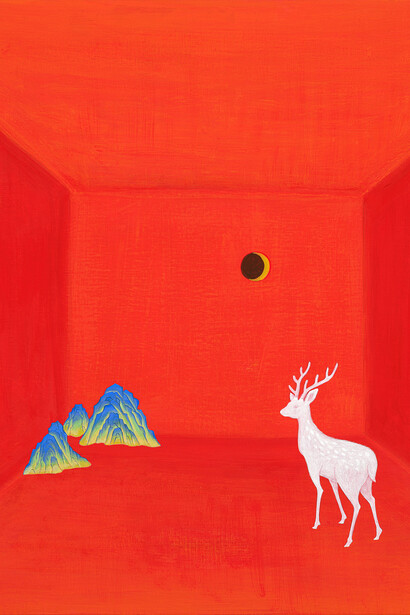
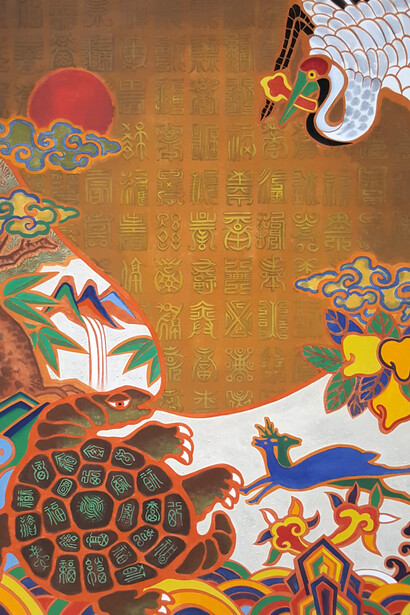
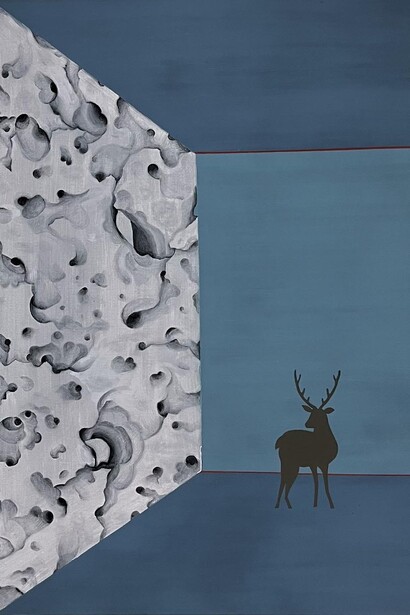
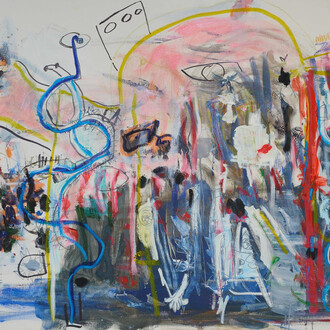
Yoon Eunei's work also commands meticulous sensitivity to detail, the winding turtles shells inscribed with glowing jade letters. Here, too, the artist’s colorism is pronounced, heightened by the thick line-work. Kim Ji Eun's Waves of genesis is more impressionistic than the other works, pastel hues to softly benighting the crane in a blush wash, clouded fascicles spiraling into the nexus sun—the pictorial field’s center. Lee Jeesun's poetic Time evaporated is perhaps the most (post-) Modernist of the works; a white deer (baekrok) is posited in a hollow metallic crimson chamber. Aquamarine-yellow bluffs peak from the corner; the image is doubled, with an inverted palette and, to the left, a porous slate wall.
Song Yune Kyoung's vertically sprawling A time for glory places a sumptuous, tawny-lemon disk at the top of the canvas. Scaley sapphire ferns enrobe the acquisitive imaginative scene, with outpouring tentacles and roping falls. The artist produces an impressive scalar-shift from brilliant blue to moon-lit dusk.
As a preeminent exhibition-cum-examination of Korean longevity/sipjangsaengdo motifs, this show is highly deserving of “intelligent viewing”—that is, the kind of art viewership where one slowly moves from work to work, examining each element and cognitively gathering them into a sphere of understanding.
(Text by Ekin Erkan)