English
 Español
 Français
 Deutsch
 Italiano
 Português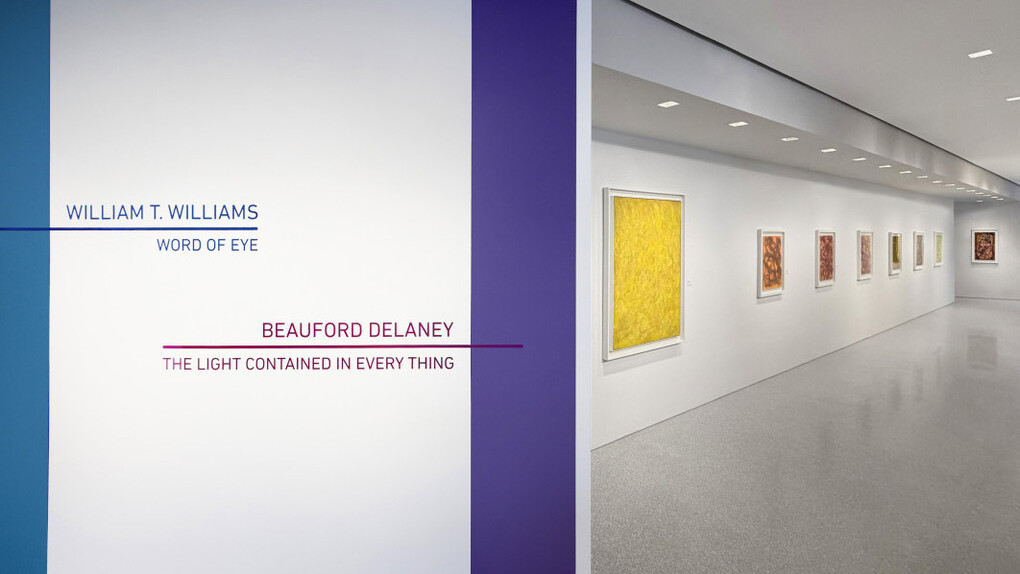
I learned about light from Beauford Delaney, the light contained in every thing, in every surface, in every face. Many years ago, in poverty and uncertainty, Beauford and I would walk together through the streets of New York City. He was then, and is now, working all the time, or perhaps it would be more accurate to say that he is seeing all the time; and the reality of his seeing caused me to begin to see.
(James Baldwin) 1
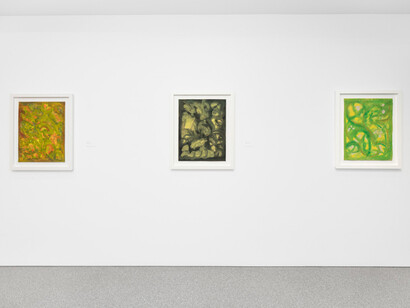
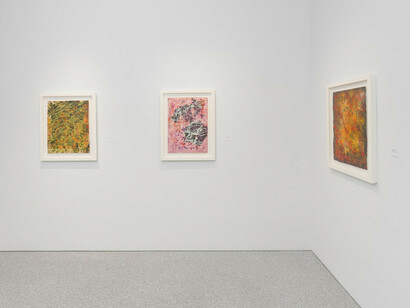
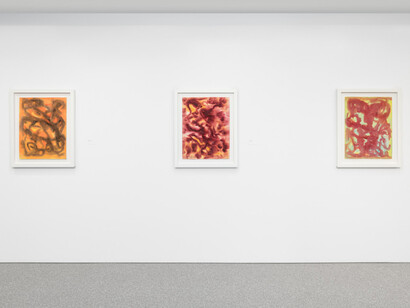
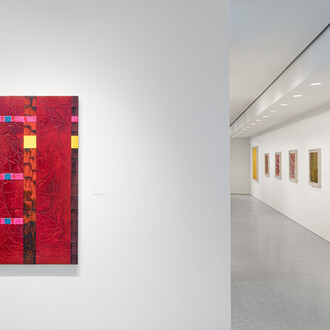
The gallery’s fourth solo presentation featuring the work of celebrated American artist Beauford Delaney (1901–1979), Beauford Delaney: The light contained in every thing includes abstract paintings and works on paper created between 1954 and 1968 that reflect the artist’s spiritually informed exploration of light, color, and gesture. The exhibition follows The Drawing Center’s 2025 In the medium of life: the drawings of Beauford Delaney, which was the first major New York museum exhibition of the artist’s work in over three decades as well as the first to focus solely on his drawings. Taking its title from the introduction to Delaney’s 1964 solo exhibition at Galerie Lambert in Paris written by his close friend and famed author James Baldwin (1924–1987), this exhibition illuminates Delaney’s unmatched ability to imbue his abstractions with a scintillating radiance that resonates on a visual, psychological, and spiritual level.
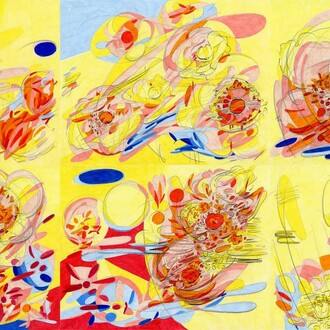
After moving from New York to Paris in September 1953, Delaney began working in an increasingly abstract style while also continuing to create portraits and figurative works. His abstractions, which consist of elaborate, fluid swirls of pigment applied in luminous hues that evoke pure, concentrated expressions of light, developed organically out of his vibrant, semi-representational works that defined the first twenty years of his oeuvre. Reflecting on this pivotal moment in his life and career, Delaney wrote: “I left New York for Paris in 1953, and I have painted with greater freedom ever since. I tried to paint light, different kinds of light, and my painting has been associated with ‘abstraction.’ But there are no precise limits for me between ‘abstract’ and ‘figurative’ paintings.”2
A throughline in the exhibition is Delaney’s expressive use of yellow, a color the artist favored for its sacred connotations. Whether peeking through washes of fiery orange, swirling in almost calligraphic forms across the paper, or dappled amongst verdant greens and vibrant reds, yellow takes on an ethereal quality that recalls the artist’s roots as the son of a preacher. In a 1955 sketchbook, Delaney wrote vividly of mornings spent in his father’s church: "Sun high summer. The brightness of Sunday morning sings with the earnest unison of deeply felt songs by the devout congregation of the Methodist Church of John Samuel Delaney of Cleveland, Tennessee. The variety of color resplendent in the audience-from the color of purple and black eggplant to deep amber and...even mother of pearl... all colors of the rainbow make the stained-glass effect in the choral reality of the splendor."3 This synesthetic recollection evidences Delaney’s unwavering commitment to recording the intertwining themes of light, color, and the divine.
Delaney’s abstractions were also greatly inspired by what he was seeing in Paris, including the luminosity of the iconic water lilies cycle by Claude Monet (1840–1926)—an artist who Delaney had long admired for his studies of the changing effects of light—at the Musée de l’Orangerie as well as rays of light streaming through stained glass windows in the Notre Dame Cathedral of Paris and the Chartres Cathedral. Fittingly, the light Delaney captured in his work transcends natural light, instead embodying the kind of all-encompassing luminance the artist felt in his early memory of Sunday church services or when he was surrounded by the glimmering surfaces of Monet’s water lilies or bathed in the color-filtered light of the hallowed French cathedrals.
Also on view are examples of Delaney’s Rorschach tests. Created between 1961 and 1962 while the artist was suffering from paranoia and hallucinations, these watercolor and gouache works on paper are characterized by thick brushstrokes and a darker palette. These works, which are the product of a dark period in Delaney’s life, are evidence of the artist’s complex inner world that was at times colored by psychological struggle. However, as art historian Joyce Henry Robinson writes: "the light in these compositions is not absent, but merely enshrouded or overwhelmed, struggling to hold the forces of darkness at bay."4 In one work from 1962, billowing swaths of black are underpinned by a bright yellow that, in some places, breaks through to the top layer.
Taken together, the works in the exhibition are testament to the power of Delaney’s light-infused abstractions. As Baldwin profoundly concludes in his introductory text: “Well, that life, that light, that miracle, are what I began to see in Beauford's paintings, and this light began to stretch back for me over all the time we had known each other, and over much more time than that, and this light held the power to illuminate, even to redeem and reconcile and heal.”5
Since 1995, Michael Rosenfeld Gallery has championed the art of Beauford Delaney. The gallery has previously mounted three solo exhibitions focused on the artist: Beauford Delaney: Paris abstractions from the 1960s (1995); Beauford Delaney: Liquid light–Paris abstractions, 1954-1970 (1999), which was accompanied by a catalogue featuring an essay by Delaney biographer David Leeming; and Be your wonderful self: the portraits of Beauford Delaney (2021), which was also accompanied by a catalogue with new scholarship by art historian Mary Campbell and a comprehensive, illustrated chronology. In 2022, Be your wonderful self traveled to the Ogden Museum of Southern Art in New Orleans.
Notes
1 James Baldwin, introduction to “Beauford Delaney” (Galerie Lambert, 1964), n.p.
2 Beauford Delaney, “Beauford Delaney - Career as a Creative Artist,” c.1963, Beauford Delaney collection, Sc MG 59, Schomburg Center for Research in Black Culture, Manuscripts, Archives and Rare Books Division, The New York Public Library, New York, NY.
3 Delaney as quoted in Mary Campbell, “Beauford Delaney in Ecstasy” in “The Portraits of Beauford Delaney” (Michael Rosenfeld Gallery, 2022), 21-22.
4 Joyce Henry Robinson, “An Artistic Friendship: Beauford Delaney and Lawrence Calcagno” (Palmer Museum of Art, 2001), 13.
5 Baldwin, introduction to “Beauford Delaney,” n.p.