English
 Español
 Français
 Deutsch
 Italiano
 Português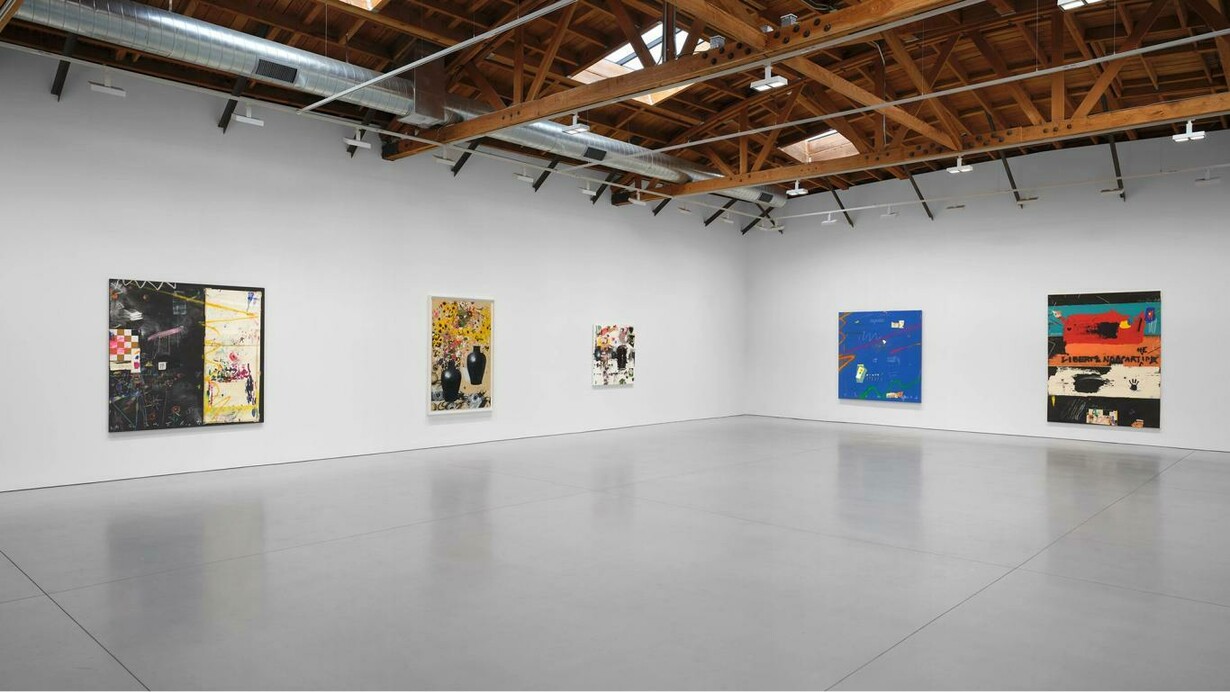
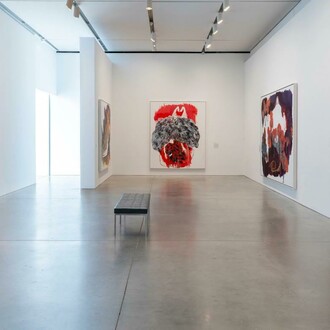
David Zwirner is pleased to present an exhibition of works by Raymond Saunders (1934–2025) at the gallery’s 616 N Western Avenue location in Los Angeles. Curated by Ebony L. Haynes, this will be Saunders’s third solo exhibition with David Zwirner and will mark the first exhibition in Los Angeles devoted to the artist’s work in more than a decade. This presentation coincides with the inclusion of Saunders’s work in the group exhibition Photography and the black arts movement, 1955–1985, on view at the Getty Center, Los Angeles, from February 24 to June 14, 2026.
Celebrating Saunders’s time in California—the artist lived and worked in Oakland for most of his adult life—Notes from LA features a selection of paintings and works on paper that embody many of the distinct material and conceptual concerns of the artist’s decades-long practice. Saunders had close ties to the West Coast, where most of his studio years were spent. He also became well-known as an arts educator there: having earned his MFA from the California College of Arts and Crafts, Oakland, in 1961, he began teaching at California State University, Hayward, in 1968 and went on to join the faculty of his alma mater (later known as California College of the Arts), where he was given the distinction of professor emeritus. For Saunders, teaching and artmaking were equal pursuits, and each in turn informed the other, resulting in the frequently didactic, shorthand mode of expression that is a hallmark of his works.
Beginning with his early art training in Pittsburgh’s public schools, Saunders developed a nonhierarchical relationship to pedagogy that came to echo the expansive nature of his artmaking. Select paintings on view in the exhibition speak to Saunders’s decades as a student and as an arts educator, in particular black-ground compositions like We try (1985) and Untitled (1995–2000), which are worked over with white chalk—both a pointed reversal of the traditional figure-ground relationship and a nod to the artist’s profession.
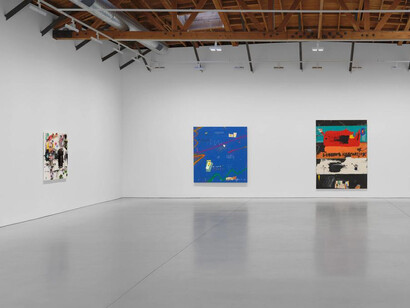
In It wasn’t easy being a first grader—first executed in 1979 and reworked by Saunders in 1984 in keeping with the loose, ever-evolving, and improvisatory nature of his painting style—crayons and fragments of children’s drawings and book illustrations are among the elements affixed to the striking royal blue canvas, a rare use of colored ground for the artist. The work’s title overtly references grade school and the growing pains of youth, with color swatches, a number table, and “Raymond” written in neat cursive appearing as nostalgic emblems of early education. Saunders understood teaching to be, like making art, an ongoing process of learning, and embraced the classroom as a vital site for exchange—of knowledge, of experiences, of ways of seeing the world. He embodied a creative and holistic approach to education that was in part a response to his skepticism around traditional, didactic systems of training. As the artist stated, “I’ve had too much schooling to think of myself as either naive or childish.… I mean, children paint beautifully, but as long as the designation ‘children’s art’ exists, there will be an undermining of their content. In some instances I seek the content of children’s brilliance, which is no more or no less than the brilliance of any other time in life.”1
Enhanced with a typical range of other markings, materials, and talismans, other works on view incorporate motifs that recur throughout Saunders’s mature oeuvre, such as scrawling text, urnlike vases, and flowers. Two paintings from the 1980s stand out for their graphic quality and political import. Malcolm (1983)—originally in the collection of writer Toni Morrison, a friend of Saunders’s—features energized loops and jags of white spray paint on a large black ground, with the year “1983” printed boldly on a torn Bloomingdale’s shopping bag that fills the upper register of the canvas. In the towering Untitled (Apartheid) (1989), Saunders utilizes the heft of acrylic paint, layering a large, vigorous swath of bright red over bands of teal and orange; characteristic motifs of a cross and handprint emerge in black against a lower band of white. Invoking a teacherly mode of communication, he uses language directly here: black spray paint spells the French word for “freedom,” and “No apartheid.” In 1993, Morrison wrote of Saunders’s work, “In painting after painting emotion fused by a rapier intelligence forces us to see clearly what we only guess at: the shape of language, the speed of color, the massy weight of space. We look at his pictures and (suddenly or slowly) begin to imagine our own humanity—a kind of trembling tenderness touched with menace, exhilaration, relief, and the outrageous bounty at our disposal.”2
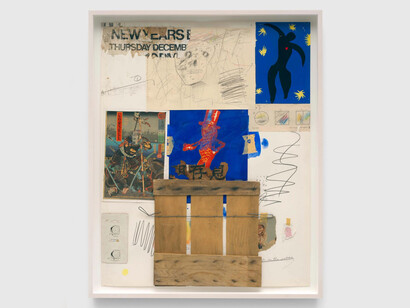
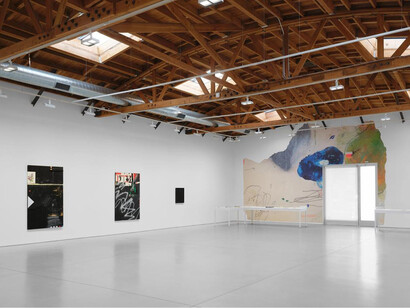
As well as an artist and teacher, Saunders was a committed correspondent. Along with his large-scale, assemblage-style paintings, Saunders also made works on paper and intimate collages whose mixed materials point to the artist’s practices of note-taking—an extension of his mark-making that encompassed scribbling notes to himself, giving notes to his students, receiving notes from colleagues and friends—and the related routine of collecting. Saunders was an archivist who gathered and kept objects and mementos both personal and cultural, precious and abandoned, and these materials appear throughout his work. This throughline is underscored by an illustrative selection of archival materials from his Oakland studio, which are displayed in vitrines installed in the gallery space and further demonstrate the artist’s lifelong impulse to annotate, keep in touch, and accumulate. These materials include selections from Saunders’s extensive collection of postcards, photographs, and stamps, as well as ephemera from exhibitions, conferences, and classes, among other documents from the artist’s life, one that produced a rich archive both professional and personal.
On the occasion of the exhibition, the gallery has published a book of postcards printed with statements by a wide range of contemporary artists, its design informed by Saunders’s personal archive of postcards. Proceeds from the sales of the publication will benefit Inner-City Arts, Los Angeles, which was founded in 1989 to provide quality arts instruction for students from underserved communities, integrated arts workshops for educators, and programming designed for the community.
In his assemblage-style paintings, American artist Raymond Saunders (1934–2025) brought together his extensive formal training with his own observations and lived experience. Expressionistic swaths of paint, minimalist motifs, line drawings, and passages of vibrant color tangle with found objects, signs, and doors collected from his urban environment, creating unexpected visual rhymes and resonances that reward careful and sustained looking and allow for a vast and nuanced multiplicity of meanings.
Notes
1 Raymond Saunders in Harvey Stein, Cornell Capa, and Elaine A. King, Artists observed (New York:
Abrams, 1986), p. 86.
2 Toni Morrison, “Introduction,” in Raymond Saunders. Exh. cat. (San Francisco: Stephen Wirtz
Gallery, 1993), p. 5.