English
 Español
 Français
 Deutsch
 Italiano
 Português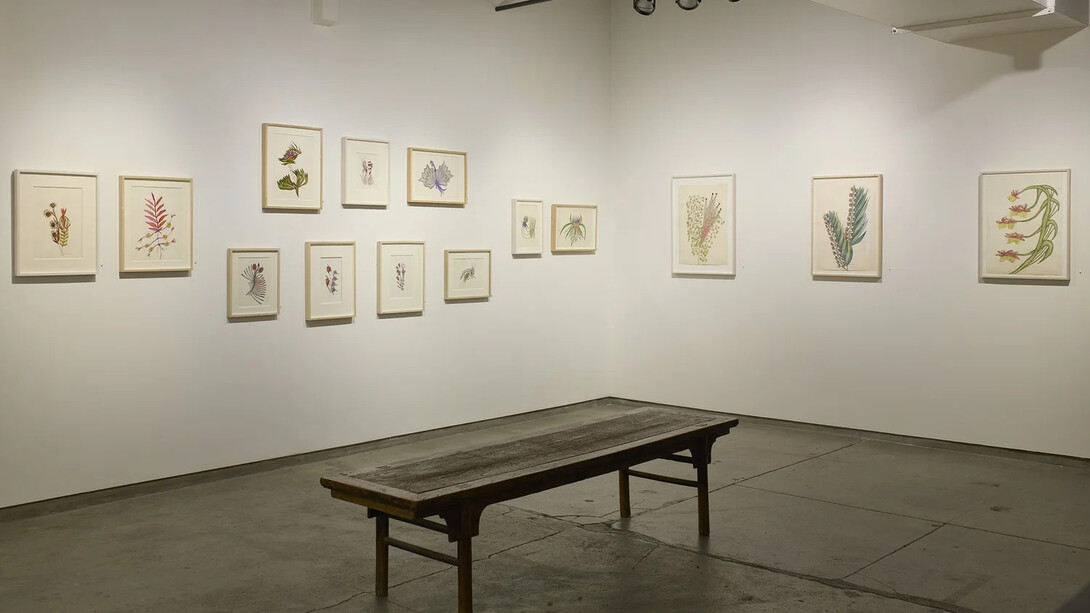
Anna Zemánková was born in Olomouc, Moravia (then Czechoslovakia) in1908. Although interested in drawing from a young age, she was discouraged by her father who wanted her to follow a more lucrative career. At his suggestion, she studied dentistry from 1923-26 and then worked in a dual capacity as a technician and a dentist, performing simple procedures until 1933. At age 25, she married First Lieutenant Bohumir Zemanek and stopped practicing: at that time, it was not socially acceptable for her to continue to work after her marriage. The young couple moved to the town of Brno, a major manufacturing center, and had four children. Unfortunately, one son died at age four marking the artist profoundly. Her two sons and one daughter survived.
The war years, with the Nazi occupation, were difficult; by 1948, with the Communists in firm control, the Zemaneks moved to Prague. Anna spent her time caring for her family, generally trying to survive the external political turmoil. Her passions were listening to classical music and reading. With her children grown and her marriage in shambles, her personality changed: she began to have 'fits' and periods of severe depression. In 1960, her son Bohumil, an artist, remembering her reports of an earlier interest in painting, brought her pastels and paints. She largely ignored the latter, but began drawing with the pastels, and immediately became consumed with artmaking. Into it she directed all her creative energies, attempting to channel universal forces into her practice. The previous societal boundaries that had been drawn for her—marriage, motherhood, then the shackling her spirit with age, a feeling of abandonment, and diabetes, and she reacted first with frustration, then anger, and finally with this ancient ululation of art-making that lasted her until she died.
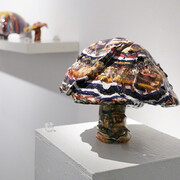
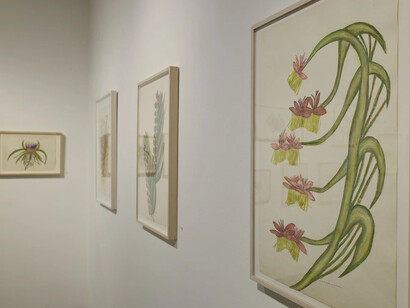
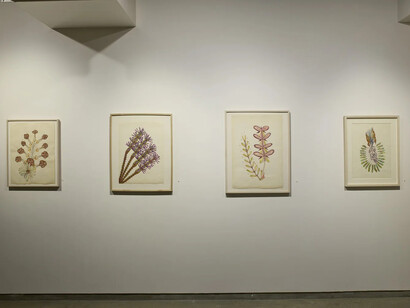
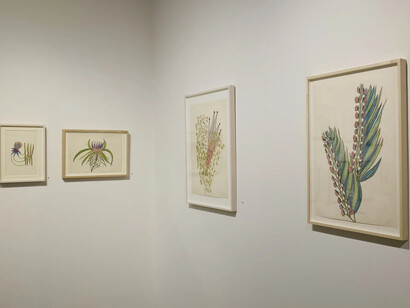
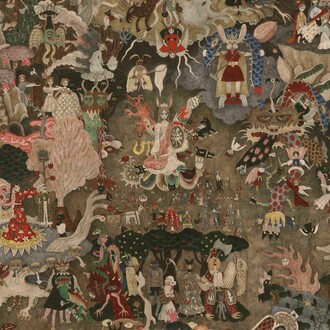
Creating became a regular part of her day. She rose early enjoying the solitude. Not liking the silence, music was her constant creative companion. Her early tempera paintings were followed by oil pastel and ink works on paper in all sizes. The pastels went through their own transitions. She pierced them, she embossed them, and then later, she stitched on them sometimes adding sequins to the surfaces. Perhaps provoked by the three-dimensionality of the raised surfaces achieved through embossing she began drawing on sheets of paper, cutting out the forms, folding and otherwise shaping them, sometimes overlaying one piece of cut paper over other drawn-on papers that she had also folded and shaped, sometimes weaving paper through paper, and further detailing the collage in ink with her finely skilled hands. When there was no paper she began to experiment with satin, a fabric she had always loved for its glow and its “human touch”. She experimented with methods to keep the edges of the cut satin from fraying, then painted the satin with fabric paint, and detailing these somewhat botanical, somewhat animal shapes with ink. The paper and satin collages do not sit politely on the paper. The forms are animated as if on their way to become another creation. When two distinct shapes are placed side by side there is visual tension. Will their proximity give rise to another form? Will one supplant the other? What she had learned from prior successes joyously informed her new creative interests for the remainder of her life. Her creations, whether in oil pastel, cut paper collages, or painted satin collages, are sublime. It was her way of reordering the world.
As Randall Morris has written:
There are some rare and fortunate times in one’s life when one is allowed, by intent sometimes, yet most often by fluke or by luck, to witness on some sensual level a beauty that is completely unadulterated and heart-piercingly direct. Mankind has never invented an adequate eschatology of words to match those moments. I am not sure that Anna Zemánková deliberately set out to make this kind of beauty that she created in such profusion. I am sure that it represents the outcome of a struggle for inner balance, a way of bursting out of the cage of her physical and emotional body, a way of thinking about things, of attempting to will an equilibrium. Her works have been called mediumistic, spiritual, surreal, visionary, and sensual. Her art has been compared to that of Hilma af Klint and Georgia O’Keefe. Perhaps these comparisons offer a way into an appreciation of her creations, which remain, despite the attempts of categorization, singular and exalted.