English
 Español
 Français
 Deutsch
 Italiano
 Português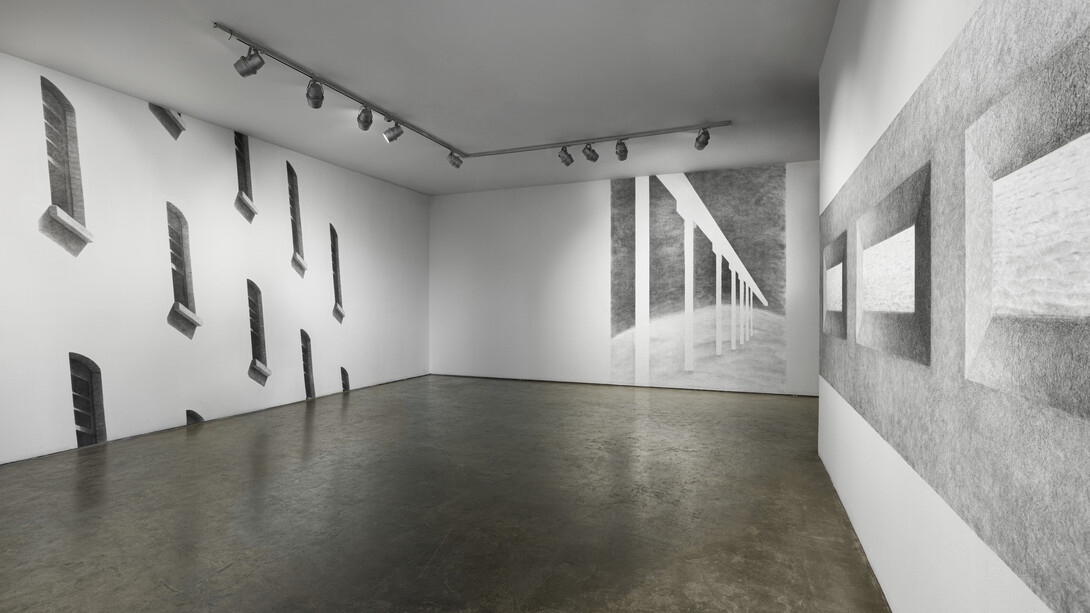
Kate Teale’s site-specific installation in Smack Mellon’s back gallery departs from the specificity of historic architecture in and around its local Dumbo neighborhood, including Smack Mellon’s own interior. Dumbo, once an industrial hub, still retains many of its built features from over a century ago in various states between disrepair and new refurbishment. The ornate concrete and brick structures impose as well as protect, highlighting persistent tensions and durations between human bodies and the spaces constructed to hold them. Using intense tonal greyscales of graphite and charcoal on Tyvek, Teale visually excises these architectural details and transports them onto the walls of the gallery.
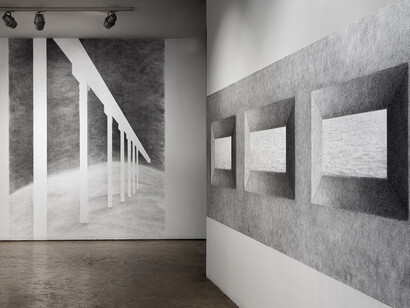
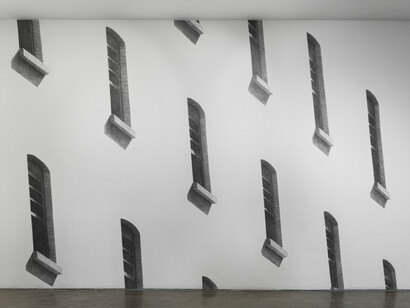
To the left of the gallery’s entrance, floating windows sink and grow from shadows to create a perfectly distorted perspective. To the right, geometric thresholds open onto water, visually collapsing the distance between the gallery space and the East River directly behind, and repurposing the walls as the gateway. Lastly, in an installation covering the back wall, Teale both reflects and continues the columns holding up the building’s now defunct coal trough–located in the adjacent gallery–which at one time served the crucial function of providing heat and energy to the neighborhood.
In Teale’s visual universe, minor architectural moments provide shelter and respite from the outdoors. Buildings are porous and vulnerable to time, weather, and human destruction. Teale’s focus on windows and columns reveal these elements for their functions: as portals and infrastructure. As portals, the windows act as transitions between states–light and dark, inside and outside, water and concrete, and thus, as a bridge, provide visual comfort in knowing that there is another side. The columns physically, and enduringly, uphold the building’s structure, stabilizing the space despite the concrete’s slow entropy over the past century and a half. In this universe, darkness can be generative, concrete can be soft, and time can expand while looping back onto itself.
Through permutations of physical boundaries, light, and fragility, Teale considers the intrinsic connections between humanity and the built environment. Her drawings are both reflections and ghosts of the neighborhood, pushing familiar vistas to the edge of abstraction. Her works command a sustained attention, due in part to her accumulation methods–layering and removing material from the Tyvek’s surface. In orienting viewers in relation to light, she asks at which point do the frameworks that sustain our environments begin to vanish.